

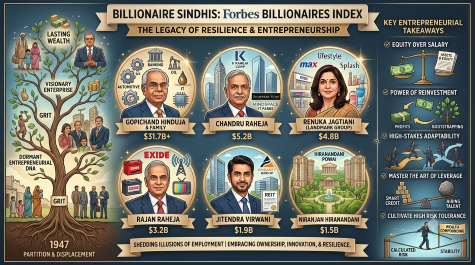
The legacy of these Sindhi billionaires is living proof that external circumstances do not dictate your financial destiny.
- By shedding the illusions of corporate or public sector employment and embracing a culture of ownership, innovation, and resilience, the modern generation can unlock its dormant entrepreneurial DNA and build lasting wealth.
By: Raphic Burdo
The Forbes Billionaires List carries names of a few Sindhis. These individuals and families represent a master class in wealth creation, urban development, and corporate resilience. They have built their massive fortunes not from government jobs, not through unfair means but through self-made enterprises. These people started from a state of total displacement which was result of events of 1947. Today, their names are etched into the upper echelons of global net worth tracking.
The rise of these Sindhi billionaires is one of the most remarkable sagas of economic resilience, grit, and visionary entrepreneurship in modern history. Arriving as penniless refugees during the 1947 Partition, these Sindhis lost their ancestral lands, homes, and businesses overnight. Yet, within a few generations, they transformed from displaced migrants into the architects of some of their country’s largest corporate empires. This phenomenal ascent speaks volumes about an inherent entrepreneurial DNA. It is evidence of a mindset that views displacement not as a dead end, but as a blank canvas for building generational wealth. For contemporary Sindhis trapped in the safety net of lifelong employment. The history of these tycoons serves as both a roadmap and a powerful wake-up call to reclaim their heritage of risk-taking for wealth and value creation.
In following paragraphs, we will look at individual breakdown of these iconic Sindhi tycoons. We will briefly touch upon their current net worth, primary industries, and their unique entrepreneurial journeys.
- Gopichand Hinduja & Family
- Net worth: $31.7B+
- Field of business: Diversified Conglomerate (Automotive, Banking, Oil & Gas, IT)
- The billionaire journey: The Hinduja Group traces its origin back to Shikarpur, Sindh (now Pakistan). Gopichand’s father, Parmanand Hinduja, initially migrated to Mumbai and then built a merchant trading hub in Tehran, Iran, dealing in food commodities like onions and textiles. Following the Iranian Revolution, the family pivoted to Europe and aggressively expanded. Gopichand, along with his brothers, institutionalized the empire by acquiring massive legacy brands like Ashok Leyland and Gulf Oil, alongside establishing IndusInd Bank. Today, they sit comfortably as global mega-billionaires.
- Chandru Raheja
- Net worth: $5.2B
- Field of business: Real Estate and Retail
- The billionaire journey: Chandru Raheja is a foundational pillar of Mumbai’s luxury commercial real estate. His family arrived as migrants in the wake of Partition and began operating small-scale construction projects. Following a major, highly publicized family business split in 1996, Chandru forged ahead independently to establish K Raheja Corp. He single-handedly revolutionized the Indian commercial sector by building state-of-the-art Mindspace IT Parks, high-end malls, and launching Shoppers Stop, India’s premier department store chain.
- Renuka Jagtiani (Landmark Group)
- Net worth: $4.8B
- Field of business: Retail and Hospitality
- The billionaire journey: Carrying forward the monumental legacy of her late Sindhi husband, Mickey Jagtiani, Renuka leads the Dubai-headquartered Landmark Group, which commands a massive presence across India and the Middle East. Mickey Jagtiani’s journey is legendary; after tragic family losses, he moved to the Gulf and started his retail venture as a single shop in Bahrain selling baby products. Through aggressive consumer tracking and flawless supply chains, the family scaled the brand into a global retail titan with major household names like Lifestyle, Max, and Splash.
- Rajan Raheja
- Net worth: $3.2B
- Field of business: Industrial Manufacturing and Media
- The billionaire journey: Cousin to Chandru Raheja, Rajan started within the joint family real estate business but displayed an innovative, disruptive streak that led him to build an completely separate industrial conglomerate. Rather than sticking solely to property, Rajan diversified into core sectors. He took control of Exide Industries (making it India’s dominant automotive battery manufacturer), built up Supreme Petrochem, and entered digital telecom infrastructure via Hathway Cable Datacom.
- Jitendra Virwani
- Net worth: $1.9B
- Field of business: Commercial Real Estate
- The billionaire journey: Operating out of Bangalore, Virwani’s [Embassy Group] has developed over 62 million square feet of prime commercial space. His family timeline tracks the classic Sindhi migration trajectory into trading and property. Realizing that the modern internet boom required premium corporate infrastructure, Jitendra turned his sights to tech parks, securing massive multinational clients like Google and IBM. In a historic move, he partnered with private equity titan Blackstone to launch India’s very first public Real Estate Investment Trust (REIT), forever shifting how capital is raised in Indian real estate.
- Niranjan Hiranandani
- Net worth: $1.5B
- Field of business: Real Estate and Infrastructure
- The billionaire journey: The son of a prominent Sindhi doctor who migrated to Mumbai, Niranjan rejected a comfortable medical track to dive headfirst into the high-risk world of construction. He co-founded the [Hiranandani Group] with his brother. His defining moment of innovation occurred in the late 1980s when he acquired a vast expanse of barren, rocky wasteland in Powai, Mumbai. While others dismissed the land as useless, Niranjan envisioned a self-sustaining city. He integrated schools, hospitals, and lush Greek-inspired architecture, pioneering ultra-luxury integrated townships in India.
Key Entrepreneurial Takeaways for Aspiring Sindhis
Analyzing the Forbes data and the journeys of these specific billionaires reveals distinct operational principles that stand in stark contrast to a safe employee mindset:
The Equity Over Salary Rule: None of these individuals built wealth by trading hours for a paycheck. They focused entirely on owning assets. They dealt in physical land, corporate stock, and manufacturing intellectual property among other asset classes and enterprises.
The Power of Reinvestment: In the initial chapters of their journeys, these entrepreneurs lived lean, bootstrapping their ventures and routing 100% of their cash flow back into scaling their operations rather than inflating their lifestyles.
High-Stakes Adaptability: When the Raheja business split, or when the Hindujas had to shift out of Iran, they did not panic; they adapted. They shifted capital flawlessly from old-world commodities to emerging sectors like technology and real estate.
Embrace the bootstrap mindset: Start small, but think global. You do not need tons of money to launch a business; you need a viable idea and the willingness to sweat. Reinvest every single rupee of profit back into the business rather than upgrading your lifestyle prematurely.
Cultivate high risk tolerance: True wealth is always found on the other side of calculated risk. While employment prioritizes the avoidance of failure, entrepreneurship treats failure as a necessary data point for refinement. Do not fear losing temporary stability if it stands in the way of permanent equity.
Master the art of leverage: You cannot scale a business relying solely on your own two hands. Learn to leverage OPM (Other People’s Money) through smart credit and partnerships, and OPT (Other People’s Time) by hiring talented individuals who can execute your vision.
Focus on asset creation: Shift your focus from earning an income to owning assets. Dictate your financial future by owning real estate, equity in a business, or intellectual property. Real wealth compounds silently in the background while you sleep.
The legacy of these Sindhi billionaires is living proof that external circumstances do not dictate your financial destiny. By shedding the illusions of corporate or public sector employment and embracing a culture of ownership, innovation, and resilience, the modern generation can unlock its dormant entrepreneurial DNA and build lasting wealth.
Read: Rich Benefit, Others Left Out
____________________
Raphic Burdo is student of Finance, Entrepreneurship, Public Policy, Psychology and Literature. He writes on the intersection of these subjects. He can be approached at RaphicBurdo@gmail.com


