The modern theatre does not merely present stories; it creates worlds
Souad Khalil | Libya
Throughout the development of modern theatre, many creative playwrights and theatre practitioners have sought to establish a deeper connection with the audience, a connection based on strong artistic and intellectual foundations. At the same time, the movement toward decentralization in theatre gained increasing importance in France, particularly with the emergence of the French director Jean Vilar (1912–1971), who contributed to establishing the concept of theatre as a public service and making it accessible to wider audiences.
In modern times, theatrical activity has expanded beyond major capitals. The emergence of permanent theatre companies and new performance spaces has facilitated the search for broader audiences and opened new perspectives on the relationship between theatre, society, and place. Theatre was no longer confined to traditional buildings; instead, spaces of performance multiplied, allowing theatre to reach different communities and social environments.
The concept of theatrical space underwent a significant transformation with the emergence of the modern director. Although directing existed in various forms before, the director as an independent artistic figure became prominent during the late nineteenth century, especially around the 1880s. Before this period, theatrical performances were often organized around the leading actor, who controlled the distribution of roles according to personal interpretation and preference.
With the emergence of the director, theatrical performance became a complete artistic structure governed by a unified vision. Directing developed throughout Europe, accompanied by increasing attention to historical accuracy and the search for a coherent relationship between all elements of the performance. The rise of the director coincided with the appearance of realistic and naturalistic movements in literature and theatre.
However, directing cannot be understood merely as the transfer of a dramatic text onto the stage. The essence of directing lies in the creative mediation between text and performance. The director does not simply reproduce what exists in the written work; rather, they reorganize the various components of theatre — acting, movement, space, scenery, costumes, and lighting — into a coherent artistic system capable of producing new meanings.
The theatrical performance possesses its own artistic identity and independence from the written text. Recognizing this independence represents the beginning of a deeper understanding of directing as a creative process. Through this perspective, the stage becomes not only a place where events occur but also a space that participates in writing the theatrical meaning itself.
When theatre moves toward performance as a complete artistic expression, the importance of its constituent elements changes fundamentally. The written text is no longer the only primary means of expression; instead, a new structure emerges in which all theatrical elements acquire a renewed significance.
Scenography, for example, exceeds its traditional function as a simple visual framework surrounding the action. It becomes an active element in the creation of meaning. The actor’s performance is no longer limited to influencing or persuading the spectator through speech alone; rather, the actor’s body, movement, and presence become essential tools in constructing the theatrical image. The director selects and organizes these elements — together with costumes, lighting, and spatial arrangements — transforming them into instruments of artistic thought and interpretation.
 When the director understands theatre as an independent art form, directing becomes a creative act through which we can speak of “theatrical writing” in its modern sense. The stage itself becomes a field of creation, where every element contributes to the production of meaning.
The French director André Antoine, one of the pioneers of modern Western theatre, viewed the stage as a tangible and enclosed world that represents reality itself. He considered the opening of the stage toward the audience during performance as a transparent “fourth wall,” allowing the actors to remain immersed in the dramatic world without directly acknowledging the spectators.
Antoine emphasized the material nature of the theatrical environment through the use of real objects, carefully selected furniture, and elements that preserved their authentic qualities. Unlike traditional theatrical objects that often function merely as symbols or decorative elements, realistic theatre attempted to give objects a physical presence close to their everyday existence.
Within this realistic framework, the actor’s body gained a new importance. The performer was no longer simply a voice delivering a text but became a physical presence interacting with the surrounding environment. Electric lighting also contributed significantly to creating a realistic atmosphere by enhancing the material qualities of the stage and shaping the spectator’s perception of space.
The tendencies of realistic theatre extended into naturalistic theatre and popular boulevard theatre, where directors continued to employ realistic techniques. Scenery often recreated domestic environments, costumes reflected contemporary fashion, and performances attempted to reproduce aspects of everyday life. This approach sought to present reality through characters who speak a dramatic text designed to move the spectator emotionally, whether by provoking laughter or encouraging reflection, within a space that closely resembles the real world.
However, theatrical realism does not simply mean copying reality. The stage transforms reality according to artistic principles. The theatrical space remains a constructed world, where real elements acquire new meanings through their placement within the dramatic structure.
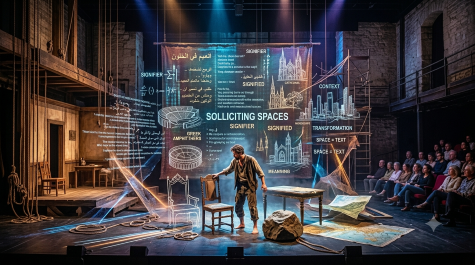
he development of theatrical studies has led to a deeper understanding of space as more than a physical environment. Structuralist and semiotic approaches revealed the complex relationship between theatrical performance and systems of meaning. Theatre is no longer regarded only as a representation of reality, but as a network of signs through which meanings are produced and communicated.
The studies of the Prague School of structuralism and semiotics, beginning in the 1930s, contributed greatly to this understanding of theatre as a signifying phenomenon. Among the important contributions in this field are studies that examined theatre as an artistic system based on communication and interpretation. Later, the French thinker Roland Barthes described theatrical performance as a semiotic act that uses multiple signs and codes to communicate meanings and convey different forms of expression.
From a semiotic perspective, theatre is considered a highly dense field of signs. Everything present on stage — including spatial elements — functions as a theatrical sign. These elements may appear in different forms: as images, signals, or symbols. Therefore, all visible and audible components of performance participate in the process of meaning production.
The spatial elements of theatre acquire the quality of signs even when they are borrowed from everyday reality. Once an object enters the theatrical context, its original function may change. The stage transforms ordinary objects into artistic signs, giving them new meanings that may differ completely from their practical functions in daily life.
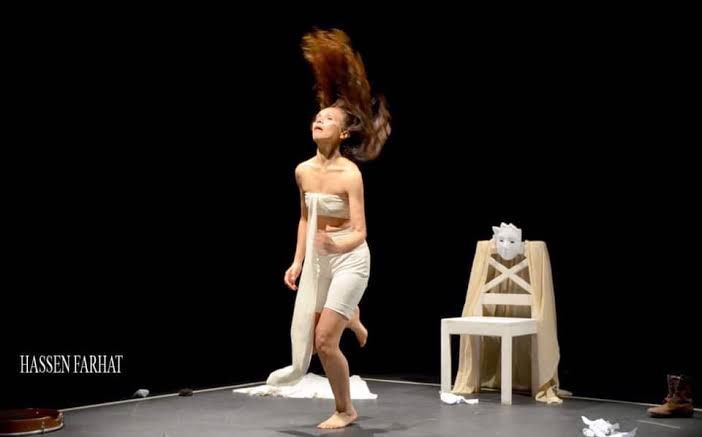
A chair, a door, a table, or any other object does not remain merely a physical thing on stage. Its presence within a specific dramatic context allows it to represent ideas, emotions, memories, or symbolic meanings. Theatre transforms natural objects into artificial signs, providing them with new aesthetic and intellectual functions.
For example, a simple piece of fabric placed on stage may cease to represent only a piece of cloth and become the sail of a ship. Through this transformation, the object moves from its ordinary practical existence into a symbolic theatrical existence. The spatial element no longer expresses itself alone; rather, it points toward a meaning beyond its physical appearance.
This transformation requires the spectator to reconsider the external appearance of theatrical objects and understand them according to their role within the overall structure of the performance. The meaning of space is therefore not determined only by what the object is, but by how it is used, positioned, and connected with other elements of the theatrical composition.
The theatrical relationship with space does not aim to reproduce the real world exactly. Instead, it seeks to refer to reality, reshape it, or create a metaphorical image of it that stimulates the imagination of the spectator and encourages deeper interpretation.
Thus, theatrical space becomes a creative field where material objects, movement, sound, and visual composition interact to produce a complex system of meanings. It is not merely a place where action occurs; it becomes a language through which theatre wri
One of the essential characteristics of theatrical space is its ability to transform and generate multiple meanings. The spatial sign on stage does not remain fixed; rather, it changes according to the context, structure, and function assigned to it within the performance. This capacity for transformation allows theatrical space to continuously produce new interpretations.
A theatrical sign must possess the ability to respond to different artistic contexts. A spatial element may move from one position to another, combine with other elements, or acquire a new function that differs from its original purpose. Through these transformations, space becomes an active participant in the construction of theatrical meaning.
For instance, a visual spatial element such as a door may acquire an auditory dimension when its sound becomes connected to the dramatic action. The door is no longer only a physical object seen by the spectator; its sound may suggest arrival, departure, fear, expectation, or a dramatic turning point. In this way, the visual meaning may transform into an auditory meaning, or both meanings may exist simultaneously.
Theatrical space is one of the richest artistic fields for such transformations because it is not limited to visual signs alone. It includes auditory, verbal, and sometimes sensory dimensions that expand the spectator’s experience and create a more complex relationship between perception and interpretation.
Some scholars consider the image to be one of the defining characteristics of theatre. However, theatrical space reveals that theatre cannot be reduced to visual appearance alone. A dramatic text may be read like any other literary text, but the theatrical experience depends on the relationship between performance and the space in which it occurs.
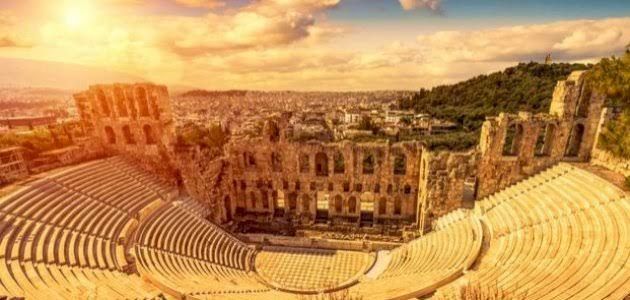
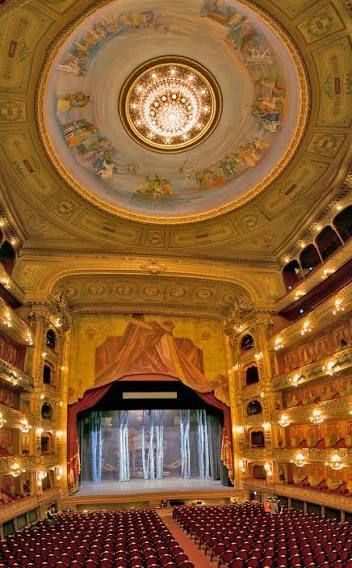
The first element that emerges when analyzing theatrical reality is therefore the close relationship between performance and place. The stage is not only a physical area where actors move; it is a space with specific material qualities and a particular relationship with the audience. Historical examples such as the ancient Greek theatre, Roman theatre, Palais Garnier, and La Scala demonstrate how theatrical spaces establish specific relationships between the stage and the spectators.
The theatrical space, therefore, possesses its own physical characteristics and its own relationship with the practice of performance. It influences movement, perception, communication, and the overall structure of the theatrical event.
The Basic Meaning and the Contextual Meaning of Spatial Signs
The analysis of theatrical space requires distinguishing between two levels of meaning: the basic meaning and the contextual meaning.
The basic meaning refers to the immediate recognition of an object as it appears on stage. A chair is recognized as a chair, a staircase as a staircase, and a table as a table. These objects initially carry their ordinary meanings derived from everyday experience.
However, once these objects enter the theatrical structure, they may lose their fixed meanings and acquire new interpretations according to their position and function within the performance. Their meaning becomes connected to the overall context in which they appear.
 The contextual meaning emerges from the relationship between spatial elements and the complete theatrical composition. The director reorganizes objects, movements, colors, lighting, and relationships between elements in order to create a new artistic context. Through this process, space becomes a form of artistic discourse capable of communicating ideas and emotions.
Therefore, the meaning of theatrical space is not contained in individual objects alone but is produced through the interaction between all elements of the performance. Space becomes a dynamic language that changes according to artistic vision and the spectator’s interpretation.
The meaning of theatrical space is not created only through the objects and elements placed on stage, but also through the relationship established between the performance and the spectator. Modern theatre has significantly transformed this relationship, moving the audience from the position of a passive observer to an active participant in the process of interpretation.
The spectator does not simply receive the visual and auditory elements of the performance; rather, they read and interpret the network of signs presented before them. The understanding of theatrical space occurs through several stages: first, recognizing the elements that carry meaning; second, interpreting these elements according to cultural and social references; and finally, discovering the complete meaning through the relationships that connect the different signs throughout the performance.
The theatrical sign is therefore characterized by its ability to generate multiple meanings. A single spatial element may produce different interpretations depending on its location, function, and relationship with other components of the stage. This is what gives theatrical space its richness and complexity.
The relationship between signifier and signified represents a fundamental principle in semiotic studies of theatre. A sign may function as an image, an indication, or a symbol. Some signs depend on a recognized connection between the object and its meaning, while others create symbolic relationships that require imagination and interpretation from the spectator.
In theatre, space is never a simple reproduction of reality. It is a creative structure that reshapes reality and gives it new dimensions. The stage transforms ordinary places and objects into artistic expressions capable of communicating ideas, emotions, and philosophical visions.
The evolution of theatrical space represents one of the most important characteristics of modern theatre. Every director seeks to create a distinctive space that belongs to a particular performance. This does not refer only to scenery or decoration, but to the entire concept of the theatrical place: the space of acting, the relationship between performers, the position of the audience, and the connection between the stage and the surrounding world.
Despite the diversity of theatrical theories and practices concerning space, they all meet at one essential point: the necessity of redefining the relationship between the spectator and the theatrical environment.
Theatrical space has moved beyond being a physical container for dramatic events to become an essential element of theatrical writing. It speaks, communicates, and participates in the creation of meaning. Through its visual, symbolic, and emotional dimensions, space becomes a living language that interacts with the actor, the director, the text, and the audience.
The modern theatre does not merely present stories; it creates worlds. Within these worlds, space becomes a text that can be read, interpreted, and experienced. The stage is therefore not only a place where theatre happens — it is one of the fundamental elements through which theatre writes itself.
Read: Cinema: Dynamic Language of Human Existence
_____________________
 Souad Khalil, hailing from Benghazi Libya, is a writer, poet, and translator. She has been writing on culture, literature and other general topics.