Listening to People, Strengthening Governance
Citizen Feedback Systems for Better Public Services

Good governance begins with a simple yet powerful principle: listening.
Citizen feedback systems provide governments with an opportunity to transform public administration from a process-driven model into a people-centered system built on trust, transparency, and accountability.
By Nuzair Ahmed Jamro
“The most important office in a democracy is not that of the President, Prime Minister, or Governor, it is the office of the citizen.” Justice Louis Brandeis
A government’s true success is not measured by the number of policies it announces or the funds it allocates for development. Rather, it is reflected in the quality of public services it delivers and, more importantly, in the satisfaction of the people it serves. After all, governments exist for citizens, and every public institution ultimately derives its purpose from meeting the needs and expectations of society.
Whether a parent visits a government school to enroll a child, a patient seeks treatment at a public hospital, a farmer applies for agricultural assistance, or a young graduate requests a government certificate, every citizen expects services that are timely, transparent, and respectful. Therefore, governments must not only provide services but also listen carefully to the experiences of those who use them.
As Peter Drucker, the renowned management thinker, wisely observed, “The most important thing in communication is hearing what isn’t said.” This principle applies equally to public administration. Governments that actively listen to their citizens are better equipped to identify shortcomings, improve services, and build lasting public trust.
Listening Is the First Step towards Better Governance
For decades, public institutions have measured their performance through official reports, inspections, audits, and administrative reviews. While these mechanisms remain necessary, they often present only one side of the story. They describe what departments have done, but they may not always reveal how citizens actually experience public services.
For instance, a hospital may report that all medical staff is present, yet patients may still wait for hours before receiving treatment. Likewise, a road project may be declared complete, but local communities may continue to face drainage issues or poor construction quality.
This is precisely where citizen feedback becomes invaluable. It provides governments with real-world information that cannot always be captured through official statistics. More importantly, it allows policymakers to understand public services from the perspective of the people who depend on them every day.
Consequently, decisions become more responsive, practical, and people-centered.
Citizen Feedback Is More Than a Complaint
Many people mistakenly believe that citizen feedback systems exist only to receive complaints. In reality, they serve a much broader purpose.
A modern feedback system allows citizens not only to report problems but also to appreciate good performance, suggest practical improvements, and participate in shaping better public policies. In other words, it transforms citizens from passive recipients of government services into active partners in governance.
As former United Nations Secretary-General Kofi Annan once remarked, “Good governance is perhaps the single most important factor in eradicating poverty and promoting development.” However, good governance cannot flourish unless governments remain connected to the voices of their people.
Therefore, citizen feedback should not be viewed as criticism; instead, it should be regarded as an opportunity to learn, improve, and innovate.
Digital Technology Has Changed the Conversation
Fortunately, advances in digital technology have made citizen engagement easier than ever before.
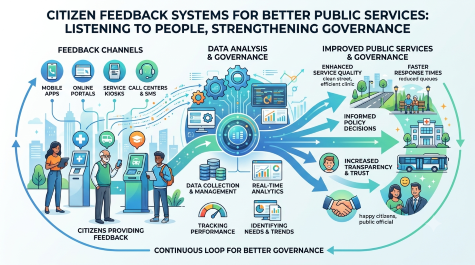
Today, governments can receive feedback through mobile applications, online complaint portals, SMS services, dedicated helplines, social media platforms, and digital service centers. Instead of visiting multiple government offices, citizens can submit complaints or suggestions within minutes using their mobile phones.
For example, a resident can upload a geo-tagged photograph of a damaged road, report a broken water supply line, highlight sanitation issues, or register a complaint regarding delayed public services. The information immediately reaches the concerned department, allowing officials to respond much faster than traditional paper-based systems ever could.
Furthermore, digital dashboards enable senior administrators to monitor complaints in real time, identify recurring issues, and evaluate departmental performance across districts.
As a result, governments are able to move from reactive administration to proactive governance.
Transparency Builds Public Trust
Trust is one of the most valuable assets any government can possess. However, trust cannot be demanded; it must be earned through transparency, fairness, and consistent performance.
Citizen feedback systems contribute significantly to this objective because every complaint, suggestion, and response is recorded electronically. Consequently, departments become more accountable for resolving issues within reasonable timeframes.
Moreover, digital records create transparency by allowing supervisors to track response times, monitor pending cases, and evaluate institutional performance objectively.
When citizens witness that their concerns receive prompt attention, their confidence in public institutions naturally increases.
As American writer Stephen Covey wisely said, “Trust is the glue of life. It’s the foundational principle that holds all relationships.” The relationship between governments and citizens is no exception.
Better Feedback Leads to Better Decisions
Collecting feedback is only the beginning. The real value lies in analyzing that information and transforming it into better policies.
For instance, if thousands of citizens repeatedly report delays in issuing driving licences or identity documents, this indicates that administrative procedures may require simplification. Similarly, recurring complaints regarding medicine shortages in public hospitals may highlight weaknesses in procurement or supply chain management.
By studying these patterns, governments can address root causes rather than merely responding to individual complaints.
Consequently, public resources are utilized more efficiently, institutional performance improves, and service delivery becomes increasingly citizen-focused.
Building a Citizen-Centered Government
Modern governance is gradually shifting from a government-centered approach to a citizen-centered model. This means that success should no longer be measured solely by the number of projects completed or policies introduced. Instead, it should also be measured by the satisfaction, trust, and well-being of the people.
Citizen feedback systems encourage public institutions to become more responsive, accessible, and accountable. At the same time, they create a culture of continuous learning, where every suggestion becomes an opportunity for improvement.
Indeed, governments that listen continuously are far more likely to improve continuously.
Challenges That Cannot Be Ignored
Nevertheless, implementing an effective citizen feedback system requires more than technology alone.
Governments must ensure that digital platforms are simple to use, accessible in rural as well as urban areas, and available in languages that citizens can easily understand. Likewise, protecting personal information and maintaining data privacy should remain a top priority.
Equally important is institutional commitment. If complaints are ignored or remain unresolved for long periods, citizens will gradually lose confidence in the system.
Therefore, technology must be supported by capable leadership, trained public officials, clear accountability mechanisms, and a genuine willingness to respond to public concerns.
Looking Ahead
Around the world, governments are increasingly integrating Artificial Intelligence (AI), data analytics, and predictive technologies into citizen feedback systems. These innovations enable authorities to identify emerging service delivery challenges, forecast public needs, and improve policy decisions through evidence-based analysis.
Pakistan is also moving steadily towards digital governance. As this transformation continues, integrating citizen feedback systems with e-governance platforms, local government institutions, and development monitoring frameworks can significantly improve the quality of public administration.
More importantly, such integration can strengthen the relationship between the state and its citizens by making governance more transparent, participatory, and responsive.
Conclusion
Good governance begins with a simple yet powerful principle: listening.
Citizens are not merely beneficiaries of government programs; they are partners in national development. Their experiences, observations, and suggestions offer valuable guidance for improving policies, strengthening institutions, and enhancing public services.
As Mahatma Gandhi wisely observed, “The best way to find you is to lose yourself in the service of others.” Public institutions fulfill their highest purpose when they genuinely serve the people and value their voices.
Citizen feedback systems provide governments with an opportunity to transform public administration from a process-driven model into a people-centered system built on trust, transparency, and accountability.
Ultimately, when governments listen sincerely, respond promptly, and act responsibly, citizens become more confident, institutions become stronger, and democracy becomes more meaningful. In the end, a government that listens to its people is not only more efficient it is also more just, more compassionate, and far better prepared to build a prosperous and inclusive future for all.
Read: Smart Classrooms: Transform Pakistan’s Colleges
_______________________
 Based in Shikarpur Sindh, the writer is a civil servant and MS research fellow in Public Administration. He writes on governance, public policy, and digital transformation. Email: najamro@gmail.com.