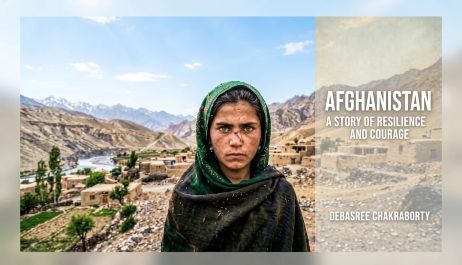
After twenty years in American newsrooms, Afghan-born journalist Nadia steps off the plane in Kabul with a single, urgent mission: to uncover the untold stories of her homeland’s forgotten daughters. Traversing a landscape of scarred palaces, dried rivers, and veiled shadows, her journey leads directly to the formidable walls of Badam Bagh Women’s Prison. There, amid the dust of a broken past, she prepares to face the raw, unyielding reality of the women left behind.
A Novel by Debasree Chakraborti
Part-2 of Chapter-2
After getting ready early in the morning, Nadia set out to speak to the women. Today, she intended to spend a considerable amount of time with them.
As she descended the staircase, she noticed countless different faces around her, each pair of eyes revealing a different expression.
Among them, one particular face caught her attention.
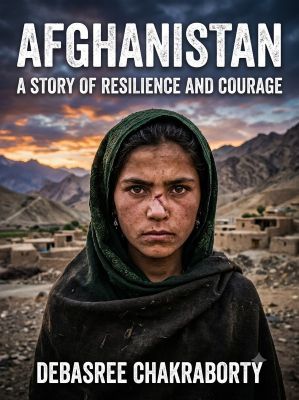 A woman, perhaps thirty-five years old, stood beside an iron gate. Her face was extraordinarily stern. Nadia almost wondered whether that face had ever known how to smile. Yet her eyes radiated tremendous self-confidence.
There was something extraordinarily magnetic about those eyes. They seemed to draw Nadia towards her, compelling her to walk closer.
The woman looked at Nadia.
She was staring directly at Nadia. Her eyes radiated an overwhelming sense of confidence. It was difficult to hold her gaze for long. Nadia could not quite figure out how to begin a conversation with her, yet an intense curiosity to know more about this woman had taken hold of her.
Nadia began with a straightforward question.
“How many years have you been sentenced to prison?”
The woman replied, “Eighteen years.”
What a terrifying expression she had while speaking! What an extraordinary stillness! There was no trace of pleasure, hope, desire or affection for anyone left on her face. Her entire being seemed to have built an extraordinary wall of resistance—a silent resistance. Getting past that wall would not be easy.
Almost without realizing it, Nadia found herself asking,
“How did you end up with an eighteen-year prison sentence?”
The woman replied,
“I murdered my husband.”
Nadia stared at her in astonishment. This woman had committed murder, yet there was not the slightest trace of remorse on her face.
Nadia said, “I would like to talk to you for a while. Could you spare me some time?”
The woman replied quite casually, “Come, let’s find somewhere to sit.”
As Nadia began talking to her, she learnt that the woman’s name was Ara.
Ara means an ornament or adornment. Perhaps she had been the ornament of her mother’s life, and that was why she had been given such a name.
There was a bench on a stretch of green grass behind the prison. The two women walked over and sat down.
It felt lovely to sit beneath the open sky. From there, the sky appeared particularly clear, with two kites of prey circling overhead. Nadia found herself enjoying the sight of them. Gradually, a deep sense of calm settled within her.
Both women sat gazing at the circling birds.
Then Nadia asked, “Don’t you ever feel remorse for having committed a murder?”
The answer came without hesitation.
“No. I have no regrets whatsoever. The man I killed should have been killed by me long ago.”
They continued gazing at the two kites of prey circling endlessly across the vast sky. Somehow, Nadia and Ara seemed to have disappeared into that endless expanse.
Nadia asked no further questions. Yet, somewhere deep inside, she wanted to open the doors of her own mind and let everything buried within come pouring out. Now that someone had finally knocked, perhaps it was time to let all the accumulated refuse spill out. Only then might Ara be able to spread her wings and fly across the sky like a kite.
Ara spoke. Nadia listened.
Ara began,
“I was married to Abdul Bari when I was ten years old. Abdul was then a twenty-six-year-old young man.”
Ara had brought a doll with her to Abdul’s house. She could not fall asleep at night without her doll. Everything felt strange to her on that first night.
The smell of henna on her hands was almost suffocating. She sat on the bed, clutching her doll tightly against her chest.
Red roses had been scattered across the white velvet bed-sheet. Their fragrance made her feel nauseous. Outside the room, dogs were barking in the street. She was frightened, terribly frightened. The more frightened she became, the tighter she held her doll against her chest.
On a small table beside the bed stood a glass of milk. Delicate strands of red saffron floated on its surface.
How long had it been since Ara had tasted saffron!
In a family like hers, even drinking milk was considered a luxury. She picked up the glass and began sipping the milk.
Just then, Abdul Bari entered the room.
As she continued drinking, Ara looked at him carefully.
The man must have been around her father’s age. But he was nothing like her father. A foul smell emanated from his body. Ara knew exactly what that smell was.
Her father had told her that Allah had forbidden such things in the Quran. Those who consumed them, he said, neither obeyed nor believed in Allah.
Ara was frightened by the man’s eyes. They were not eyes at all, but two blazing balls of fire.
The man could barely stand upright. He staggered as he made his way towards her.
Never before had Ara felt such discomfort in the presence of a grown man. But tonight, something felt terribly wrong. She began thinking of her mother.
Clutching her doll tightly against her chest, Ara watched as the man approached her.
Abdul Bari came and stood right in front of her…
Abdul Bari bent down towards Ara and looked at her. Then he began pulling at her doll. Ara refused to let go. But the man was equally determined. With one violent jerk, he snatched the doll from her hands and flung it away.
Ara watched helplessly as her beloved doll landed in a corner of the room. Her precious doll, the one thing she held closest to her heart.
Then everything went dark. There was the brutal rampage of a hungry beast, and after that, she remembered nothing.
Ara remembered vomiting. The sour smell of milk seemed to cling to her entire body. As soon as morning came, the man left the house. When the first rays of sunlight entered the room through the narrow gap in the door, Ara saw patches of bright red blood scattered across the white velvet bedsheet.
The following day, she could not find her doll anywhere. Perhaps they had wanted to snatch away even her last remaining source of comfort.
And so the days and nights continued to pass. Before she knew it, a year had gone by. She had been married in one year, and the following year, in the month of Hamal, she experienced her first menstruation. That same year, in the month of Mizan, she gave birth to her first son.
Life continued in much the same way.
Her mother-in-law was a widow. After her father-in-law’s death, she had never considered beginning her life anew. Clutching her son and daughter close to her heart, she carried on with her existence.
Everyone in the household obeyed her. She would spend the entire day sitting on her cushion, and I had to carry out every task according to her instructions. My sister-in-law shared the same fate. Four months after her marriage, she lost her husband and returned to her parental home.
She was extraordinarily beautiful. Her beauty seemed too magnificent to be contained within the walls of a single room. I could not bear to see her suffering. It pained me deeply.
I never allowed her to do any household work. She would spend the entire day sitting beside Ammi, while I took care of everything—from cooking and cleaning the house to feeding the chickens.
Years passed like this. Eventually, my sister-in-law got married again.
Meanwhile, memories of my own father, mother, village and even my beloved doll gradually began fading from my mind. Every year, another child was born. My entire world revolved around children and household responsibilities. I was like a little girl endlessly absorbed in playing with her dolls.
Even after four years of marriage, I had no idea what my husband’s actual business was.
Nadia had been listening very attentively. When Ara paused, Nadia asked,
“How could you not know what your husband did for a living? You were living in that very household.”
Ara replied: “Every now and then, he would disappear for ten or twelve days. When he returned, he would bring along a little boy. He arranged for the boys to stay in a house adjoining ours.
They lived there, ate there and received training in dancing and singing. Every night, there would be musical and dance performances. Wealthy Sheikhs would come to watch the performances.
That house would come alive with dazzling lights.
Initially, I was extremely curious. I desperately wanted to know what went on inside that house.
One day, after putting the children to sleep, I quietly crept down the staircase. Crossing the dark, open courtyard, I made my way towards the house outside.
The closer I got, the clearer the sound of the ghungroos, music and singing became.
When I was a little girl, whenever someone in our family got married, I would watch these performances attentively from behind the curtains. Music had always fascinated me deeply. I had always longed to sing, but because of family restrictions, that desire had never been fulfilled.
But let me not digress.
I was slowly making my way towards the outer house. When I finally reached it, I peered through the latticework of a window. The dazzling lights inside almost blinded me.
What I saw was astonishing.
The little boys whom my husband brought home were dressed up like girls. Wearing elaborate feminine costumes and ghungroos around their ankles, they were dancing.
Looking at them, nobody could possibly have guessed that they were boys. They looked exactly like girls.
I turned my eyes towards the other side of the room and saw the musicians playing their instruments. The entire atmosphere inside seemed enchanting.
I became completely absorbed in watching the dance.
Suddenly, I thought I heard my youngest daughter crying.
Her cries were coming all the way from the inner house and reaching the courtyard outside. The child was crying so loudly that my heart began to ache.
Forgetting the music and the dance, I rushed back inside.
From that night onwards, I began feeling a strange affection for those little boys in the outer house.
Poor children! How old could they possibly have been? One of them, Abraham, was perhaps the same age as the little boy I held in my arms.
They were so desperately poor. Their parents must have sent them away to dance and perform simply because they could not afford to feed them.
That very night, I made up my mind.
No more. From now on, whatever good food or ordinary food was available in our household, those boys would share it with my own children.
We had chickens slaughtered at our house almost every day…”
“Ours was a well-to-do family. By the grace of Allah, we never had any shortage of food or clothing. I would go to the outer house and take them chicken, bread and other things to eat.
Initially, whenever I visited, the boys were reluctant to talk to me.
Perhaps they had been forbidden to do so. But you know something? When people receive love, they eventually surrender to it. Gradually, they began to trust me. They no longer felt afraid of me.
Whenever my husband was away, I would go and sit with them.
That outer house gradually became like my father’s home—a place where I could sit with my little fathers, breathe freely and talk to my heart’s content.
One day, I asked the youngest boy, ‘Don’t you feel like going back to your mother?’
I saw his eyes fill with tears. My heart ached terribly. I pulled him close to my chest and said, ‘I am your Ammi now, understand? From today onwards, you will tell me everything, whether good or bad. You can tell your mother anything.’
He told me his name was Riyaz.
Gradually, the bond between Riyaz and me grew deeper. It was an invisible connection, something that could never be seen with the naked eye.
One night, snowfall began in Herat.
I knew there were hardly any quilts or blankets in the outer house. When little flakes of snow began striking the glass windows, I could no longer remain comfortably inside my warm room.
Taking two quilts, I set out towards the outer house.
Snowflakes fell all over my body. It was becoming increasingly difficult for me to walk.
When I reached the house, I noticed that the front door was open. Usually, after the night’s dance and music performances were over, the boys would lock the door from inside. But tonight, everything had been left open.
A brightly colored curtain, decorated with intricate patterns in different shades, hung across the doorway.
When I heard Riyaz crying from outside, my heart sank. I felt deeply disturbed. Nothing seemed right.
Slowly, I walked towards the room concealed behind the curtain. Then I moved the curtain aside and stepped inside.”
Nadia could see that Ara was sweating. She had become terribly agitated, her face flushed red with emotion.
Ara continued speaking.
“It was like a devastating flood of pain, breaking through every barrier.
Ara’s eyes had turned blue. Poison seemed to drip from them.”
Nadia did not disturb Ara. She allowed her to remain lost in her own thoughts. After a while, Ara began speaking again.
“When I entered the room, I saw a monster crouched over Riyaz. His back was turned towards me, so I couldn’t see his face.
Riyaz was writhing in agony. I could no longer bear to watch him suffer.
There was an iron bar hanging on the wall of the room. I took it down and began striking the man on his back.
At the very first blow, he screamed. As he turned around, another blow landed on his chest.
I had completely lost control of myself. I kept striking him until his very last breath.
The moment the man collapsed onto the floor, Riyaz rushed towards me.
As I was tying the drawstring of his pyjama, something suddenly dawned on me. By then, I had regained my senses.
I turned and looked at the man lying on the floor.
It was my husband, Abdul Bari.
The following day, the police arrived at our house. They took me away. And eventually, I ended up here.”
Nadia felt deeply distressed listening to Ara’s story.
She asked her, “Where are your children now?”
For the first time during their conversation, Ara broke down in tears.
“I honestly don’t know where they are. But I have absolutely no regrets about killing my husband. My father is a devout Muslim. I know that what Abdul Bari did was a sin in Islam. I killed a sinner, a man who had abandoned the path of truth and chosen to live in sin.”
Before she could finish speaking, tears began streaming down Ara’s face.
Nadia knew what those tears were for. She knew whom Ara was crying for.
She gently told her, “I will find out what happened to your children and bring you news of them. Don’t worry.”
Their time was up. They could no longer remain outside. The prison guards rang the bell, instructing everyone to return indoors.
Ara walked back inside, obediently, like a little girl following orders. The other women, just like Ara, began filing back into the prison.
The entire scene resembled an animal enclosure. These women had no freedom. They were captive beings, deprived of their liberty. Creatures of different appearances and colors were returning at the sound of a bell, just as animals respond to the call of their keepers.
Their wishes and unwillingness meant nothing.
They had no right to admire the sky, the birds or nature, to experience the beauty and richness of the world around them. They were not even entitled to the freedom to speak as they pleased.
Nadia remained seated for a while, gazing at the sky.
The kite was no longer circling overhead. It had gone away, perhaps to attend to its own business. Perhaps that brief flight had been the only freedom it had known.
Perhaps every living creature on earth is, in some way, bound by the chains of rules and restrictions. Perhaps nobody is truly entitled to live entirely on their own terms.
Nadia glanced at her watch. It was already quite late. She had promised to speak to several other women that day. They were probably waiting for her.
She got up and walked away. (Continues)
Read: Part-1, Part-2, Part-3, Part-4,
_________________

Debasree Chakraborty is a renowned novel writer of Bengali language. Based in Kolkata, West Bengal, India, she has done Master’s in Modern History from the Kolkata University, and authored some thirty books, mostly the novels, with historical perspective and themes. Her novel is ‘Maharaja Dahir’ that covers the history of Sindh from 662, the year of first attack on Sindh by the Arab armies till date, was published last year and translated by Nasir Aijaz into Sindhi language. Her new novel “The Last People of Mohenjo Daro” in Bengali language, has recently been published.