Will the New Sukkur–Rohri Bridge Solve Congestion Without Proper Approach Roads?
Engr. Bhawan Das
The Government of Sindh’s decision to construct a new bridge between Sukkur and Rohri has been widely welcomed as a long-overdue response to the region’s worsening traffic crisis. For years, commuters, traders, and transporters have endured hours-long delays while crossing the River Indus, relying almost entirely on the aging Lansdowne Bridge. With the Sukkur Barrage closed to traffic until at least 2027 for essential repairs, the urgency for an alternative crossing has only intensified.
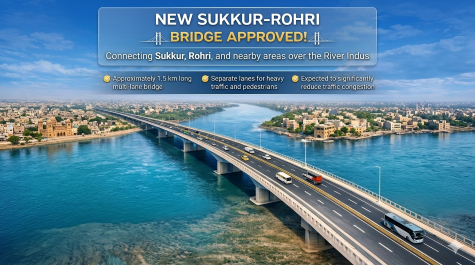
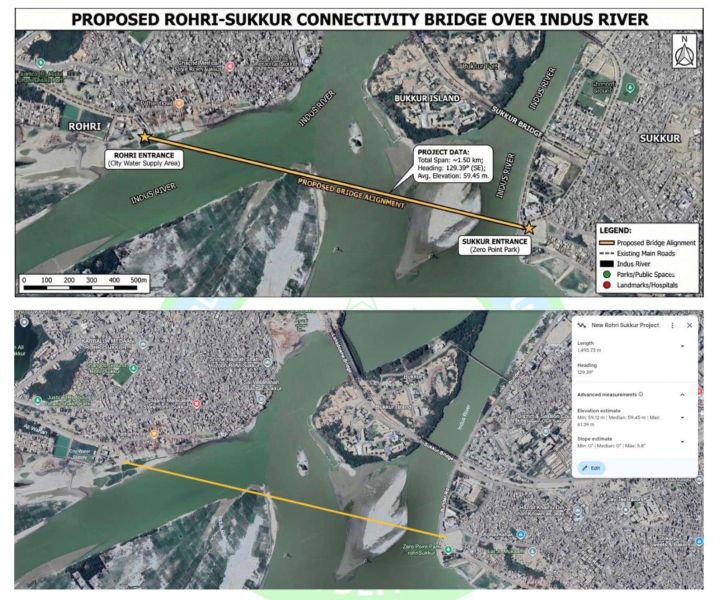
At first glance, the proposed project appears both timely and transformative. The new bridge—planned as a modern, multi-lane facility approximately 1.5 kilometers long and located north of Bukkur Island—is designed to accommodate heavy commercial vehicles, include pedestrian walkways, and feature modern lighting systems. While the final cost is yet to be formally disclosed following feasibility and PPP structuring, infrastructure experts estimate that a project of this scale, including associated works, could run into tens of billions of Pakistani rupees, depending on design specifications, land acquisition, and approach road development.
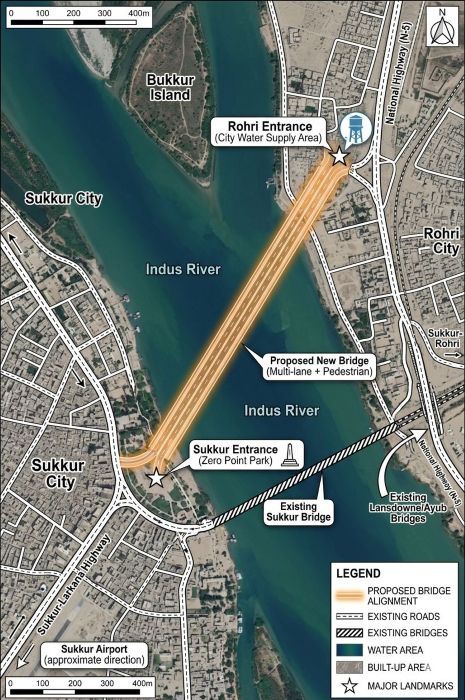
The project was discussed in the 51st meeting of the PPP Policy Board on March 16, 2026, chaired by the Chief Minister of Sindh, and is being pursued under a Public-Private Partnership (PPP) model on a Build-Operate-Transfer basis. The alignment connects Zero Point in Sukkur with the DSP Office and Water Supply area in Rohri, aiming to minimize displacement while linking with existing road networks.
However, beneath this optimism lies a fundamental question: can a new bridge alone resolve congestion if the roads feeding into it remain narrow, congested, and poorly designed?
 A Bridge Without Roads?
Infrastructure, by its nature, functions as a system. A four-lane bridge cannot deliver its intended benefits if it connects to two-lane urban streets riddled with bottlenecks. This is precisely the concern surrounding the Sukkur–Rohri bridge project. While the structure itself is being designed to modern standards, the approach roads on both sides tell a different story.
On the Rohri side, the proposed alignment passes through densely built urban areas near the water supply zone. On the Sukkur side, it connects to Zero Point, which already experiences heavy traffic pressure. Neither side currently has straight, wide, or high-capacity corridors capable of handling the projected increase in traffic—particularly freight moving between Karachi, Punjab, and upper Sindh.
Without substantial upgrades, these approach roads risk becoming choke points, merely shifting congestion from the bridge to the city streets.
The Freight Factor
The stakes are even higher when viewed through the lens of regional trade. Heavy vehicles traveling between major economic corridors such as the National Highway N-5 and the M-5 Motorway currently face significant detours due to restrictions on the Lansdowne Bridge. The new bridge is expected to restore direct connectivity, reducing travel time and transportation costs.
However, freight traffic requires uninterrupted, high-speed movement. This cannot be achieved through city streets with sharp turns, encroachments, and mixed traffic. Proper integration with highways—such as linking Sukkur’s Zero Point to National Highway N-65—is essential. Otherwise, the bridge may fail to deliver its promised economic impact.
A Larger, Unaddressed Project
What is often overlooked is that constructing approach roads is not a minor extension of the bridge project. It is, in itself, a major infrastructure undertaking. It involves land acquisition, demolition of built-up areas, resettlement planning, and the construction of flyovers, bypasses, and interchanges.
Such work requires a separate and well-defined planning framework, including a comprehensive PC-1, dedicated funding, and strong political commitment. Without this, the project risks being implemented in isolation—technically sound as a bridge, but functionally incomplete as a transport solution.
PPP Model: Efficiency or Delay?
The government’s decision to execute the project through a Public-Private Partnership (PPP) on a Build-Operate-Transfer basis introduces another layer of complexity. In principle, PPP models can bring efficiency, innovation, and private investment. In practice, however, they often face delays during feasibility studies, transaction structuring, and investor negotiations.
There are also concerns about transparency and the potential for preferential treatment of certain investors. For a project of such strategic importance, delays or governance issues could undermine public confidence and postpone much-needed relief for commuters.
 The Legacy of the Lansdowne Bridge
Any discussion of a new crossing must acknowledge the historic importance of the Lansdowne Bridge. Constructed between 1887 and 1889 and opened on 25 March 1889, this iconic structure was designed by Sir Alexander Meadows Rendel and named after Lord Lansdowne, the then Viceroy of India. Spanning approximately 820 feet (250 meters) across the River Indus without intermediate piers, it was once the longest rigid girder bridge in the world.
Its distinctive steel cantilever design, with massive arms supporting a suspended central span, allowed uninterrupted river flow—an engineering necessity in a flood-prone region. Originally built for railway traffic and later adapted for road use, the bridge played a pivotal role in connecting Sukkur and Rohri and facilitating trade across Sindh.
Today, however, at over 130 years old, its structural limitations necessitate restricted usage. Recognizing its heritage value, the bridge was transferred in January 2024 from Pakistan Railways to the Sindh Culture Department following directives of the Sindh High Court. Plans now focus on its preservation, including structural rehabilitation, controlled restoration, and beautification to transform it into a cultural and tourism landmark.
Risk of Repeating Old Mistakes
Pakistan’s infrastructure history offers several examples of projects that addressed one bottleneck while creating another. The Sukkur–Rohri bridge risks following the same pattern if approach roads are not developed in parallel.
Temporary measures such as one-way traffic systems, signal adjustments, or partial widening may provide short-term relief but cannot substitute for comprehensive planning. Without dedicated corridors for high-volume traffic, the bridge could quickly become another point of congestion rather than a solution.
The Way Forward
To ensure the success of the project, a holistic approach is essential. This includes:
Developing four-lane (or higher capacity) approach roads on both sides
Establishing direct, signal-free connectivity with major highways
Constructing interchanges and bypasses to divert through-traffic away from city centers
Implementing proper urban planning and resettlement strategies
Ensuring transparency and efficiency in PPP execution
Most importantly, the bridge and its approach infrastructure must be treated as a single, integrated project—not as separate undertakings.
Conclusion
The new Sukkur–Rohri bridge has the potential to transform mobility and economic activity across northern Sindh. Its 1.5 km modern structure, combined with expected multi-billion-rupee investment, reflects the scale of ambition behind the project. But without equally robust approach roads, it risks becoming an incomplete solution—an impressive structure feeding into inadequate networks.
The real test, therefore, is not just the construction of the bridge, but the vision to see beyond it. Only then can this long-awaited project truly deliver on its promise of easing congestion and driving regional progress.
Read: New Sukkur-Rohri Bridge Project Approved
___________________________