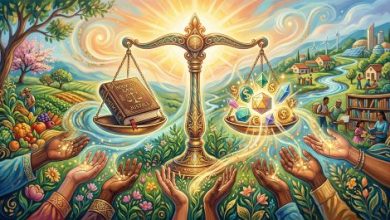
The global value system is not a destination—it is a dialogue, a process, and a promise we must renew with each generation.
By Abdullah Usman Morai | Sweden
A Fractured Unity
In a world bound together by trade, travel, technology, and turmoil, the idea of a shared moral code remains elusive. While humanity can orbit satellites in unison and combat pandemics across borders, we still cannot agree on what constitutes justice, freedom, or even truth. What, then, is a “global value system”? Can nearly eight billion people—diverse in faith, culture, language, and ideology—find common ethical ground? Or is the dream of universal values merely a construct, shaped by dominant powers and diluted by cultural relativism? As climate crises, wars, and technological disruptions demand collective responses, the need for shared values has never been more urgent. Yet, in practice, the planet seems more divided than united.
This article delves into the foundations, challenges, contradictions, and future of the global value system. It examines whether we are converging toward a shared moral compass or fracturing further under the weight of identity, inequality, and ideology.
The Ideal of Universal Values: A Human Dream
The modern concept of universal values was crystallized in the aftermath of World War II. The horrors of genocide, fascism, and atomic warfare compelled world leaders to articulate a collective moral framework. The Universal Declaration of Human Rights (1948), adopted by the United Nations, asserted that all human beings are born free and equal in dignity and rights. Concepts like freedom of expression, protection from torture, the right to education, and gender equality were hailed as universal.
This aspirational framework aimed to transcend national borders, political ideologies, and religious doctrines. It served as the moral backbone for many global institutions, from the World Health Organization to the International Criminal Court. Global treaties on climate change, nuclear disarmament, and child rights further sought to codify shared ethical responsibilities.
But ideals, no matter how noble, are not immune to selective application and political hypocrisy. The real world is messier.
Cultural Relativism vs. Moral Absolutism: The Value Debate
Despite the appeal of universality, many societies argue that values are culturally grounded and cannot be imposed from outside. This debate pits moral absolutism—the belief in unchanging ethical truths—against cultural relativism, which sees values as fluid and context-specific.
Consider freedom of speech. In Western democracies, it’s a sacred principle. But in many Asian, Middle Eastern, and African societies, speech is often moderated in the interest of communal harmony, religious sanctity, or national unity. Similarly, LGBTQ+ rights are celebrated in some regions and criminalized in others, not necessarily due to malice, but due to differing cultural, religious, and historical contexts.
Is it ethical to demand that one system conform to another’s moral code? Or does that risk cultural imperialism? These questions expose the tension between protecting human dignity and respecting cultural sovereignty.
Power and the Politics of Values
Who gets to define “global values”? In practice, these values often mirror the ideologies of powerful nations, particularly Western democracies. This raises accusations of double standards.
The West advocates for democracy and human rights abroad while tolerating autocratic allies. It promotes peace but exports arms. It champions freedom of the press yet battles misinformation with censorship. Meanwhile, countries in the Global South argue that development, dignity, and sovereignty are values too—ones often trampled by colonial histories, economic coercion, or ideological imposition.
Any country, for example, champions “non-interference” and economic development over Western-style democracy. Any other country may invoke traditional values against what it sees as moral decay in the West. In response, many countries are pushing for a multipolar world, not just in geopolitics, but in moral philosophy.
Thus, global values often reflect global hierarchies.
Global Crises and Shared Ethics: Unity in Emergencies
Ironically, it is during times of crisis that shared values become most visible.
During the COVID-19 pandemic, the idea of collective responsibility—protecting the vulnerable, trusting science, valuing healthcare workers—resonated globally, even as national responses varied. Climate change has sparked a universal discourse on sustainability, intergenerational justice, and ecological stewardship. Mass migrations, caused by conflict or catastrophe, have ignited debates about hospitality, human rights, and compassion.
In such moments, common values emerge not from ideology but necessity. They are forged in survival, in empathy, and in the recognition of our interdependence.
Yet even here, the response is unequal. Vaccine hoarding, climate inaction, and selective compassion reveal that shared ethics often dissolve under pressure.
Technology, Social Media, and the Digital Morality Shift
In the 21st century, digital platforms have become the new battleground for values. Algorithms now shape our exposure to ideas, reinforcing bubbles or breaking them. Global outrage over injustices—like the murder of George Floyd or the bombing of Gaza—spreads within seconds, creating moments of collective moral clarity.
But digital ecosystems also facilitate disinformation, polarization, and moral disengagement. Platforms like Facebook, YouTube, and TikTok carry content that reflects the full spectrum of human values, from compassion to cruelty.
Moreover, the tech industry, dominated by a few corporations, raises new ethical questions: Who decides what is acceptable speech? How should AI respect cultural nuance? Is digital surveillance ever justified for public safety?
As the internet erases borders, it complicates value systems.
The Youth and the Rise of Global Moral Movements
Young people across the world, connected by technology and animated by urgency, are redefining global values. Movements like Fridays for Future, Black Lives Matter, MeToo, and Free Palestine transcend national boundaries. They prioritize climate justice, racial equality, gender rights, and anti-colonial resistance.
Unlike older generations, many youth see themselves as global citizens first. Their values are not inherited but interrogated. They question traditional authority, challenge inherited prejudices, and seek solidarity beyond borders.
This generation’s activism suggests that a global value system might emerge not from treaties or institutions, but from grassroots movements, moral imagination, and cross-cultural empathy.
Resistance to Global Values: The Return of the Tribal
Despite these movements, a powerful backlash is underway. Populist leaders, nationalist ideologies, and fundamentalism are on the rise. From India’s Hindu nationalism to America’s culture wars, from Europe’s anti-immigration sentiments to theocratic regimes, many societies are retreating into narrow identities.
This resistance often stems from a fear of erasure—the worry that global values dilute local traditions, moral codes, and ways of life. For many, defending “our way” becomes an act of survival.
Thus, the global moral landscape is increasingly marked by polarization: between the cosmopolitan and the traditional, the pluralist and the purist.
Toward a Pluralistic Moral Framework
Is a single global value system possible? Perhaps not in the rigid sense. But a pluralistic moral framework—one that honors diversity while affirming shared human dignity—is both necessary and achievable.
Rather than imposing uniformity, the global community must foster mutual respect, dialogue, and reciprocity. Shared values like empathy, justice, nonviolence, sustainability, and truth-seeking can be cultivated without flattening cultural identity. Moral humility must accompany moral conviction.
In a world shaken by division and distrust, we must ask not just what values we live by, but whose values get to define the future. If we are to survive and thrive together, our moral compass must be both globally sensitive and locally grounded.
In the end, the global value system is not a destination—it is a dialogue, a process, and a promise we must renew with each generation.
Read: Unveiling Hidden Motivations Behind Lying
_________________
 Abdullah Soomro, penname Abdullah Usman Morai, hailing from Moro town of Sindh, province of Pakistan, is based in Stockholm Sweden. Currently he is working as Groundwater Engineer in Stockholm Sweden. He did BE (Agriculture) from Sindh Agriculture University Tando Jam and MSc water systems technology from KTH Stockholm Sweden as well as MSc Management from Stockholm University. Beside this he also did masters in journalism and economics from Shah Abdul Latif University Khairpur Mirs, Sindh. He is author of a travelogue book named ‘Musafatoon’. His second book is in process. He writes articles from time to time. A frequent traveler, he also does podcast on YouTube with channel name: VASJE Podcast.