Feminine narrative constitutes one of the most prominent manifestations of transformation in contemporary Arab cultural consciousness
Souad Khalil | Libya
Feminine narrative has emerged as a significant field within contemporary literary and cultural studies, reflecting profound transformations in the perception of identity, creativity, and representation. It goes beyond the mere inclusion of women’s voices in literature to become a dynamic space for questioning dominant structures and redefining reality through aesthetic and imaginative practices. In this context, women’s writing articulates a unique vision shaped by the intersection of personal experience, social conditions, and cultural memory.
 This study explores the intricate relationship between reality and imagination in feminine narrative, examining how creative expression serves not only as a reflection of lived experience but also as a transformative force that reconfigures meaning, challenges established norms, and opens new horizons for understanding the self and the world.
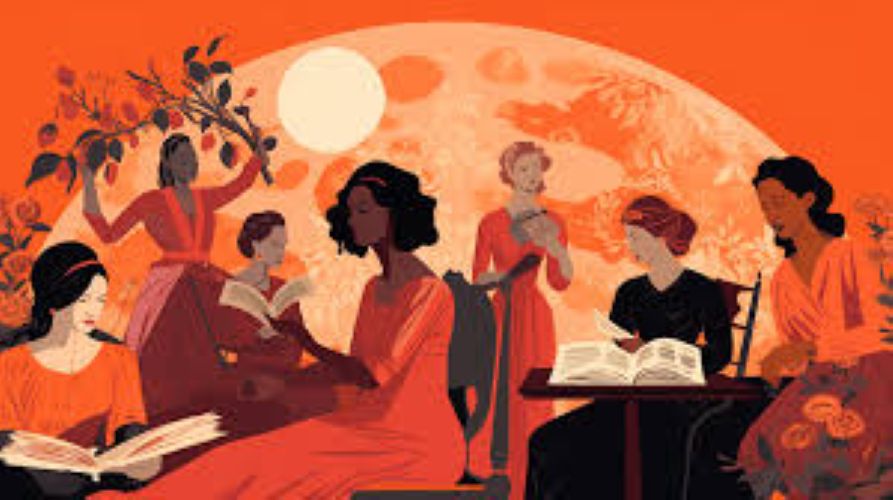
Feminine narrative constitutes one of the most prominent manifestations of transformation in contemporary Arab cultural consciousness. It is no longer merely the presence of a female voice within the literary field; rather, it has become a space for re-examining reality and reshaping it through the tools of imagination and aesthetic vision. Women’s writing cannot be separated from the social and historical context in which it is formed; instead, it engages in a dialectical dialogue with its structures and values, seeking to reveal the unspoken, dismantle stereotypes, and restore the feminine self as an active and creative entity.
From this perspective, the relationship between reality and imagination emerges as a central axis in understanding the specificity of feminine narrative. The real and the imagined intertwine within a complex creative process that goes beyond mere representation or recollection, establishing instead a new vision of the world and an aesthetic formulation reflecting women’s awareness of themselves and their surroundings. Thus, feminine narrative is not simply writing about women, but writing from the standpoint of lived experience and from a horizon of liberation and the rebalancing of human relationships.
In this context, I draw on what Noura Al-Jarmouni has written about feminine narrative (reality and imagination). Discussing the relationship between reality and imagination in women’s creativity is essentially a discussion of a dialectical relationship between reality—with all its social issues and cultural transformations—and creativity as an imagined product that can only be grounded in a social reality.
It is important to note that imagination does not merely reformulate things or rearrange images and stories. While it involves the individual self in its production, it simultaneously transcends it to intersect with what Paul Ricoeur terms the social imaginary. Here emerges a dynamic interplay of liberation and integration, or difference and correspondence, whether at the level of national culture or within world literature.
 The imaginary can either reinforce existing social conditions or transcend them. Consequently, the nature of the creator’s engagement with reality, in all its dimensions, directly influences the formation of her creative imagination and the degree of its distinction. Imagination undeniably plays a fundamental role in either consolidating reality or reshaping it. Many scholars have emphasized this point. William James, for instance, defines imagination as the power that restores images or sensory patterns as they originally were—what he calls reproductive imagination—and also as the capacity to combine disparate elements from different sensations to form a new whole—what he terms productive or creative imagination.
As a tangible outcome of the act of imagining, the imaginary represents an expressive level that reveals manifestations of the body, language, and reality. While it brings these elements together, it also separates them, as the imaginary is always marked by tension—either toward the assertion of power or toward liberation and transcendence. In this sense, imagination becomes a tool through which humans widen the gap between the object as a reference and its representation within a given cultural structure.
In light of these definitions, we may say that what the novelist imagines—although conditioned by engagement with reality—is not limited to the retrieval of past images, but also involves the creation and invention of new ones. This makes the relationship between distinguished feminine narrative writing and reality a matter of challenging deeply ingrained representations of women in collective memory. The specificity of women’s creative writing is thus fundamentally linked to historical and social conditions, as well as to its ability to engage women’s issues from a perspective distinct from political or ideological discourse—namely, a creative and innovative perspective.
The emergence of Arab women writers within the broader literary field, with its conflicts and transformations, has endowed this experience with a particular character, making it a medium for articulating new questions. Among the most significant of these is the question of individual identity and its status within Arab society. Creative writing necessitates a departure from generalizing discourses that seek to structure society and emphasize shared traits, in favor of exploring individual experience.
Novels are not shaped through slogans, political rhetoric, or ideological embellishments. Rather, writing in its various genres and expressive forms constitutes a fertile field for imaginative work, capable of fostering cultural dialogue—sometimes more effectively than rigid rational approaches. Writing, as an expression of both conscious and unconscious reservoirs of the writer’s being, is fundamentally a distinctive call. The written text represents an invitation to an encounter between the writer’s imagination and that of the reader, who, in turn, interprets it through their own symbolic framework. The more the reader engages positively with the text, the more the limitations of reality are transcended and the cultural authority of creativity is affirmed.
Imagination, as an act of discovery and transcendence beyond the constraints of time and place, grants the female writer limitless possibilities to shape her creative vision and restore balance disrupted by rigid social norms that restrict women’s freedom of expression and self-determination. These constraints stem largely from entrenched cultural and social structures that have historically reduced women to objects governed by familial and societal conventions.
Furthermore, the depth of social and cultural vision in narrative writing—particularly feminine narrative—depends on the refinement of the writer’s talent through study and research, as well as on her level of awareness and education. Critic Rachida Benmasoud emphasizes the importance of improving women’s education, arguing that creativity is closely linked to educational reality, which forms a key condition for the development of cultural awareness. Similarly, critic Hamid Lahmoudani asserts that women’s writing should focus on the educated female subject, who, despite facing patriarchal authority, resists it through conscious engagement and writing as a means of asserting identity.
The more the novelist’s creativity merges with her personal experience—its frustrations and its humanity—the deeper her artistic vision becomes. Creative expression of the feminine self is not confined to emotion and the body; it necessarily involves revealing its relationship with the other. This contributes to the liberation of both the writer and the reader, transforming creativity into a space of freedom and exploration through which values and aesthetic systems are conveyed.
Across modern literatures, writers have often used gender relations and attitudes toward women as a measure for shaping new human values. In developing societies, such narratives are not only educational but also transformative. The marginalization of women reflects a broader societal deficiency, and any project of cultural or social reform that neglects women’s issues remains incomplete.
 The responsibility thus remains with the female creator to artistically reveal the tragic conditions of women and to envision alternative possibilities. Writing, in this sense, not only exposes the unspoken but also challenges reductive stereotypes that confine women to simplistic dichotomies such as angel or demon—frameworks perpetuated by certain strands of male-dominated literature.
If we consider that the issue of women in Arab society is not merely social, political, economic, or gender-based, but a complex intersection of all these dimensions, then advancing it through narrative writing requires a comprehensive creative approach. Such writing must go beyond merely presenting issues, engaging instead in deep aesthetic and intellectual exploration, thereby enriching Arabic narrative with distinguished feminine models.
Ultimately, respect for the mechanisms of narrative imagination and openness to diverse themes—many of which were historically dominated by male perspectives—enable feminine writing to become a testament to existence and a manifestation of being. Through imagination, artistic techniques, and aesthetic vision, it allows for the continuous rediscovery of the self, others, and the world.
Feminine narrative, with its imaginative power and critical engagement with reality, represents a vital force in renewing the Arabic novelistic discourse. It not only exposes the structures that have constrained women but also seeks to redefine relationships between self and other, individual and society, within a more just and open human horizon.
The more the female writer succeeds in blending the depth of personal experience with historical and cultural awareness, the more her writing gains the ability to challenge conventions, transcend stereotypes, and articulate an authentic artistic vision. Ultimately, feminine narrative is not merely a discourse of protest, but a creative act that establishes new consciousness and affirms women’s rightful place within the cultural landscape—as a partner in meaning-making and a voice capable of reshaping the world through language and beauty.
In conclusion, feminine narrative stands as a powerful mode of creative expression that transcends conventional boundaries between reality and imagination. It embodies a continuous process of negotiation between the personal and the collective, the social and the aesthetic, offering new perspectives on identity, freedom, and human relationships.
Through its capacity to question, reimagine, and reconstruct reality, feminine writing contributes significantly to the renewal of literary discourse and the enrichment of cultural dialogue. Ultimately, it affirms the role of women as active participants in shaping meaning and producing knowledge, establishing a creative space where the self can be expressed, redefined, and liberated.
Read: Cinema and Poetry: Artistic Interaction
______________
 Souad Khalil, hailing from Benghazi Libya, is a writer, poet, and translator. She has been writing on culture, literature and other general topics.