

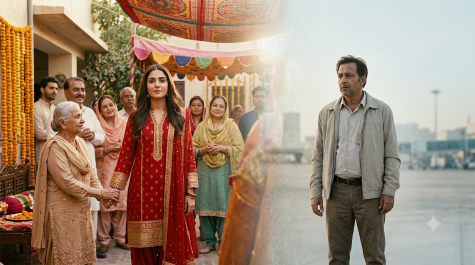
This story follows a daughter who reclaims her dignity from the shadow of a father’s lifelong neglect.
By Mohammad Ehsan Leghari
Hassan sat alone in the canteen of the Arts Council, Karachi. Evening had settled over the building like old debt. The canteen carried its usual exhaustion; plastic chairs dragging against the floor, spoons striking chipped cups, waiters moving with the tired rhythm of men who had stopped expecting kindness from the day. On one open side of the canteen, an old black table fan groaned like an aging witness forced to repeat the same testimony forever. Outside, Karachi roared impatiently. Inside, Hassan waited for tea.
His phone lay on the table before him, screen glowing upward like an accusation. He had already read the message at least ten times.
“Uncle, you don’t know how difficult it was to get your number. I am the daughter of Mohsin… your friend… who lives in the USA now. Please call me whenever you can.”
Hassan was not a habitual smoker. But anxiety had a way of manufacturing rituals. Whenever restlessness tightened around his chest, he convinced himself that a cigarette would untie the knot inside him. It never did. Three cigarettes later, the anxiety remained. Only the bitterness deepened. The tea arrived. He called the number.
—
The girl spoke softly, carefully, as though life had taught her that every sentence must walk barefoot to avoid hurting others. She sounded educated, composed; someone who had learned dignity from surviving humiliation quietly. There was no anger in her voice. That disturbed him more than anger would have.
“Uncle,” she said gently, “I only need one favour.”
She wanted her father to come to Pakistan, only for a day or two. Her rishta was being finalized. The family wanted elders present. According to their tradition, her father should sit there, should speak for her, and should give his consent. In Sindh, such things still mattered. A daughter’s marriage was not merely paperwork. It was recognition. Presence. Respect. A father’s silence in such moments echoed louder than speeches.
“He can leave immediately afterward,” she added quickly, almost apologetically. “I am not asking him to stay. He can return to his wife.”
That word stayed with Hassan. Wife. Not our family. Not home. Just his wife.
“How long has it been?” he asked.
A faint laugh emerged from the other side. Dry. Empty.
“Maybe I was three when he left,” she said. “I am twenty-six now. In twenty-three years… I have probably seen my father less than twenty-three times.”
The noise of the canteen seemed to fade.
“We never demanded anything from him,” she continued. “Amma made sure we studied. Whatever we became, it was because of her. He used to send money sometimes — peanuts, really. But Amma never allowed us to hate him.”
She paused.
“She never once spoke his name. Twenty-two years. He was only ever ‘your father.’ Even at the end, when she had every right, she only said: tell your father I forgave him.”
Another pause.
“I never got the chance to deliver it.”
Her voice did not break. That was the frightening part.
“Every morning she ironed my school uniform. Even on the mornings she could barely stand. I only understood later what that cost her.”
She was quiet for a moment.
“I remember one Eid — she had been saving for months without telling us. She stayed up the whole night before to fix the border on my kameez because the stitching from the shop was not quite right. In the morning she said she had slept well.”
“She raised us twenty-two years alone, Uncle. She did not rest until there was nothing left of her to rest.”
“My mother died last year.”
“I’m sorry,” Hassan whispered.
“He came for ten minutes.”
The words landed without emotion, which made them unbearable.
“Ten minutes,” she repeated. “For a woman who spent her entire life building his.”
Hassan remembered Mohsin then; not this distant American shadow, but the young man from university days. Thin. Ambitious. Brilliant. Always quoting poetry. Always speaking about revolution, humanity, justice. Always poor. And always dependent on the wife he later abandoned.
“He used to say Amma was not compatible with him,” the daughter continued. “That she was older. Uneducated. No aesthetic sense. He once told someone: I am a writer. My emotional and intellectual needs were different. I would have been destroyed if I had not married again.”
She paused.
“He writes about emotions now,” she said softly. “About love. About Sindh. About the pain of ordinary people.”
Another pause. Then, very quietly:
“What about his own daughter, Uncle? And what about the woman who stood beside him when he had nothing?”
When the call ended, Hassan lit a cigarette immediately. Then another. Nothing eased.
—
The call to America connected after the third ring.
“Hassan!” Mohsin’s voice arrived warm and confident. “You still remember old friends?”
“And you still remember old lines,” Hassan replied.
Mohsin laughed. For a while they spoke about safe things — books, politics, old hostel memories, dead poets who once seemed immortal. Mohsin recited verses from memory, savouring each word like a man admiring himself in a mirror.
“We believed literature could change society,” Mohsin said nostalgically.
“I also remember,” Hassan replied quietly, “that we believed writers were better human beings.”
A brief silence followed. Then Hassan said:
“I received a message from your daughter.”
Everything stopped.
“You spoke to her?” Mohsin asked carefully.
“For almost an hour.”
Mohsin exhaled slowly.
“She wants you to come,” Hassan continued. “Just for her engagement. One or two days.”
“These traditions are exhausting,” Mohsin replied.
“For whom?” Hassan asked.
No answer came.
“She did not ask for money,” Hassan said. “She did not complain. She only wants her father to exist publicly for a few hours.”
“You don’t understand my life,” Mohsin replied defensively. “I was suffocating in those years.” His reply was different than what Hassan asked him.
“I remember those years very clearly,” Hassan said. “I remember who paid your university fees when you couldn’t.”
“That marriage would have destroyed me,” Mohsin snapped. “I needed intellectual companionship. I was a writer.”
“Yes,” Hassan replied softly. “You already told the world that.”
Silence thickened between them. Then Hassan spoke again, slower this time.
“She asked me one question, Mohsin. What about his own daughter?”
Mohsin said nothing.
“I am not asking you to repair the past,” Hassan continued. “Some ruins remain ruins forever. I am only asking you to arrive once. As a father.”
A long pause.
“Let me think,” Mohsin said at last.
“Please think quickly,” Hassan replied. “Children do not remain standing at the same emotional doorstep forever.”
The call ended without commitment.
—
That night Mohsin stood at his apartment window. America outside; orderly, clean, indifferent to everything that had just happened in that phone call.
He had been twenty-three when they married. She was twenty-seven. He remembered thinking, even then, that the poverty was temporary. A man with his mind, his words, his sensitivity; this was not his permanent life. He had not been wrong about that.
He remembered the fees appearing. The food. The clothes washed without comment. The weight carried by hands that never asked to be thanked.
He moved past this the way you move past a room in a house you are trying to sell.
That was survival, he told himself. Not love. He had said it so many times it had become indistinguishable from truth. His second wife was demanding and controlling, he knew this, but she understood his world; his books, his hours, his silences. That was compatibility. That was what he had needed and been right to need. He did not ask himself what it had cost. He was skilled at not asking.
Before he went to bed, he opened his desk drawer. There was a photograph — his daughter at perhaps two years old, sitting on someone’s lap. He did not remember whose. He closed the drawer.
He slept.
—
Days passed, then weeks. One evening he mentioned the matter casually to his wife.
“My daughter wants me to visit Pakistan.”
She continued scrolling through her tablet.
“You are too busy right now,” she replied flatly. “Besides, we already planned Europe with my sister. You need to be here.”
That was all.
—
Back in Sindh, his daughter understood the silence. Silence also answers.
She called her fiancé.
“Come with your elders,” she said calmly.
Then she informed the relatives who had truly raised her; maternal uncles, cousins, aging elders who had carried her mother’s weight without ever announcing it. Hassan came too, with his wife. The village house filled slowly. Tea circulated. Voices softened respectfully.
At last, she stood before everyone.
“You all know my mother has passed away,” she began.
Heads lowered.
“My father has also died.”
No one interrupted. Not because they misunderstood; but because they understood completely.
“I give my maternal elders the right to speak on behalf of my family,” she said steadily. “You may accept this proposal or refuse it. I will respect your decision.”
The room held its silence. But it was not shameful silence. It was dignified silence. The proposal was accepted. Her marriage was fixed. No tradition collapsed that day. Only responsibility changed hands.
—
Weeks later, Mohsin’s wife placed some property documents on his desk.
“Go to Pakistan,” she said. “The ancestral land issue must be settled.”
The dates were the same days. The days of the wedding. He looked at them for a long time. He did not ask her how she had chosen them. There are questions a man does not ask because the answer matters less than what the asking would reveal.
—
He arrived quietly. No one waited at the airport. No relative called. The village felt smaller than memory; narrower, older.
He found her in the courtyard among wedding preparations. Women laughed nearby. Bangles clinked. Someone carried trays of sweets across the veranda. Life moved forward without consulting grief.
She looked at him calmly. Not angrily — that would have required attachment.
“I am….” Mohsin could not complete sentence.
“Sir,” she said politely. “My father has died.”
The word sir struck harder than abuse.
“And I do not know you.”
For the first time in many years, Mohsin found himself without language. No poetry arrived. No ideology defended him. No sophisticated explanation rescued him from the plainness of truth. Around him the wedding continued — laughter, instructions, bangles clinking — the sounds of a family that had already, quietly, permanently arranged itself without him.
A man can write his whole life about human feeling and still arrive at his own daughter’s door a stranger. He had written the feeling. He had not lived it. And there is no second chance for that. A man can win every argument against love and still arrive too late to be remembered as a father.
Read: The First Time – A Short Story
_____________________
 The author is a water expert, former Sindh member of Indus River System Authority (IRSA), and a prolific writer


