Pakistan’s education debate often revolves around the 25.3 million out-of-school children aged 5–16, with Sindh accounting for almost half. But Functionally Out-of-School Children show us that the real crisis is even deeper
11,000+ schools in Sindh are non-functional due to lack of staff or infrastructure. 40% of teachers in rural areas are frequently absent.
Muhammad Mikail
Who are Functionally Out-of-School Children?
They are enrolled on paper, counted in statistics, and celebrated in reports, but in reality, they are absent from classrooms and excluded from non-formal education. Sindh’s education crisis is deeper than we admit.
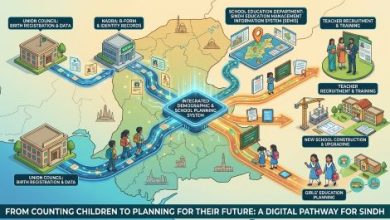
During fieldwork in a Tharparkar village, I came across a puzzling situation. The Non-Formal Education (NFE) center in that community, set up by DL& NFE, Government of Sindh, to serve out-of-school children, had low daily attendance; barely 15 to 20 students. Yet as I walked through the village, I saw dozens of children loitering in the streets, working in the fields, or simply idle. When I asked the NFE facilitator why these children weren’t in the center, her answer revealed a much bigger problem. “Most of them are already enrolled in government schools. On paper they are students, so we can’t admit them here as per enrollment guidelines set in NFE policy. But in reality, they haven’t attended school for years.” This gap between numbers and reality is what I call ‘Functionally Out-of-School Children’ (FOOSC). They are technically counted in enrollment statistics, but they are not learning. They remain invisible to both formal schools and non-formal centers—and the system has no plan to even identify them.
The Numbers We Don’t See
Pakistan’s education debate often revolves around the 25.3 million out-of-school children (OOSC) aged 5–16, with Sindh accounting for almost half. But FOOSC show us that the real crisis is even deeper. Sindh’s education department reports enrollment rates of over 57% in rural areas. Yet surveys paint another picture:
- 11,000+ schools in Sindh are non-functional due to lack of staff or infrastructure.
- 40% of teachers in rural areas are frequently absent.
- 58% of schools lack usable toilets, while nearly half have no electricity.
- Girls often drop out after primary school because 90% of villages have no middle section nearby.
In such conditions, enrollment becomes meaningless. A child’s name may exist in a register, but the child does not exist in the classroom.
Lost Twice Over
NFE centers were meant to be a lifeline for children excluded from formal schooling. Sindh has established over 500 NFE centers, aiming to serve 15,000 children through flexible, community-based learning. They are innovative spaces, often with better attendance than government schools. But the policy rule that NFE centers cannot admit children already “enrolled” in school has turned into a trap. FOOSC; children who are enrolled on paper but absent in practice, are denied entry. They are counted once in schools where they do not learn, and rejected again from NFE centers where they could have learned. In Tharparkar, facilitators estimate that more than half of the out-of-school children identified in villages fall into this FOOSC category. It is a silent crisis, absent from reports, but evident in every community.
Why Children Become FOOSC
The reasons are depressingly familiar:
- Closed schools: Thousands of government schools exist only in name.
- Teacher absenteeism: In some villages, the teacher shows up once a month.
- Poor infrastructure: No roof, no toilets, no electricity; making attendance nearly impossible.
- Poverty: Families enroll children to access stipends, but send them to fetch water or work in fields instead.
- Gender barriers: Girls may be enrolled at primary level but are withdrawn after class five due to lack of middle schools or unsafe transport.
Each of these factors produces the same result: children appear in enrollment statistics but vanish from actual learning.
The Cost of Paper Enrollment
This inadequate picture of progress comes at a high price. Governments claim success in raising enrollment, while ignoring dropouts in disguise. Donors and NGOs are misled, directing funds to enroll “new” children while FOOSC languish. NFE centers are under-utilized, even though villages are full of children who need them due enrollment policy deadlock. Most importantly, children lose their futures, locked in a system where their education exists only in reports. The cruel irony is that the very rule designed to prevent double-counting ends up double-excluding FOOSC.
Recognizing FOOSC as a Category
The first step is simple; official recognition. FOOSC must be counted as a distinct group in education statistics. Without recognizing and naming them, we cannot plan for them. Second, enrollment data must shift from being about registration to being about attendance and learning. A child who has not attended school for six months should no longer be considered “enrolled.” That would free them to enter NFE centers where they could actually learn. Third, NFE policy must adapt. If a child can show consistent non-attendance, they should be allowed to join NFE; even if they are technically still on a school roll. This flexibility would allow thousands of FOOSC to be rescued. Finally, community monitoring is essential. School Management Committees (SMCs), local youth groups, and NGOs can verify attendance and identify FOOSC at the village level far better than centralized databases.
Beyond Counting, Toward Learning
The Functionally Out-of-School Child is the most painful symbol of our education system’s disconnect from ground realities. These children are celebrated as “enrolled” in official records, and speeches, but in truth they are neither in school nor learning anywhere else. In Tharparkar’s villages, you can see them sitting idle outside shuttered schools, or wandering through fields when they should be in class. They are counted, but not educated. Enrollment is not education. Until we close the gap between the two, Pakistan will keep losing generations of children to the shadow world of FOOSC; the children present in numbers but absent in education.
Read: Quiet Intellectuals, Falling Education in Sindh
___________________________
Muhammad Mikail is Manager Reporting and Communications at the Thar Education Alliance. He is a development professional and research scholar with a postgraduate degree in SDG-6 (Water and Sanitation). He has previously worked with MUET, HANDS, and the World Bank.