Didda was an exceptionally intelligent woman. Having moved through countless blows and counterblows since birth, she had learned to understand human nature with ease.
Maharani Didda: Witch Queen of Kashmir
By Debasree Chakraborti
These days, nothing feels right. Swept along by the current of life’s changes, how profoundly she has been transformed! This is not the life she wanted. Instead of jealousy, hatred, and bloodshed, she had longed for a beautiful life—one where she could live in peace, surrounded by the love of her own people. Yet, at every step of her life, in trying to prove herself, her two hands have become stained with blood.
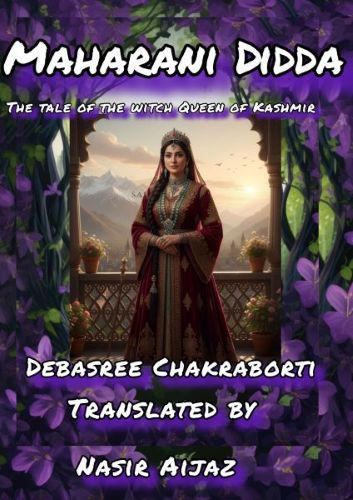 Inside Didda’s palace lies a pool paved with white stone. Ever since her return to Srinagar, she has loved spending most of her time by this water. In the darkness of night, holding a torch, she sees her true self reflected on the surface of the pool. How deeply life has changed her. At birth, her parents abandoned her; her own relatives looked upon her with hatred. As she grew older, the people around her began to view her with ridicule. She has remained a beggar for love all her life. While she gave love to everyone, she too yearned to be loved. Yet, apart from Bhalaga, no one ever truly loved her.
Kṣemagupta gave her a place in his family because he loved her beauty and youth. The queen mother loved her because she gave the dynasty a crown prince. Had she not been beautiful, Kṣemagupta would never have placed her on the throne as his queen. And had she not given birth to the prince, the queen mother herself would have driven her out of the palace. She has done no little for the welfare of Kashmir, yet simply because she is a woman, the Kashmiris have not deemed her worthy of the throne. Despite being her father’s eldest child, she was deprived of his throne solely because she was not a man. Though she possessed all the qualities of a capable ruler, she could not attain that position. And yet, the responsibility of protecting the kingdoms of her husband, her father, and her uncle was placed upon her shoulders.
At every stage of her life, everyone has used her. No—Bhalaga never used her; he bound his entire life with Didda’s. Vikramasena? He too never loved Didda selflessly. He sensed her inner strength. Physically disabled, yet endowed with such extraordinary power—he understood that if a princess like her were given proper training, her virtues would one day be celebrated. Thus, whatever he did for Didda, he did entirely for his own purposes. Even her son Abhimanyu never thought of his mother. He has always been driven by his own self-interest.
At no point has he felt the urge to come to his mother and share his thoughts or feelings. In this way, under the relentless pressure of duty and the compulsion to prove herself, she is slowly transforming from a human being into a mechanical figure. Didda sat with a torch in her hand, gazing at the water, lost in these thoughts.
Then, as she plunged the torch into the pool, darkness spread all around. A faint light filtered in from another part of the palace, creating a dim, half-lit atmosphere. Having extinguished the torch, she lay down by the edge of the pool. A cascade of her hair was submerged in the water, while she pressed both hands against her chest and wept silently—no sound could be heard.
Only a thin stream of water flowed from the corner of her eyes.
At that moment, a shadow appeared on the distant wall. Though the shadow was far away from Didda, it was remarkably still—such a slow, steady presence is rarely seen.
For on the stage of life, many such shadows appear, only to vanish within moments. But this shadow seemed determined to claim an important place on the stage of Didda’s life; hence its resolute stillness.
Just then, the evening aarti began at the temple of Mother Bhavani. Hearing the sound of the bells, Didda sat up and began wiping her eyes with the end of her sari. At that moment, a voice called out from afar, “Maharani, I wished to speak with you.”
From the voice, Didda understood that Naravahana had arrived. Composing herself, she said calmly, “Yes, please come in.”
Using her sari to cover her wet hair and body, Didda rose from the floor and seated herself on a nearby cushioned chair. She gestured for Naravahana to sit on another chair placed at some distance. Naravahana took his seat and sat for a while with his head bowed.
Between the two of them, amid the silence, only the ringing of the temple bells could be heard. After some time had passed thus, Naravahana spoke, “Maharani, you yourself are Mother Bhavani incarnate. Yet power is incomplete without Shiva—this you too acknowledge, do you not? Tell me.”
Didda was an exceptionally intelligent woman. Having moved through countless blows and counterblows since birth, she had learned to understand human nature with ease. From the very tone and intent of their words, she could discern what others truly wished to say. And so she She said, “No, I do not consider myself incomplete at all. I have walked this path alone all my life; I have never needed any Shiva.”
Naravahana exclaimed in astonishment, “And the Maharaja? Was he not needed in your life?”
Didda replied, “In his life, my presence was needed the most.
Even if your Maharaja had not come into my life, I would have lived on. But had I not entered his life, Kashmir would not have received a crown prince, nor would it have been freed from many of its troubles.”
After a pause he asked, “After the Maharaja’s death, do you not feel lonely? Do you not long for the love of a man?”
A crooked smile appeared on Didda’s lips. She said, “I have always been alone; therefore, this question does not apply to my life.” Without answering Naravahana’s next question, Didda rose to her feet and then said, “Each of us is surrounded by a Lakshman Rekha. Crossing that line is absolutely inappropriate. Now you may leave.”
Naravahana was deeply hurt by Didda’s final words. He had never imagined that the queen he had supported all his life—the woman whose backbone he believed himself to be—would reject him in this manner today.
As Naravahana hurriedly left Didda’s palace, Didda returned to her bedchamber, where Bhalaga was preparing her bed. Bhalaga noticed that Didda seemed highly disturbed. He understood the movements of her mind intimately, and as he stepped forward to embrace her, Didda burst into sobs.
Bhalaga knew that Didda was not someone who broke down easily; something must have happened that had wounded her deeply. After crying for a while, Didda went and sat on her bed. Bhalaga sat facing her without saying a word. Wiping her eyes and regaining some composure, Didda said, “Bhalaga, can anyone believe that a woman can be complete in herself, without a man…? …do not want to accept it. Power (Shakti) is incomplete without Shiva, but Shiva too is incomplete without Shakti—yet no one wishes to acknowledge this.
When Didda fell silent, Bhalaga said, “What has happened? Open your heart to me; you will find peace.”
It was as though fire was now blazing from Didda’s eyes—there was a clear display of resolve and self-confidence. She looked at Bhalaga for a while and then said, “I thought Naravahana was different from everyone else. But he too considers me weak and wants to settle his own calculations accordingly.
Now he wishes to become my Shiva and complete me. That can never be possible for me. It means that whatever he has done for me all this time was entirely driven by purpose and self-interest, not by duty or love for his motherland.”
Understanding the essence of Didda’s words, Bhalaga replied, “But at times, even when we understand the truth, we must remain silent. You are still surrounded by enemies, and Naravahana is your principal ally. Therefore, I believe it is inappropriate for you to disregard him at this moment.”
Didda said firmly, “Do you too consider me weak?”
“Not weak, Maharani—this is politics. Sometimes, for one’s own interests, one must use certain people.”
“No, Valaga. I truly need no one. I am governed by my own will. I will not hand over control of my life to anyone. I will establish this truth in society—that a woman can be complete in herself.”
The next day, Didda appeared in the royal court alongside Maharaja Abhimanyu.
Naravahana was also present along with the other courtiers. It was well known that Didda usually followed Naravahana’s counsel in all matters and that she discussed every decision with him before acting. But from that day’s assembly onward, Didda began to create a distance from Naravahana. Whenever a decision had to be taken in the court, she took it herself, without even glancing in Naravahana’s direction. This did not escape the notice of the courtiers, and whispers and mockery soon began to circulate over the matter. Because the Maharani had long given importance to Naravahana, a muted jealousy had existed in many hearts, and now they began to express it openly. These taunts and mockery fell with devastating force upon Naravahana as well. For so long he had been the most important courtier in the Kashmiri court, the man whom everyone regarded as the queen’s backbone. People believed that the governance of Kashmir was, in effect, run by Naravahana himself. And now, here was his humiliation. The queen had, in a sense, cast him aside. Naravahana understood all too well that he would never again regain his former status, honor, or position.
And a life stripped of honor and dignity was not one he could bear. Thus, he chose death as his final refuge. Gradually, everyone stopped inquiring about him, for he had become unnecessary to all. After being absent from the royal court for several days, one day Maharani Didda made inquiries and learned that he had not left his chamber for quite some time. This news deeply unsettled Didda. Accompanied by guards, she struck repeatedly at the closed door of Naravahana’s chamber; when it still did not open, she ordered it to be broken down. When the door was forced open, Naravahana’s hanging body was found inside the room.
News of Naravahana’s suicide spread rapidly throughout the kingdom. Soon after, the people began to weave all kinds of lurid tales about Maharani Didda and Naravahana, turning them into objects of mockery and scandal. These stories spread like a storm in all directions, and even Didda’s relatives, close kin, and even her son began to believe them. Some claimed that Naravahana had taken his own life because he could not bear the queen’s alleged infidelities with various men. Others said that the witch-queen herself had murdered her lover and hung him. When such words reached Didda’s ears, she grew even harder in spirit. No emotion—no feeling, insult, or slander—seemed capable of affecting her anymore. Once again, the truth stood reinforced: society can never accept that a woman can be complete in herself.
Didda now began to contemplate marrying off Abhimanyu, placing a new queen in Kashmir, and thereby withdrawing herself from all responsibilities and duties. (Continues)
Click here for Part-1, Part-2, Part-3, Part-4, Part-5, Part-6, Part-7, Part-8, Part-9, Part-10, Part-11, Part-12, Part-13, Part-14, Part-15, Part-16, Part-17, Part-18, Part-19, Part-20, Part-21, Part-22,
______________________
 Debasree Chakraborti is a renowned novel writer of Bengali language. Based in Kolkata, West Bengal, India, she has done Master’s in Modern History from the Kolkata University, and authored some thirty books, mostly the novels, with historical perspective and themes. Her novel is ‘Maharaja Dahir’ that covers the history of Sindh from 662, the year of first attack on Sindh by the Arab armies till date, was published last year and translated by Nasir Aijaz into Sindhi language.