Not all eggs in one basket
Diversification of strategies and the lesson from US-Iran war

“In the current era of modern hybrid warfare, forging multilateral defense alliances would not only help to counter the ever evolving threats but would also offer tailored and targeted support.”
Momina Khan
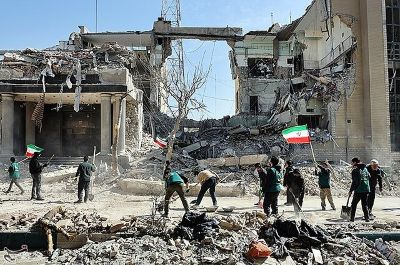
One of Richard Paul Evan’s iconic line, where he states, “Any time you put all your eggs in one basket, you’re just one stumble away from catastrophe” is not only relatable with regards to the Middle East’s long term dependence on the United States as their chief security provider but at the same time also serves a clear warning against excessive reliance on a single source. Gulf States deep dependence on America has been significantly shaken while experiencing the heaviest consequences of the current US Iran war. The unsettling images of missile and drone attacks across the region is a somber documentation of the conflict’s impact and this destruction of critical infrastructure, including army bases, energy power plants and civilian amenities coupled with the unfathomable loss of life has deeply scarred the Middle East.
Although the Gulf States have been successfully averting these missile attacks by using the highly effective American air defense system, yet ironically these retaliatory attacks by the Iranian regime are a result of a war, which was triggered by the US itself. Oddly enough, Arab world ‘s primary security provider tends to be responsible for dragging the entire region into an unnecessary conflict, as the current President of Germany Frank-Walter Steinmeier has rightly put it by stating that, “This war is a violation of international law- there is little doubt about that. It is also a politically fatal error, and what I find most frustrating is that it is an avoidable and unnecessary war if its goal really was to stop Iran on its path towards a nuclear bomb.”
These unpredictable times marked by geopolitical uncertainty across the region require a shift from the previous strategy of over dependence on the United States to embracing regionally oriented security setups. For this purpose, an effective security framework with regional states which tends to not only address potential threats but also offers a comprehensive and balanced defense partnership is highly desirable. Meanwhile security agreements and defense modernization deals with global defense partners both for defensive and offensive operations can ensure long term safety from existential threats.
Recently Ukraine’s President has signed air defense deals with UAE, Qatar and Saudi Arabia which mainly addresses the threat of incoming missiles and drones from Iranian side. Iran’s latest strategic approach of launching wave upon wave of missiles has the capability to overwhelm even high cost American air defense system. Amidst this critical scenario, the Ukrainian interceptor drones tend to be relatively cost effective alongside having a history of downing Iranian -Russian drones, thus allowing Ukraine to leverage its anti-drone expertise in order to help the Gulf Arab states.
Meanwhile a mutual defense agreement between Saudi Arabia and Pakistan which was signed in Riyadh in September 2025 aims at strengthening joint deterrence, thereby reflecting a thriving multipolar strategic environment.
The latest meeting between Qatar’s Emir and the British defense secretary on the 30th of March 2026is a continuation of a pact which was formalized in October 2025.
Growing alarm and frustration over America’s security guarantees has forced the Arab allies to reconsider their complete reliance on the United States and contemplating the option of diverse strategic partnerships.
Since the beginning of the war, the Islamic Republic has launched approximately 4,000 drones and missiles at the neighboring Gulf States, as a strategy of damage intended to put pressure on all GCC states coupled with a widespread impact on global economies. These relentless attacks on the energy infrastructure have not only exposed the limits of US defense guarantees in the Gulf but have also sent shock waves across global energy markets. American military presence across the gulf has made the region a prime target of Iranian aggression, yet has failed to protect their territories.
Amidst growing frustration with America over the Iran war, some GCC officials have also suspected that the US prioritized Israel’s security over the Gulf States. Former Saudi intelligence Chief Prince Turki Al Faisal has been a vocal critic of America’s bias towards the Israeli state. He argued that the Israeli Prime Minister ‘somehow convinced’ the President Trump to wage war against Iran.
In Islam, Muslims are encouraged to adopt diverse ethical strategies to achieve success accompanied by complete trust in Allah and while facing obstacles a believer should be flexible, hence embracing necessary revision and modification. During the battle of Trench which took place in 627 CE, Muslims adopted various strategies of psychological warfare, diplomacy, resilience, innovation and active defense along with solely relying on almighty Allah. Middle East’s deep reliance on the United States for defense has been exposed during the current US-Iran war, triggering concerns across the region. The way forward would encompass a rather diversified approach in defense against complex security threats.
“In the current era of modern hybrid warfare, forging multilateral defense alliances would not only help to counter the ever evolving threats but would also offer tailored and targeted support.”
Read: Concept of Mercy in International Relations
__________________
The writer is a freelance journalist focusing on politics, international relations and tourism.