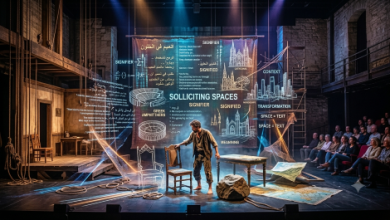
Studies indicate that painters and poets can jointly observe their sensory experiences through the eye, from which the sense of sight arises
Souad Khalil | Libya
Studies indicate that painters and poets can jointly observe their sensory experiences through the eye, from which the sense of sight arises. This is considered the first step in creating artistic images in their works, as well as through sensory perception, meaning our awareness of the world around us relying on the information we receive through our senses. The sense of sight holds particular importance compared to other senses in shaping the painter’s perception, making it difficult to forgo in presenting visual art. In contrast, the same importance is not ascribed to the poet unless their sensory perceptions focus on forming visual images in their poems. However, it increases significantly when the motive behind invoking these visual images is present.
On this dual vision between poetry and visual art, Dr. Ahmed Jarlallah Yasin wrote a study that we will rely on in this article. He states that ideas often emerge in the form of stimuli and situations with specific artistic significance, serving as the starting point for the poetic text that harbors intentional aims to simulate the act of painting and to employ techniques and artistic elements that bring the poetic image closer to that of a visual painting.
 The eye is not just a regular device for reception; it is an artistic shaping tool that elevates perceived images beyond mere automatic visual transfer, which anyone can practice within their normal perception of the things around them. In the realm of artistic perception of the world, one does not only need to look around but must learn to “see” with a sculptural imagination. This is characteristic of the sharp-eyed, observant individual who is directly provoked by the external world and sensory perception. From this perspective, it is crucial to emphasize that creative perception processes differ from ordinary perception processes, as creative perception is typically directed at discovering the distinctive and the new. It is also characterized by action, inclusiveness, and comprehensiveness.
The most significant aspect is that the artist’s perception of the surrounding world affirms the aesthetic proportions within it that only the artist’s discerning eye can capture, always alert to seize beauty wherever it may be. We should also emphasize that, although the sense of sight has a leading role in the perception process during shaping, it is not the only factor. It intertwines and connects with other senses, generated by other organs beyond the eye, since any partial sense is merely a front point of a comprehensive activity involving all organs.
Thus, the visuals in the poetic image may relate to other qualities that originally belong to sounds, tactile sensations, etc. The same applies to visuals in a visual painting; in every art form, all senses are intertwined, yet there remains a priority in prominence.
Materiality is not a necessary condition for the perceived object chosen for reshaping into a new visual image, whether in poetry or painting. It is also possible to benefit from immaterial things such as abstract concepts, which we imagine in the forms of the conditions applicable to them. In fact, it seems that we cannot think of the abstract or the immaterial without relating them to sensory perceptions connected to them in one way or another. Therefore, the abstract concept can become an object of our imagination and embodied in a sculptural image within poetry or painting.
The initial concepts arising from sensory perception and presence are not sufficient to draw the final image in the artist’s consciousness and imagination unless they are integrated with the element of personal experience rooted in memory. The experiences of past observations stored in memory significantly contribute to forming perception and its ability to gather sensations to create a meaningful form, which is presented in its final image to the recipient through the artistic work. (The artist, whether a poet or painter) creates unreal mental images from the many sensory perceptions previously acquired, as they establish those imaginative images by selecting from the various remembered perceptual components and linking them to the immediate perceptual images encountered during their imaginative work.
 The image of memory in the artist is the decisive factor in transforming the absorbed object into an artistic image, wherein the shape is distorted and reshaped, merging the image of the perceived reality, selected and transformable from the perceived object, with the imagined memory of that object or its relation. At this stage, the process transitions from the interaction between the absorbed environment and the psyche to a complex interaction of images within the artist’s consciousness, enriched by accumulations of experience, memory, and imaginative capacities. For this reason, Jarlallah referred to it as the “transformative device,” as the merging of the images of reality and memory, after being represented in the artist’s consciousness, happens under a transformative impulse within the artist, powerful enough to transfer the composite image into a distinctly separate realm from the “reality” of the absorbed environment—when it imbues it with new attributes, as Breton mentions in “The Kingdom of Transformations.”
If we want to illustrate this with an example in the poetic realm, we might cite the words of Yusuf Al-Sayigh: “Her bag was between us. The cat’s hair was black.” The poet, by virtue of his sculptural sensitivity as a painter, selects from the comprehended image of the perceived object (the bag) two transformable aspects (the color black, and the small size of the bag resembling the cat’s size), merging them with some related memory image, enriched with past residues of shapes, colors, and sizes to produce a third image with a sculptural symbolic feature, transformed from the two images (the image of the perceived object and the memory images) into the image of the black-haired cat. This indicates that the components of the shape, when stripped from the absorbed object, must reunite with other elements from memory images to form the artistic image.
In visual art, we can cite Picasso’s opinions when explaining his drawing approach, which relies on the concept of transformative sensory perception. Picasso believes that while he may want to draw a head, he ends up with an egg, and even if he starts drawing the gap between the two, he is not satisfied with either, regarding the relationships with significant differences—meaning the unexpected relations between the images of the perceived objects in reality and their representation in the artistic work. Thus, he emphasizes the dissimilarity between the two images, asserting that his goal is to place the objects in such tense, contradictory relationships, as they generate the moment of artistic pleasure from his perspective.
The tension Picasso speaks of is the same tension that creates the imagery of the image in poetry. It is in the same sense that Kamal Odaib defines the term “poetics” as a function of what he calls the gap or the tension space that arises between objects and their relationships in the context of the poem, giving a new poetic existence. Just as Picasso integrates the perceived head with the egg shape, merging it with related memory images, which seemingly favored the egg image for this task due to its oval shape close to that of the perceived head, thus creating a gap between the two realities and their forms, resulting in a poetic tension in the space separating the two images.
This closeness between artistic and poetic concepts is also evident in Picasso’s discussion of using newspapers and pasting them in a collage manner in cubist paintings, where he states: “The newspaper page was never used to make a newspaper; it was used to become a bottle or something similar. It was never used literarily but always as an element removed from its usual meaning to transform into another meaning, generating a shock between the ordinary meaning at the starting point and its new definition at the endpoint.”
Meanwhile, Salvador Dalí explains the idea or origin of the melting clocks in his famous painting “The Persistence of Memory,” stating that it occurred to him while sitting and eating soft cheese. In other words, he selected or borrowed from the perceived shape of the cheese the aspect of its softness, which materialized after merging with memory images and their surreal imaginative implications into the image of soft, melting clocks.
Returning to poetry, we find that metaphor, like the transformative sensory perception of the painter, reveals another centered reality with deeper new significances. For instance, Yaseen Taha Hafiz employs metaphor to express the sculptural nature of his visual perception, which he transforms with vibrant colors into a rose after dismissing its realistic image.
This study by Dr. Ahmed Jarlallah Yasin, published in Al-Rafid magazine, is significant as it references various books and research, demonstrating the creative closeness between the visual artist and the poet and how they draw inspiration from their paintings and poems. He states that sometimes the poet provides a verbal definition of the thing that the painter might represent with line and color, and both, in their respective styles, reflect the form the artist seeks without interruption. However, it should be noted that this transformation, sometimes referred to as distortion or deviation in depicting the image, whether in poetry or painting, does not always occur to the same degree in terms of how far the new image diverges from the perceived reality. It remains governed by varying degrees of deviation from one image to another, where the degree of deviation at the formal level may not exceed a simple level, as seen in metaphorical poetic images or in painted images rendered in an academic style in visual paintings, where it is hardly easy to discern the extent of the deviation of their artistic elements from reality due to the closeness of the space between their reality image and their current image in the painting.
In contrast, what we see in modern methods of forming poetic or artistic images is that the resulting image from the artist’s interaction with the elements of reality may seem distorted due to exaggerated degrees of deviation, to the extent that we might think the poet or artist is tampering with their images of nature and actual things. We may label this tampering as “distortion.” The actual truth appears incomplete or even false before us; however, the reality is that there is no distortion or falsification because it is not necessary for the world of sentiment to be identical to the world of facts, which explode with their different implications under the projective force of sentiment.
From all this, we conclude that art is the crafting of forms that express the nature of human sentiment. We can also say that “the artist is simply a person with the ability and desire to transform his visual perception into a material form.” The first part of his act is perception, and the second is expression, and it is practically impossible to separate these two actions: the artist expresses what he perceives, and he is aware of what he expresses. Artistic expression, when at its peak of creative energy, revealing another reality, carries the act of “visual sight” with much broader semantic dimensions than merely linking its physical concept to the material act of sight, even though this act is the first step where poet and painter can meet and later exchange influences between their artistic works in various ways.
This shared rooting of what is possible constitutes one of the key points of initial convergence between the poet and the painter at the threshold of vision, which is inseparable from its material manifestations, whether in the painting or the poem. We acknowledge that the artist creates in this way or that his artistic image even before he begins his direct work with the material; he creates it in his imagination. Yet this imaginative creativity is closely tied from the outset to perceptions of colors, lines, shapes, and sounds through which the image is later embodied, and all of this equally pertains to the art of words. The image and its elements cannot appear and evolve far from the word and the verbal material. At the same time, this central characteristic of the image, which is inseparable from it, presents itself in the art of words with the same clarity and certainty found in the art of painting, given its direct visual representation in displaying and depicting images.
In poetry, there are symbolic connections between language and the visible, perceived objects in reality, as one of the primary functions of language is to name the units that vision cuts out, aiding in their delineation. One of the functions of sight is to establish semantic formations for language and to inspire them as well.
 Thus, we see through this study that the preceding discussion, with its various nuances, addresses the subjective visual sensory perceptions of the artist (the poet, the painter). However, the artist is not merely a tool connected to a sensory organ capable of perceiving the external world visually. He is also a human being belonging to a specific era, class, and nation, possessing a particular temperament and disposition, all of which play a role in how he writes, feels, paints, and perceives the world.
Just as internal factors stemming from the artist’s self significantly influence the crystallization of his visual vision and how he shapes his perceptions of the elements of reality, external factors also impact it in one way or another. However, the artistic materials themselves, which will form the structure of the artistic image in both the poem and the painting governed by the fundamental rules of their artistic genre, have a critical and greater impact on that vision, the way it is perceived, and the extent of its effectiveness and dynamism.
The immediate visible nature of the compositional display in the painting places the sense of sight at the forefront during perception. In the context of a style that emphasizes the details of shapes, such as in academic styles, this nature requires the visual monitoring and recording of many perceptible visual elements from the object to an extent that may rival the camera’s eye.
When a painter visually perceives the image of a house or recalls it entirely from the reservoir of his sculptural imagination and previous perceptions, he can, during execution, depict and showcase more than one visual and compositional element of this house, such as the door, windows, areas of light and shadow, colors with their various characteristics, the outer lines of the shape with its details, its location in space, size, and the geometric dimensions of its design. Moreover, the way the brush is used and its strokes will leave a sculptural effect through the thickness or transparency of the paint or through a specific direction of brushstrokes, whether in spots, slanted lines, or circular patterns, etc. These details often appear spontaneously in the painter’s hand due to his knowledge of the visual requirements of his art and the stylistic familiarity he practices in drawing.
In contrast, the poet suffices to express the presence of the compositional shape (the house) by mentioning the linguistic symbol indicating it, backed by the prior intention for sculptural simulation through the act of “drawing.” If the poet wishes to depict the house just as the painter did, he must suggest a massive number of visual details through elaborate sculptural description, a task unsuitable for poetry, whose sensitive structure is molded for condensation, brevity, and tension. Any verbosity in description leads to a relaxation within the joints of poetic language, which remains, in all cases, a drawing by suggestion rather than a direct display before the eye. Thus, its depiction will not be highly faithful compared to the things of reality because language does not express them by their referential selves but rather through the poet’s perceptions of them.
In contrast, the painting’s capabilities and its compositional manifestations can, at the very least, create iconic signs similar to those objects. While the word, no matter what is said about it or intended from it, is not a pure pictorial tool capable, in every circumstance and degree, of conveying to us or placing before our eyes paintings as the painter makes with his own means.
Thus, these truths lead us to conclude that the poet, even if he deliberately aims to sculpt (draw) his visual perceptions in the pictorial level of his poems, will inevitably be compelled, under the pressures that limit his choices in sculptural description, to make a precise selection of the most prominent foundational compositional elements in every painting he wishes to draw in the poem without delving into the details as the painter can.
From all that has been mentioned, we infer that the prior knowledge of both the poet and the painter regarding the artistic materials they work with, and the nature of their operation governed by the norms and traditions of their genre, plays an essential and influential role in defining the nature of their visual vision, the extent of their sensory perceptions of reality, and the number of available choices before them for selection. This knowledge must also be subjected to sculptural experience regarding artistic techniques for the painter. Similarly, the poet, when opening his poetic text to receive sculptural influences, must recognize that the technique for forming surreal images, for example, differs from that for forming cubist or impressionist images. Hence, we point to the poet’s essential need in such situations for sculptural culture alongside his poetic culture.
Read: Caricature: An Art that speaks
__________________
 Souad Khalil, hailing from Libya, is a writer, poet, and translator. She has been writing on culture, literature and other general topics.
All images provided by the author