

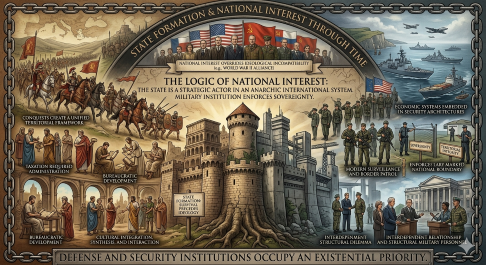
The historical evolution of the state suggests that military institutions have played a foundational role in state formation, territorial consolidation, and the creation of political order.
- National interest, rather than ideology alone, has often guided state behavior in critical moments, as seen in major global alliances and conflicts.
By Noor Muhammad Marri Advocate | Islamabad
The question of how states are formed, sustained, and stabilized has remained central to political thought throughout human history. One powerful interpretation places the military institution at the core of this process. In this view, the state is not primarily a moral or ideological project but a strategic organization built around survival, sovereignty, and national interest. From early human societies to modern nuclear powers, organized force has often been the decisive factor in shaping political order, territorial unity, and even cultural integration.
At the foundation of this argument lies a simple but hard historical truth: survival precedes ideology. States may later develop constitutions, moral frameworks, or ideological systems, but their initial formation is usually rooted in the need for protection against external threats and internal disorder. This is why the military institution often appears not as a secondary organ of the state, but as one of its earliest and most essential structures. In many historical contexts, the army is not merely an instrument of the state; it is one of the earliest forms through which the state itself becomes visible and effective.
Historically, the formation of large political systems has frequently followed military consolidation. Early empires expanded through conquest and then gradually developed administrative systems to manage conquered territories. In this sense, conquest was not only destruction; it was also a process of political unification. Once military authority established control over a region, it created space for different cultures, economic systems, and administrative traditions to interact. Over time, this interaction often produced new hybrid orders rather than simple domination.
A useful historical example is the modern European state system, which evolved after centuries of warfare. The consolidation of territorial states in Europe was deeply connected to military competition. Armies required taxation, taxation required administration, and administration required bureaucratic development. In this way, war and defense requirements contributed directly to the formation of modern state structures.
Similarly, in imperial history, conquest often created the framework for civilizational interaction. When empires expanded, they did not simply erase local cultures; instead, they created layered systems where different traditions coexisted under a single political authority. The Roman world is a classic example of this pattern, where multiple regional cultures operated within a unified imperial structure. Over time, this produced not cultural uniformity but cultural synthesis.
The same pattern can be observed in later imperial systems. In South Asia, for example, successive waves of conquest and consolidation created conditions where Central Asian, Persian, and indigenous traditions interacted. The result was not a single homogeneous civilization but a complex cultural landscape shaped by political unification and long-term coexistence.
Read: The Origins of the Modern State in Europe
A particularly important dimension of this historical process is the role of national interest as the guiding principle of state behavior. Unlike individuals or moral communities, states are not primarily governed by ethical ideals; they operate on the logic of survival and strategic advantage. This becomes especially clear during major global conflicts. During the Second World War, for instance, ideological differences between the Soviet Union and the United States were significant, yet both powers formed an alliance against a common existential threat. This demonstrates that in extreme conditions, national interest overrides ideological incompatibility.
From this perspective, the state is best understood as a strategic actor in an anarchic international system. Its primary responsibility is not moral consistency but survival. Ideology, economics, and diplomacy are important, but they are often secondary to the fundamental requirement of maintaining sovereignty and territorial integrity.
Within this framework, the military institution occupies a central position because it is the only structure directly responsible for enforcing sovereignty. Borders, territorial control, internal order, and external defense ultimately depend upon organized coercive capability. Without it, no state—regardless of its legal or moral framework—can survive for long in a competitive international environment.
This leads to an important debate in modern political theory: the relationship between professional military institutions and civilian authority. One common argument, influenced by civil-military theory, suggests that a more professional military remains politically neutral and therefore avoids involvement in civilian governance. According to this view, professionalism creates discipline, specialization, and institutional boundaries that separate military and political spheres.
However, historical experience presents a more complex reality. A highly professional military often possesses deep expertise in foreign policy, defense strategy, intelligence assessment, and security dynamics. In many cases, military institutions may understand external threats and strategic realities more directly than civilian political actors, who are often influenced by electoral pressures, party competition, and short-term political considerations.
This creates an inherent tension. On one hand, civilian supremacy is considered essential for democratic governance. On the other hand, the military is the institution most directly engaged with the realities of national security. This duality has been one of the most persistent structural dilemmas in modern state systems.
The argument that “defense dominates all institutions” is rooted in the logic that sovereignty is the foundation of all other state functions. Economic development, legal systems, education, and governance all depend on the existence of a secure and stable political order. If sovereignty collapses, all other institutions lose meaning. Therefore, defense and security institutions occupy a structurally superior position in terms of existential priority.
Yet history also shows that military dominance alone does not automatically produce stable or prosperous societies. While military power can secure territory and enforce order, long-term state stability requires integration with economic systems, administrative capacity, and social legitimacy. States that rely exclusively on coercive power often face internal rigidity, lack of innovation, or legitimacy crises over time.
At the same time, it would also be historically inaccurate to separate military power from state development. In many cases, the military has played a foundational role in building administrative systems, securing trade routes, protecting infrastructure, and enabling economic growth. Maritime trade, for example, has historically depended on naval protection. Strategic chokepoints in global trade demonstrate that economic systems are deeply embedded within security architectures.
Modern global powers continue to reflect this reality. Naval presence, strategic alliances, military bases, and defense networks are closely linked to the protection of international trade and economic stability. In this sense, military power and economic systems are not separate domains but interconnected structures within global order.
Therefore, the relationship between military institutions and civilian governance should not be understood as a simple hierarchy or opposition. Instead, it is better understood as an interdependent system where each sphere performs distinct but connected functions. The military secures sovereignty, while civilian institutions organize society within that secured framework. However, in moments of crisis, war, or instability, the balance between these roles often shifts toward security institutions.
In conclusion, the historical evolution of the state suggests that military institutions have played a foundational role in state formation, territorial consolidation, and the creation of political order. National interest, rather than ideology alone, has often guided state behavior in critical moments, as seen in major global alliances and conflicts. Conquest and military expansion have frequently created the conditions for cultural interaction and civilizational synthesis, while professional military structures remain central to the protection of sovereignty.
Yet the complexity of modern states also shows that survival alone is not sufficient. While military power may be the foundation of sovereignty, the durability of states depends on a broader system of governance that integrates security with economic development, institutional legitimacy, and social cohesion. The challenge of modern political order lies not in choosing between military and civilian spheres, but in managing their permanent and necessary interdependent.
Read: Utopian Dogma and Human Cost
________________________
 Noor Muhammad Marri Advocate & Mediator is based in Islamabad


