Groundwater, Construction, and the Silent Cracks Beneath Urban Life
- Urban civilization often celebrates what rises upward: towers, skylines, highways, glass buildings, and massive infrastructure. Yet the long-term survival of cities may depend equally on what happens underground. Water beneath the soil quietly supports everything above it.
By Abdullah Usman Morai | Sweden
“Cities are not built only on concrete and steel; they are built upon the behavior of water beneath the soil.”
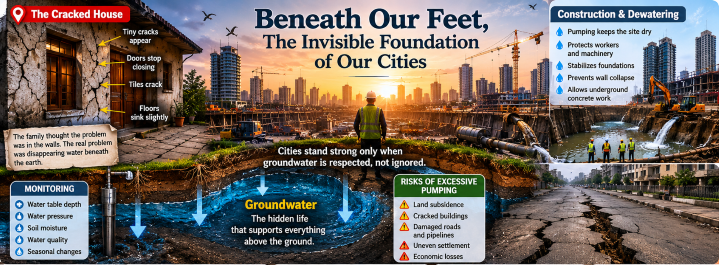
For months, a family believed the problem was minor.
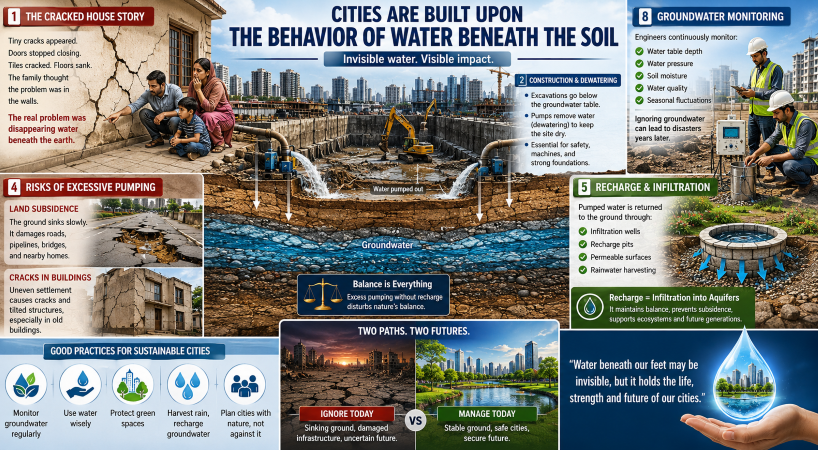
It began with a hairline crack near the living room window. Barely noticeable. Easy to ignore. Old houses develop cracks, they told themselves. The nearby construction of a massive commercial plaza probably caused some vibration. Nothing serious.
But weeks later, the bedroom door stopped closing properly.
Then, the ceramic tiles in the hallway cracked diagonally like thin lightning bolts spreading across the floor. One corner of the house sank slightly lower than the other. Furniture no longer stood evenly. During the rainy season, rainwater strangely accumulated near the entrance instead of flowing away naturally.
The family blamed poor construction, humidity, weather, and aging walls. Nobody suspected the real problem existed deep beneath the ground.
Across the street, powerful pumps had been operating day and night at a large excavation site where engineers were constructing several underground basement levels. Thousands of liters of groundwater were continuously being removed from beneath the soil in a process known as dewatering.
Months later, a geotechnical engineer inspecting the neighborhood delivered the disturbing explanation.
“The family thought the problem was in the walls. The real problem was disappearing water beneath the earth.”
The ground beneath the neighborhood had slowly settled because groundwater levels had dropped.
The city above appeared modern and powerful, but the invisible balance below had been disturbed.
 The Hidden World Beneath Every City
Modern cities often appear to be monuments of concrete, glass, steel, and engineering brilliance. Yet beneath roads, shopping malls, bridges, apartments, tunnels, and skyscrapers lies another world that silently controls their stability: Groundwater.
Groundwater is the water stored within soil, sand, gravel, and underground rock formations called aquifers. Although invisible to most people, groundwater constantly interacts with the soil supporting buildings and infrastructure.
Every foundation rests not only upon earth, but upon moisture, pressure, and underground balance.
When this balance changes suddenly, cities can crack, sink, flood, or weaken slowly over time.
Groundwater and Construction: Why Monitoring Matters
Before constructing roads, bridges, tunnels, basements, dams, housing societies, or high-rise buildings, engineers must carefully study groundwater behavior beneath the site.
Ignoring groundwater conditions can lead to structural instability, flooded excavations, land subsidence, wall failures, environmental damage, and massive financial losses.
Yet groundwater often receives less public attention because its movements are hidden underground.
Unlike collapsing bridges or flooded streets, groundwater problems develop silently.
Soil Is Not as Solid as It Appears
Many people imagine the earth beneath buildings as permanently solid and motionless. In reality, soil behaves like a living material influenced by water pressure and moisture. Groundwater directly changes soil strength.
When water levels become excessively high, soil may weaken, excavation walls may collapse, foundations may shift, and landslides can occur.
Certain soils, especially clay, expand when wet and shrink when dry. Repeated changes in groundwater levels gradually stress buildings over the years.
A building may appear strong above the ground while silently weakening below it.
This is why modern construction projects conduct detailed geotechnical and hydrogeological investigations before excavation begins.
Digging Below the Water Table
As cities grow vertically downward through underground parking, metro systems, shopping basements, and tunnels, construction increasingly reaches below the natural water table.
Once excavation cuts into groundwater zones, water begins entering pits continuously.
Workers at major construction sites often arrive in the morning to find partially flooded excavations. Mud accumulates. Pumps roar constantly. Delays increase. Safety risks multiply.
The engineering reality is simple: “Water Inflow”>”Drainage Capacity”
When incoming groundwater exceeds drainage capacity, flooding occurs.
To control this problem, engineers install pumping systems that remove groundwater from excavation areas. This process is known as dewatering.
Why Construction Sites Pump Groundwater
Dewatering is essential for many projects because it keeps excavation sites dry, protects workers, stabilizes soil, prevents wall collapse, safeguards machinery, and allows underground concrete work.
Without dewatering, many urban infrastructure projects would become impossible.
However, like many engineering solutions, dewatering creates its own risks if poorly managed.
Removing groundwater too aggressively can disturb the underground equilibrium across surrounding areas.
When the Ground Begins to Sink
One of the most dangerous consequences of excessive groundwater extraction is land subsidence. As groundwater is removed, the empty spaces between soil particles are compressed, and the ground slowly sinks.
Unlike earthquakes, subsidence usually occurs gradually, millimeter by millimeter, year after year, silently beneath daily life.
People often notice symptoms only after cracked walls, uneven roads, tilted structures, damaged pipelines, jammed doors, and sinking floors.
In dense urban environments, even small changes in soil settlement can damage neighboring buildings.
Old homes become particularly vulnerable because their foundations were never designed for sudden groundwater fluctuations.
Many cities around the world already face subsidence caused by uncontrolled groundwater extraction and construction activity.
The danger is especially severe in rapidly expanding urban centers where infrastructure development outpaces environmental monitoring.
The Invisible Cost of Urban Growth
Modern cities increasingly cover natural land with concrete, asphalt, parking lots, highways, and paved surfaces.
Rainwater that once soaked naturally into the soil now rushes into storm drains.
As groundwater extraction increases and natural recharge decreases, underground reserves decline steadily. The city receives rain, but the earth receives none.
This imbalance creates a dangerous urban paradox: Floods above ground and water scarcity below ground can exist simultaneously. A city may suffer heavy rainfall and depleted aquifers at the same time.
Returning Water to the Earth
To reduce environmental damage, engineers sometimes reintroduce pumped groundwater back into the soil through infiltration systems or recharge wells.
This helps maintain groundwater balance, reduce land subsidence, recharge aquifers, protect ecosystems, and preserve soil stability.
The concept is simple: “Recharge”=”Infiltration into Aquifers”
Sustainable urban engineering increasingly recognizes that groundwater should not merely be removed; it must also be replenished.
Some modern cities now use permeable pavements, rainwater harvesting systems, recharge basins, green spaces, and controlled infiltration technologies to help restore groundwater naturally.
Groundwater Monitoring: A Hidden Necessity
Large infrastructure projects often continuously monitor groundwater depth, soil moisture, water pressure, water quality, and seasonal fluctuations.
These measurements help engineers predict settlement risks, seepage problems, structural stress, and environmental impacts.
Ignoring groundwater may not produce an immediate disaster. Sometimes the consequences emerge years later.
That delayed danger makes groundwater uniquely deceptive.
A poorly monitored project may appear successful during construction while quietly creating future instability beneath nearby neighborhoods.
The Future of Cities Lies Beneath Them
Urban civilization often celebrates what rises upward: towers, skylines, highways, glass buildings, and massive infrastructure.
Yet the long-term survival of cities may depend equally on what happens underground. Water beneath the soil quietly supports everything above it.
If urban planning continues treating groundwater as an invisible inconvenience rather than a living environmental system, more cities may face sinking land, damaged infrastructure, groundwater depletion, structural instability, and worsening water crises.
The story of the cracked house is not merely about one family. It is a warning about modern urban life itself. Because cities are not sustained only by concrete and steel. They are sustained by balance, the delicate balance between earth, water, engineering, and human ambition hidden beneath our feet.
Read: Hands Still Matter More Than Algorithms
________________________

Abdullah Soomro, penname Abdullah Usman Morai, hailing from Moro town of Sindh, province of Pakistan, is based in Stockholm Sweden. Currently he is working as Groundwater Engineer in Stockholm Sweden. He did BE (Agriculture) from Sindh Agriculture University Tando Jam and MSc water systems technology from KTH Stockholm Sweden as well as MSc Management from Stockholm University. Beside this he also did masters in journalism and economics from Shah Abdul Latif University Khairpur Mirs, Sindh. He is author of a travelogue book named ‘Musafatoon’. His second book is in process. He writes articles from time to time. A frequent traveler, he also does podcast on YouTube with channel name: VASJE Podcast.