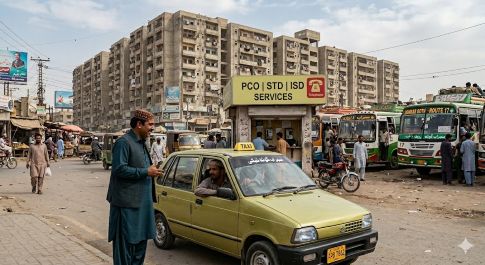
Stories of Karachi’s Taxi Drivers from 1993 to 2000
Zaffar Junejo
[Author’s Note: I joined a non-government organization in mid-1993. In those days, we were frequent travelers to other Asian countries, and during that period I maintained a diary. I once showed the notes to Muhammad Ibrahim Joyo — the legendary scholar, translator, and intellectual giant of the Sindhi world — who suggested categorizing the entries by theme and getting them published. He recalled that long ago, perhaps in 1955, the Sindhi journal Mehran had launched a similar idea titled ‘Hik Deenh Ji Ghaleh’ (The Story of a Day), even offering a prize for it. He himself had submitted the first story, he told me with a smile, just to set a standard for other writers. Later, Maulana Ghulam Muhammad Girami, a scholar of high standing and journalist; Shamsher ul Haidri, a distinguished Sindhi poet, journalist, and playwright; and Siraj ul Haq Memon, an iconic novelist, linguist, and journalist, all contributed their observations of a single day. These writings were published until 1968.
I agreed with Joyo Sahib that I would group the write-ups by subject and get them published, but I failed to do so. Recently, I sat down to organize my notes. I found various entries about the taxi drivers of Karachi city. Some were very brief and incomplete; others were short but held a finished truth. I have chosen five stories from each year, all of them gathered from the drivers of those cars. In total, there will be thirty-five stories covering the period from 1993 to 2000.
On the surface, these pieces appear to be simple narratives. However, beneath the prose, they depict the complex socio-political and cultural landscape of Karachi during those turbulent days. They are the echoes of a city in motion.]
The Clock and the Deadline
The sun was hot on the tarmac at Kala Board. The air tasted of dust and exhaust. It was a long weekend, and the heat made the city feel heavy. I wanted to see my friends at Jamshoro.
I hailed a taxi. The car was old, but the engine idle was steady.
“Sohrab Goth,” I said.
“Sit,” the driver said.
We took the shortcut down Ispahani Road. The road was broken in places, the car bouncing rhythmically. The driver looked at me through the cracked rearview mirror. His eyes were grayed with cataracts but sharp.
“Are you Sindhi?” he asked.
“I am,” I said.
The admission was a key. It opened something in him. He drove with one hand on the wheel, the other resting on the gear shift.
“How is your experience with Sindhi passengers?” I asked.
“I have a long experience,” he said. He did not look back this time; he watched the road. “It starts in 1980. It goes until now.”
“Tell me about 1980.”
He laughed, a dry, coughing sound that ended in a chuckle. “In those days, Sindhis came to visit relatives who had minor jobs at the Sindh Secretariat or the Pakistan Steel Mills. As those visiting people arrived at Sohrab Goth, I kept an eye on them.”
“Really?” I asked.
“But I only approached the passengers who arrived in the morning, during office hours,” he said.
“Why did you discriminate by the clock?”
“There was only one reason,” he said. He steered around a stalled donkey cart. “Almost all of them did not know street names or sector numbers. But they had a chit showing a telephone number of their relatives.”
“A telephone number,” I repeated.
“Yes, a telephone number. But in all cases, that number was an official office number. The passengers who arrived during office hours had a number that could actually be reached. But for the passengers who arrived after office hours, that same number was dead. So, that number in the evening was useless because the offices were closed. This was the reason to choose persons who arrived during office hours.”
He shifted his weight in the seat. The city outside was changing, moving from the dense concrete to the wider, dustier fringes of the highway.
“Was there ever an incident,” I asked, “where you picked someone up and he failed to pinpoint where he wanted to go?”
The driver took a deep sigh. It came from somewhere deep in his chest.
“It happened,” he said. “It happened more than once. That is why it became my practice to ask them for the paper. I would find a Public Call Office—a PCO—and I would dial on their behalf. Most times, someone answered. I would get the address from the man on the wire, and I would drop the passenger right at the gate.”
“And the ones who came late?”
“The ones who arrived after the offices closed, with nothing but an office number… there was no use dialing it. I told them the truth. I advised them to go back, catch a bus to the village or town, and come again tomorrow. I told them to ask their relatives to pick them up from the stop next time, unless they had a home address. If you do not have a way to find a house in this city at night, you are lost.”
He stopped talking. He took another long pause, looking out at the low buildings passing by.
“It was the only wise decision,” he said.
The car slowed. The yellow walls of the Gulzar-e-Hijri Police Station appeared on the left, stark against the gray dirt.
“Here,” I said.
He pulled over. I paid him the fare and some extra. He took the notes without counting them and nodded once.
I got out and closed the heavy metal door. The heat hit me instantly. I turned and crossed the road toward the buses heading north, leaving the old man and 1980 behind in the dust of the highway.
***
Where Schools Once Were
Winter had come to Karachi. The air was thin and dry. Dust moved low across the road like tired smoke.
I met an old friend near Numaish Chowrangi. We talked for a short while and then parted. The evening was already fading.
I walked toward the Numaish stop on Bunder Road—now MA Jinnah Road. Traffic moved slowly. Horns sounded distant, almost tired.
A taxi stood near the curb.
I approached the driver. He was leaning against the door.
“Gulshan-e-Iqbal?” I asked.
He looked at me and nodded.
“We agree on fare first,” he said.
We agreed.
He opened the back door for me.
Inside, I leaned back against the seat.
A boy sat in the front seat. He was about thirteen or fourteen. A school bag rested on his lap. He wore a fresh shalwar kameez. His hair was oiled and neatly parted.
I looked at the driver.
He noticed my glance.
“My youngest son,” he said. “A Matric student.”
He touched the boy lightly on the shoulder.
“He goes to tuition in Gulshan. We were waiting for a passenger going that way.”
He thanked me again, softly, as if it mattered.
I sat back.
The engine started.
The city moved around us.
I asked him, “Are there no tuition centers in your area?”
He did not answer at once.
Then he said, “We live in an area where MQM is strong.” He kept his eyes on the road. Then he added, “There, the government schools are closed.”
“How?” I asked.
He exhaled slowly.
“Some school rooms are offices now. Grounds are occupied. Walls are taken over.”
He shifted gears.
“Strikes are common,” he said. “Everyone wants to show strength.”
I nodded. “Yes. It is so.”
He continued.
“Before a strike, buses are taken and parked inside schools. Slowly, teachers stop coming. Then schools close.”
The boy remained silent in the front seat.
The car felt smaller.
“Really,” I said. “That is sad.”
He did not look at me.
“People like us have two choices,” he said. “Leave the area and move to mixed localities. Or stay and find alternatives like tuition centers—if we can afford them.”
Silence filled the car.
Only the engine spoke.
The road lights passed over us in cold intervals.
I asked, “How will you manage?”
He smiled, but there was no warmth in it.
“We are waiting for better days,” he said. “If we can sell our flat, we will move. Maybe then life will be safer for the children.”
He paused.
Then he added, almost to himself, “Karachi is not the same anymore.”
The city moved on outside the window.
Cold and unchanging.
___________________
 Dr. Zaffar Junejo has a Ph.D in History from the University of Malaya. His areas of interest are post-colonial history, social history and peasants’ history. He may be reached at junejozi@gmail.com