A review of Imdad Hussaini’s poem “Susti maan chha har hasil”
By: Raphic Burdo
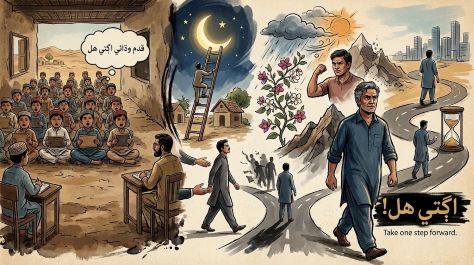
Somewhere in your memory there is a classroom of your primary school with, most probably, a mud floor, a wooden takhti/patti or a black stone or metal slate. Thirty five or so little children chanting in one voice. If you went to a Sindhi-medium school, there is a good chance the words they chanted were Imdad Hussaini‘s “Susti maan chha har hasil, qadam wadhae agte hal.”
We learnt it the way children learn everything: by rhythm, not by meaning. Every couplet lands on the same soft -al rhyming sound, so the poem rolls forward almost by itself. Long after we forgot our multiplication tables, the tune has stayed with us.
Teachers did us many favours, however they did at least one disfavor. They did not properly emphatically explain to us the true significance of this poem. As eight or ten year-olds, we did not fully grasp the meaning and message of the poem. We had not yet failed at anything that mattered. We had not yet wasted a year, or begged a favour, or stood in front of a problem the size of a mountain. The poem was waiting for us to grow into it.
Most of us now have. This review is an invitation to read it again. This time as adults.
Five Lessons in Ten Couplets
The poem is short, but it is not simple. Read slowly, it holds a complete philosophy of life, arranged in five ideas.
- Effort is the only currency. The poem opens by asking what laziness has ever produced, and answers its own question: nothing. Then it reaches for the boldest proof available to a poet of its time. Human beings have reached the moon. That one image told village children that the distance between a mud house and the sky is covered by work, not by the place or family of birth.
- Dignity before everything. The second idea is self-reliance. Do not become dependent on anyone; do not hold out your hands to anyone. In a society built on favours, sifarish and patronage, this is a quietly radical instruction to a child: earn it, or go without.
- Endurance comes before reward. The most beautiful image in the poem is a vine that bears flowers only after it has borne the cold and the heat on its own head. The mountains in the poem bow, crumble and break apart — but only before people with courage, firm intent and strength in their arms. The poem never promises that the mountain will be small. It promises that it will give way.
- Let the past go. One couplet tells the reader not to wring their hands over time that has already passed. It is easy to skip, because children have no past to regret. For adults it may be the most important line in the poem.
- Knowledge is a path, and time is the price of walking it. The poem calls learning the road of truth and tells the reader to keep walking it. It ends where it must: do not waste time for nothing, because every single moment has value.
Why the Poem Hits Harder at Advanced Age of Life
At early age, the poem was a set of instructions. At advance stage of life, it reads like a diagnosis.
By now most of us have met our mountain: a business that failed, a job that went nowhere, a debt, a loss, a door that stayed shut. Many of us have spent years wringing our hands over time already gone. The exam we didn’t pass, the chance we didn’t take, the decade we spent waiting. Some of us learnt to hold out our hands for favours, because that is how things seemed to work.
The poem saw all of this coming, and it answered before we asked. It does not tell us the mountain is imaginary. It tells us the mountain bows to the persistent. It does not pretend the cold and the heat will not come. It tells us that is what flowers are made of. And it says, with a schoolteacher’s bluntness: stop mourning the time you lost, because you are wasting the time you still have.
There is one honest thing to add. The poem promises that effort alone moves mountains, and life has taught most of us that effort needs company: the right direction, the right people, sometimes the right moment. But that is not a reason to put the poem down. It is a reason to read it as a starting point rather than the whole map. Without the effort, none of the rest ever arrives.
Agtey Hal!
So here is a small request to every adult who once chanted this poem in a classroom.
Say the first line again, out loud, in the old rhythm. Notice which couplet stops you. That is the one your life is asking about right now.
Then do what the poem told you to do before you were old enough to understand it: take one step forward.
Read: Sindhi Devotional Poetry: From Seed to Cosmos
____________
Raphic Burdo is student of Finance, Entrepreneurship, Public Policy, Psychology and Literature. He writes on the intersection of these subjects. He can be approached at RaphicBurdo@gmail.com