Sindh: Education for Sale
The Business of Degrees, the Betrayal of Students and a Nation’s Future at Stake

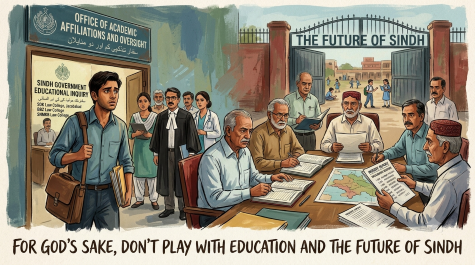
For God’s Sake, Don’t Play with Education and the Future of Sindh
By Kalavanti Raja
Imagine a young applicant standing outside a college, holding an admission form and the savings of a family. On the signboard is a university’s name. Inside, someone explains the fees, the program and the years required. Nothing looks secret. There are advertisements, institutional names and promises of a recognized qualification. The applicant pays. A family begins counting the years until opportunity arrives.
Then, years later, a notification arrives instead.
On 16 October 2026, Shah Abdul Latif University, Khairpur, declared 1,184 academic records invalid: 658 connected with its three-year LLB program and 526 with its five-year program. Results, transcripts, provisional certificates and degrees based on these unauthorized records were invalidated too. An administrative document can deliver its decision in a few paragraphs. The consequences may occupy the rest of somebody’s life.
The inquiry concerned passing years 2016, 2017 and 2018 for the three-year program and batch 2017 for the five-year program. It followed resolutions at the Syndicate’s 92nd meeting on 11 April 2026. A public notice dated 7 July allowed fifteen days for documentary evidence. The committee considered submissions from candidates and colleges before concluding that the disputed records were outside the university’s lawful academic record.
That finding demands seriousness. It also demands a question larger than the authenticity of any single certificate: how did an entire chain of admission, payment, academic documentation and institutional representation allow these records to acquire credibility? Somewhere between the advertisement and the certificate stood people entrusted with protecting education. Their decisions must be examined alongside those of students.
Human beings often prefer easier routes. Wouter Kool and colleagues demonstrated cognitive effort avoidance in experimental research published in 2010. Daniel Kahneman similarly explained our preference for easier means of reaching a goal. This tendency does not excuse deliberate fraud. It explains why public safeguards matter. Institutions must prevent the sale of unlawful shortcuts, rather than allow them to flourish and later express surprise that people took them.
An ordinary applicant cannot inspect a university’s internal ledgers. Students generally encounter prospectuses, receipts, college offices and claims of affiliation. Where they trusted those representations honestly, they must not carry the blame for institutional deception. Allegations that providers collected excessive or double fees while dispensing with proper teaching or examinations require investigation. For anyone who knowingly purchased fabricated credentials, responsibility must be established individually. Innocent reliance and conscious participation are different circumstances.
The scale deserves careful reading. Thirteen institutions appear in the uploaded notification. Records mentioning each, including jointly labelled entries, number: SDK Law College, Jacobabad, 407; SNMKB Law College, Kandhkot, 282; Qazi Mian Ahmed Qureshi Law College, Moro, 158; Abdul Wahid Soomro Law College, Kashmore, 137; BBZ Law College, 121; ABD Law College, Sukkur, 116; Mashal Law College, Daharki, 92; SBB Law College, Larkana, 74; HMBS Law College, Shikarpur, 72; Alfalah Law College, Kashmore, 58; SALU Constituent Law College, Naushahro Feroze, 57; Mirza Law College, Pano Akil, 26; and Faiz Muhammad Sahito Law College, Kandiaro, 12.
These are overlapping institutional mentions, not separate student populations. Several records name two colleges together; adding the figures would inflate the total. Repeated names, seat numbers and inconsistent institutional descriptions also require scrutiny. The notification contains 1,184 entries. Naming a college establishes its appearance in the list, not a finding that its management sold degrees. Accountability requires precision, especially when reputations and livelihoods are involved.
Who was watching? Provincial registration responsibility rests with Sindh’s College Education Department through its Directorate of Inspection and Registration of Private Colleges, with regional offices in Sukkur and Hyderabad. Academic affiliation belongs to the competent university. Law-specific approval and oversight involve the Pakistan Bar Council and, under the later framework, its Directorate of Legal Education. The applicable responsibilities must be traced to the period concerned.
Sindh’s registration framework provides for scrutiny, inspection, certificates, monitoring and action against violations. The PBC’s published NOC application asks about ownership, premises, classrooms, principal, teachers, curriculum, class timings, attendance, library resources and governance. It requires an undertaking that admissions have not already started. Although today’s form cannot automatically govern older batches, its demands illustrate something fundamental: approval is supposed to verify an educational institution, not merely acknowledge a fee payment.
The Government of Sindh must therefore answer whether failures of supervision allowed money-making to become institutionalized within education. Registration and affiliation cannot serve as decorative shields. Investigators must establish who inspected, who approved, who collected money, who entered records and who ignored complaints. Proven corruption requires action against officials and private operators alike. Cancelling certificates while protecting facilitators would leave the mechanism of exploitation intact.
Publish the registration certificates, affiliation orders, inspection reports and approved student intakes. Compare them with fee receipts, attendance registers, examination attendance and answer scripts. Let the evidence identify responsibility, rather than permitting another generation to inherit unanswered questions and broken promises.
Similar allegations surrounding Matriculation and Intermediate examinations include purchased marks, organized cheating and manipulated results. These claims must be independently investigated, not assumed true merely through repetition. The Boards of Intermediate and Secondary Education must demonstrate how examination integrity is protected. Otherwise, honest students learn a devastating lesson: effort competes against access, money and influence.
Meanwhile, the world’s competition for knowledge and skilled employment intensifies. Sindh’s children deserve preparation for science, technology, law and public service. Every neglected classroom and compromised examination weakens that preparation. Education shapes the competence of future teachers, engineers, lawyers and administrators. Its betrayal eventually reaches every household.
Return to that applicant outside the college. What happens if the lost years have carried the student beyond employment age limits? Who refunds the fees, repairs the reputation or restores the opportunity? Innocent students deserve individual hearings, practical remedies, affordable remedial study and consideration of appropriate age relaxation. An unearned qualification cannot become valid through sympathy, but institutional failure must not become a lifelong punishment for the deceived. For God’s sake, stop playing with education and the future of Sindh. Investigate the gatekeepers. Recover money where wrongdoing is proved. Protect honest students. Make those responsible answer for the years that no notification can return.
Read: Sindh Is Not a Drainage Corridor
_________________
 Kalavanti Raja is a social and political activist from Gambat, Khairpur Mirs, with 30 years of work on women’s rights, minorities, and social justice. She has served in Sindhiyani Tahreek and participated in national and international forums across Asia, Europe, and America.. She can be reached at kalavanti.raja@gmail.com