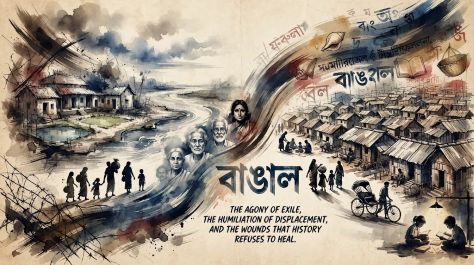
The Agony of Exile, the Humiliation of Displacement, and the Wounds That History Refuses to Heal
A meditation on memory, language, and survival. Debasree Chakraborty traces the painful journey of East Bengali refugees who fled violence only to face ridicule in their place of sanctuary—reminding us that while borders can strip people of their land, history cannot erase their humanity.
By Debasree Chakraborty | Kolkata
There are certain words in human history that carry within them the weight of entire civilizations, the sorrow of uprooted generations, and the silent anguish of countless broken hearts. They are not merely words; they are repositories of suffering, humiliation, dispossession, and memories that refuse to die.
“Bangal” is one such word.
In itself, the word is not an insult. It is a regional identity, historically associated with the people of eastern Bengal. Yet, when spoken with contempt, sharpened by prejudice, and poisoned by social arrogance, it becomes something far more sinister—a weapon directed against the dignity of those who have already lost almost everything.
“Bangal from the slums!”
“Children of Bangals!”
“These people came here and forced us to clear the wilderness for them!”
How casually such expressions have been uttered! How effortlessly humiliation has been disguised as humour!
As though the refugees who crossed the borders were not human beings at all. As though they were strange creatures escaped from a zoological garden, trespassing upon a civilization to which they had no right to belong.
But has anyone ever paused to consider who these people were before history turned them into refugees?
Perhaps the man whom you dismiss as a “Bangal” once belonged to a family whose ancestral home had stood for centuries beside a river in East Bengal. Perhaps his courtyard echoed with the sacred sound of conch shells at dusk. Perhaps his mother lit an oil lamp before the household deity every evening, while his father sat beneath an ancient mango tree, reading from a treasured manuscript.
Perhaps his ancestors were scholars, physicians, teachers, lawyers, landowners, farmers, artists, or men and women of extraordinary intellectual distinction.
Perhaps there were libraries in their homes, temples in their courtyards, ponds surrounded by flowering trees, and walls adorned with portraits of generations long departed.
And then, one day, everything was lost.
Not because they wished to leave.
Not because they were adventurers searching for distant opportunities.
Not because they had grown weary of the land that had nourished their ancestors.
They left because circumstances had made their own homeland increasingly unsafe, because communal hatred had invaded the intimacy of ordinary life, because political upheaval had transformed familiar neighbors into strangers, and because survival itself had become uncertain.
No human being willingly tears the roots of their existence from the soil of their ancestors.
No mother joyfully abandons the courtyard where her children first learned to walk.
No father casually leaves behind the graves, memories, and sacred places of generations.
No child willingly exchanges the river of childhood for the cold anonymity of a refugee camp.
People flee when remaining becomes more terrifying than leaving.
The Partition of India in 1947 did not merely draw a political boundary across a geographical landscape. It carved a wound through the living consciousness of millions.
The communal violence of 1950, the disturbances of 1964, the atrocities of 1971, and successive waves of insecurity and displacement compelled countless families from East Bengal and later East Pakistan to seek refuge across the border.
Their circumstances were not identical, nor were their individual histories interchangeable. Yet, for innumerable displaced families, one experience remained painfully familiar: the loss of security in the land of their birth, followed by the struggle to recover dignity in the land where they sought shelter.
And what awaited many of them on the other side?
Compassion?
Brotherhood?
The comforting embrace of people who spoke the same language and inherited much of the same cultural tradition?
Sometimes, yes. There were extraordinary acts of solidarity and generosity.
But there was also humiliation.
A second exile, more invisible than the first.
Across the border, many had suffered because of their religious identity. On this side, they were ridiculed because of their regional identity.
There, they had lost their homes.
Here, they were made to feel that they had lost their rightful place in society.
There, their ancestral properties had been abandoned or seized.
Here, their poverty became an object of ridicule.
A man who once possessed acres of fertile land might now find himself living beneath a leaking roof in a refugee settlement.
A family whose home once accommodated generations might be forced to share a single room with ten other people.
A woman who had grown up surrounded by books, music, and refinement might now spend her days searching desperately for employment in an unfamiliar city.
And society, instead of recognizing the magnitude of their tragedy, could dismiss them with a single contemptuous word:
“Bangal!”
What a devastating indictment of human civilization!
Is it not enough that a person has lost his homeland? Must he also surrender his dignity to those who have never experienced the agony of displacement?
Is it not enough that a family has been stripped of its possessions? Must its poverty become a spectacle for the amusement of others?
And then comes another form of cruelty—the mockery of language.
What extraordinary arrogance permits one Bengali to ridicule another Bengali for the way he speaks?
Does the Bengali language belong exclusively to Calcutta?
Is its beauty confined to one particular accent, one geographical region, or one socially approved manner of pronunciation?
The Bengali spoken in Nadia differs from that of Birbhum. The rhythms of Bankura are not those of Murshidabad. The dialects of Purulia, Malda, Cooch Behar, and Midnapore carry their own linguistic histories.
Similarly, the Bengali of Dhaka, Barisal, Faridpur, Bikrampur, Mymensingh, Noakhali, Comilla, Sylhet, and Chittagong possesses distinctive sounds, expressions, idioms, and cultural memories.
This diversity is not a defect.
It is the magnificent inheritance of the Bengali language.
Then why should the pronunciation of a person from across the barbed-wire border become an invitation to laughter?
Why should the language of his mother be treated as evidence of inferiority?
Why should the accent in which a grandmother once narrated stories, a father offered blessings, or a mother whispered her final farewell become the subject of cruel imitation?
A language is never merely a collection of words.
It is the geography of memory.
It is the music of belonging.
It is the invisible homeland that survives when the physical homeland has been taken away.
When a displaced Bengali speaks in the dialect of his ancestral village, he is doing far more than communicating.
He is preserving a world that history attempted to erase.
Within that pronunciation live forgotten rivers, vanished villages, abandoned courtyards, ancestral festivals, folk songs, lullabies, and the voices of people who will never return.
To mock that language is to mock the memory of the dead.
To ridicule that accent is to wound the last surviving fragment of a lost homeland.
Yet perhaps the most tragic chapter of this history belongs to the women.
The history of Partition is not merely the history of borders, migrations, and political negotiations. It is also the history of women’s bodies becoming battlegrounds upon which communal hatred, sexual violence, and the brutal exercise of power were inflicted.
Abduction, rape, forced separation, social ostracism, and the destruction of family life form some of the darkest chapters of the Partition experience.
For many displaced women, crossing the border did not bring an end to suffering.
It marked the beginning of another struggle.
Women who had once lived within secure and respected households suddenly found themselves confronting poverty, hunger, homelessness, and the desperate necessity of earning a livelihood.
Some became domestic workers. Others found employment in factories, schools, hospitals, and small businesses. Through extraordinary perseverance, countless refugee women sustained their families and helped rebuild shattered communities.
But not every woman found a path to safety.
Some fell victim to trafficking, coercion, sexual exploitation, and the merciless economy of urban poverty.
The history of red-light districts such as Sonagachi in Calcutta cannot be reduced to the history of Partition alone. Their origins and social realities are far more complex. Nevertheless, displacement, destitution, and the collapse of familial protection left some refugee women particularly vulnerable to exploitation.
And here lies one of the most unbearable tragedies of human history.
Imagine a young woman who once sat beside the window of her ancestral home, singing Rabindrasangeet in the fading light of evening.
Imagine a daughter whose mother had carefully preserved silk sarees for her wedding.
Imagine a girl who dreamed of attending university, reading literature, or becoming a teacher.
Then imagine that same girl, uprooted by violence, separated from her family, deprived of protection, and driven into circumstances where even control over her own body was threatened or stolen.
What greater cruelty can civilization inflict upon a human being?
And what greater hypocrisy can society display than to condemn the victim while remaining silent about the forces that destroyed her life?
The shame belongs not to the exploited woman, but to those who exploited her and to the society that failed to protect her.
Yet the humiliation of refugees continued.
Their settlements were mocked.
Their poverty was despised.
Their accents became jokes.
Their children inherited labels they had never chosen.
And the people who had already lost their homes were made to feel that they were trespassers in the very land where they had sought sanctuary.
Perhaps this is one reason why so many people hesitate to abandon their ancestral homes, even when their lives become increasingly uncertain.
They endure fear.
They endure discrimination.
They endure threats and humiliation.
They cling to their land until the final possible moment because they know that exile does not necessarily promise acceptance.
They know that beyond the border there may be shelter, but not always belonging.
There may be food, but not always dignity.
There may be safety, but not necessarily the restoration of everything that has been lost.
For a refugee, the loss of homeland is not a single event.
It is a lifelong condition of remembrance.
A father may spend the remainder of his life in Calcutta, yet speak of his village in Barisal as though he had left it only yesterday.
A mother may raise her children in a refugee colony, yet in her final illness call out for the river beside which she was born.
A grandfather may never again see his ancestral house, yet carefully describe its location to grandchildren who have never crossed the border.
For such people, homeland is not merely a political territory.
It is the fragrance of wet earth after the first monsoon rain.
It is the sound of a temple bell carried across a village pond.
It is the shade of a mango tree beneath which generations once gathered.
It is the neighbor who celebrated a different festival but shared the same joys and sorrows.
It is the language in which one’s mother first spoke one’s name.
No government rehabilitation program, however necessary or generous, can entirely restore such a world.
And yet, the history of East Bengali refugees is not merely a chronicle of suffering.
It is also an extraordinary testament to human resilience.
From makeshift colonies and overcrowded settlements emerged teachers, doctors, scientists, writers, artists, administrators, entrepreneurs, and generations of hardworking citizens.
Families that had arrived with little more than the clothes they wore rebuilt their lives through education, labour, sacrifice, and determination.
Refugee communities profoundly enriched the intellectual, political, economic, and cultural life of West Bengal.
Their contribution cannot be measured merely in buildings constructed, businesses established, or institutions founded.
They helped reshape the very character of post-Partition Bengal.
Nor should history forget those who welcomed them, defended their rights, shared their resources, and stood beside them in their struggle for rehabilitation.
Human compassion existed alongside prejudice, just as solidarity existed alongside social exclusion.
But the existence of kindness does not erase the memory of cruelty.
A wound does not disappear simply because the wounded person has learned to survive.
And the humiliation embedded in a word can sometimes outlive the generation that first endured it.
Therefore, my protest is not against the word “Bangal” as an expression of regional identity.
My protest is against the contempt that has so often accompanied its utterance.
My protest is against the mentality that transforms another person’s displacement into a reason for ridicule.
My protest is against the social arrogance that measures human worth by accent, birthplace, wealth, or inherited privilege.
My protest is against the cruelty of those who laugh at the poverty of people whose prosperity was destroyed by historical catastrophe.
To be a refugee is not a crime.
To flee persecution is not a disgrace.
To lose one’s ancestral home is not a moral failure.
To speak in the dialect of one’s mother is not a mark of ignorance.
And to rebuild one’s life from the ruins of displacement is not something to be mocked.
It is an act of extraordinary courage.
Those who were once contemptuously called “Bangals” did not merely survive the destruction of their familiar world.
They carried its memories across borders.
They preserved its language.
They rebuilt their families.
They educated their children.
They transformed grief into labor, deprivation into determination, and exile into a struggle for renewed existence.
They did not cease to belong to history simply because history had deprived them of their homes.
And so, I wish to place a question before the conscience of society.
How many times must a human being be made homeless before the world acknowledges his suffering?
How many times must a displaced family prove its worth before it is permitted to live without humiliation?
How many generations must carry the burden of Partition before the language of contempt finally falls silent?
A barbed-wire fence may divide territories.
A political agreement may redraw borders.
A government may change the name of a country.
But no border possesses the moral authority to erase a people’s memories, extinguish their cultural inheritance, or diminish their human dignity.
The next time someone uses the word “Bangal” with contempt, let them remember that the person standing before them may be the descendant of a family that once possessed a home, a history, a civilization, and a world of its own.
That person’s ancestors may have crossed the border with empty hands, but they did not arrive without a past.
Their footsteps carried the dust of an abandoned homeland.
Their voices preserved the music of lost villages.
Their hearts contained the graves of memories that no map could ever record.
They were not intruders.
They were not creatures without roots.
They were human beings upon whom history had inflicted an immeasurable tragedy.
Before you insult a refugee, look into the eyes of history.
For the person you ridicule as a “Bangal” may carry within his soul the sorrow of a thousand abandoned homes, the silence of a thousand extinguished lamps, and the unfulfilled longing of generations who died dreaming of the land they could never see again.
You may have taken away their homeland. You may have mocked their poverty. You may have ridiculed their language. But you have no right to take away their dignity.
Because a human being may become a refugee in the eyes of the world—
But human dignity must never be made a refugee.
Read: Two Shores of the Same River
___________
 Debasree Chakraborti is a renowned novel writer of Bengali language. Based in Kolkata, West Bengal, India, she has done Master’s in Modern History from the Kolkata University, and authored some thirty books, mostly the novels, with historical perspective and themes. Her novel is ‘Maharaja Dahir’ that covers the history of Sindh from 662, the year of first attack on Sindh by the Arab armies till date, was published in 2024 and translated by Nasir Aijaz into Sindhi language. Recently, her new Bengali novel ‘The Last People of Mohenjo Daro’ has also been published.