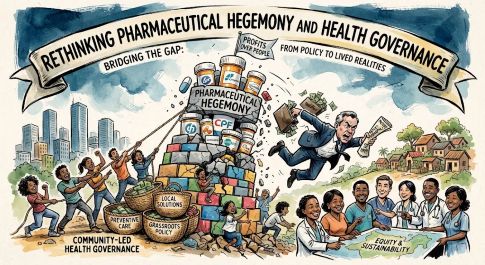
Rethinking pharmaceutical hegemony can help bridge the gap between public health policies and lived realities while contributing to more equitable and sustainable health governance.
By Sohail Ahmed
Every November, LinkedIn timelines become crowded with campaign visuals and expert discussions as global and national institutions release new data to address the growing threat of antimicrobial resistance. World AMR Awareness Week, observed from 18 to 24 November 2026, takes place under the global theme One Health, One Action: Prevent AMR Now. This campaign brings together the quadripartite organizations, including the World Health Organization (WHO), the Food and Agriculture Organization (FAO), the World Organization for Animal Health (WOAH), and the United Nations Environment Program (UNEP). Global estimates suggest that bacterial antimicrobial resistance was associated with approximately 4.95 million deaths in 2019, while projections indicate that AMR could directly cause 39 million deaths cumulatively between 2025 and 2050.
Although international institutions increasingly emphasize laboratory surveillance and the One Health approach, an important dimension receives less attention. This concerns how people understand treatment itself. In many communities, treatment is primarily associated with medical prescriptions, tablets, and injections, while preventive, palliative, and rehabilitative care receive comparatively less recognition. This raises an important question about why medicines have become such a dominant symbol of treatment that other forms of care are often overlooked.
This perception is reinforced through everyday encounters with healthcare providers, pharmaceutical marketing, prescribing practices, and institutional arrangements. From a medical anthropological perspective, this can be understood through the concept of pharmaceutical hegemony, whereby medicines acquire greater social authority than other forms of care. My professional experience managing a paediatric rehabilitation center under the Department of Empowerment of Persons with Disabilities (DEPD) in rural Sindh, alongside my ethnographic research on the social lives of medicines, has repeatedly brought this issue into focus. Caregivers attending our center sometimes question the value of speech therapy, occupational therapy, and physiotherapy because therapists do not prescribe medicines. One caregiver expressed this concern by saying, “The child is not being given any medicine, so how can we consider this real treatment?” Such encounters reveal how deeply the association between treatment and medicines has become embedded in everyday thinking. For some families, the absence of a prescription creates the impression that no meaningful care is being provided. This is not simply a matter of limited awareness. Rather, it reflects how established healthcare practices and everyday medical encounters shape public expectations about what constitutes effective treatment.
This preference for medicines becomes even more consequential when we examine how people manage illness under economic insecurity and limited access to healthcare. My ethnographic research suggests that inappropriate antibiotic consumption cannot be explained simply through individual ignorance or a lack of awareness. Instead, poverty, insecure livelihoods, expensive private consultations, limited diagnostic facilities, and gaps in public healthcare provision shape it. For people who depend on daily wages, paying for a medical consultation can mean losing an entire day’s income. One respondent explained, “A private doctor charges my entire day’s wage just for a consultation, whereas the medical store gives me capsules that allow me to return to work tomorrow.” His account illustrates how economic circumstances influence decisions about medicines. In such situations, immediate access to medicines becomes important not only for managing illness but also for maintaining household income. Similarly, another respondent described the limitations of public healthcare services by explaining, “Our village Basic Health Unit closes at three in the afternoon, so when someone falls ill at night, we have no choice but to call the local livestock peon who keeps injections and antibiotic tablets at home.” Together, these accounts show how limited public services and financial pressures encourage people to rely on informal sources of treatment. Although such practices may not be medically appropriate, understanding them requires examining the circumstances in which people make these decisions rather than attributing them solely to individual behaviour.
The commercial practices surrounding medicines further reinforce their position in everyday life. During participant observation at a local medical store, I witnessed an interaction in which a customer was owed thirty rupees in change. As the seller did not have the required change, he offered additional antibiotic capsules of equivalent value instead, saying, “I do not have thirty rupees in change, so take these medicines instead.” The customer accepted the capsules. Although this was a single encounter, it illustrates how antibiotics can become part of routine commercial exchanges without the medical assessment required before their use. This reflects the commodification of medicines, whereby their commercial value and availability can take precedence over appropriate clinical use. Consequently, antibiotics may circulate as household commodities, retained for possible future use rather than obtained through a consultation or prescription. These observations suggest that pharmaceutical hegemony is reinforced not only through public expectations and prescribing practices but also through everyday market transactions that shape how medicines are purchased, exchanged, and potentially consumed.
These experiences demonstrate why AMR cannot be addressed exclusively through laboratory surveillance or national policy directives. The One Health approach remains essential because antimicrobial use and resistance are interconnected across human health, animal health, and the environment. However, its effective implementation also requires greater attention to the social and economic circumstances that shape everyday medicine consumption. Laboratory surveillance is essential for identifying resistance patterns, but healthcare facilities in resource-constrained settings may face difficulties in maintaining reliable records and regularly reporting their findings. Therefore, healthcare authorities should strengthen local laboratory capacity and encourage hospitals to develop facility-specific antibiograms. These reports identify which antibiotics are effective against bacteria found in patients at a particular healthcare facility and help doctors make better-informed prescribing decisions. Alongside this, affordable culture and sensitivity testing should be made more accessible so that appropriate antibiotics can be selected based on laboratory findings. Stronger regulation of non-prescription antibiotic sales and the expansion of antimicrobial stewardship programs into primary healthcare facilities are equally important. Furthermore, medical curricula should incorporate antimicrobial stewardship, clinical ethics, and the social determinants of health to help future doctors understand inappropriate prescribing as both a clinical and public health concern. At the same time, these efforts must connect with responsible antimicrobial use in veterinary practice, livestock production, and environmental management as part of a comprehensive One Health response.
Ultimately, addressing AMR requires more than telling people to avoid unnecessary antibiotics. It also requires understanding why medicines have become the most widely recognized symbol of treatment and how social expectations, commercial interests, and weaknesses in healthcare systems reinforce this dependence. The concern is not that medicines are unnecessary or that their clinical importance should be reduced. Rather, it is that their dominant position can overshadow other essential forms of care. When people associate treatment almost exclusively with prescriptions, preventive care, rehabilitation, and palliative support risk receiving less attention. Similarly, when antibiotics circulate as ordinary market commodities rather than medicines used according to appropriate clinical indications, changing individual behaviour becomes considerably more difficult. A meaningful One Health response must therefore combine scientific surveillance and responsible prescribing with a deeper understanding of people’s everyday experiences. Rethinking pharmaceutical hegemony can help bridge the gap between public health policies and lived realities while contributing to more equitable and sustainable health governance.
Read: Mental Health Crises Hit Sindh Deserts
______________
 Sohail Ahmed is a medical anthropologist with an MPhil in Anthropology from Quaid-i-Azam University, Islamabad. He currently serves as Manager at the SRHD–DEPD Rehabilitation Centre. His research interests include medical anthropology, the social lives of medicines, antimicrobial resistance, and disability studies.