Through this award-winning novel, the author has attempted to illuminate a lesser-known chapter of Meerabai’s life
Meera
By Debasree Chakraborti
Location: Chittor
After arriving in Chittor, a new chapter began in Meera’s life. Since her mother’s death, her grandfather Rao Dudaji had dedicated himself to shaping her into an exceptional woman, nurturing her in a deeply spiritual environment. Though she had been aware of the country’s political matters, Meera was never subjected to familial cruelty or political intrigue while in Merta. But after coming to Chittor, she found herself caught in the midst of severe family politics and hostility.
Here, apart from her father-in-law, the Queen Mother, and Bhoj, no one even spoke to her kindly. But she had seen the Queen Mother only once—that very first day. Since then, she never came again. Meera had three mothers-in-law. The middle one was also from the Rathore family like Meera herself, but she never once came to see her. The youngest queen, a princess from Bundi, was said to be Meera’s age, yet she, too, was never seen in this palace.
Even the maids bore a look of mockery on their faces. They all looked at her with disdain. After a few months of living in Mewar, Meera began to realize that people were slowly turning against her. Otherwise, even the maids wouldn’t speak to her with mocking smiles and piercing stares. Nothing ever came easily if she asked for something. It felt as though everyone in the Chittor fort had only one goal — to insult and neglect Meera.
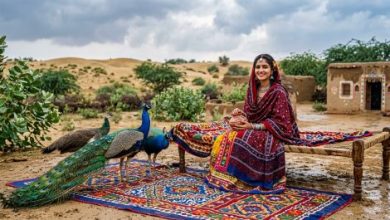
The more these thoughts filled her mind, the more disheartened Meera became. Her palace had three open sides. Through the windows, she could gaze far and wide into the vast landscape of Mewar. Since her arrival, a peacock began visiting her daily. When Meera sat down to worship her beloved Giridharji, the peacock would come and sit beside her. After the worship, it would eat the offering from her hand. Then it would stay for a while and fly away.
In her lonely life, this peacock had taken the place of her beloved pet from Merta. It had become a quiet companion in her isolation.
 Meera…She lovingly named him Shyam. Shyam came to see her every day. Sometimes, when the sky was overcast with clouds, Shyam would spread his feathers and perform a dance for Meera. Whenever one of Shyam’s feathers fell on the palace floor, Meera would collect them—she made a fan for her beloved Giridharji with those feathers. She kept two feathers aside to use while writing her devotional songs (bhajans).
Whenever the maids saw Meera deeply immersed in writing her bhajans, they would start whispering, gossiping behind her back, and quietly mocking her. Though such things left only a fleeting impact on her heart, the real pain came when she heard the raised voice of her mother-in-law echoing from her palace chambers. Whenever her mother-in-law shouted Meera’s name, each syllable felt like an arrow piercing Meera’s heart.
At times, Meera wondered if marrying Bhojraj had been a grave mistake. Even the maids of Mewar considered themselves of higher birth than her. Yet despite being surrounded by so much negativity, Meera found the strength to carry on through the support and affection of her father-in-law and husband Bhoj. Rajput women were trapped in terrifying chains of subjugation—completely deprived of freedom. But Meera, even within the walls of the Mewar fort and amid such hatred and hostility, was still able to keep holy company, attend satsang, and sing her own devotional compositions at the Kumbh Shyam temple.
People came from distant places just to listen to her sing. They raised their hands and showered her with blessings. What greater reward could there be than that? Meera wrote her songs for these listeners. Every moment she spent in the Kumbh Shyam temple, she experienced with full intensity and devotion. Like the sacred flames of the five-lamp aarti, Meera’s soul too seemed to glow with light. Holding onto that spiritual energy, she made it through her days.
Meanwhile, in Chittor, the senior queen Kunwar Bai found no peace. She spent her days lamenting and wailing, and her emotional turmoil began to cast a shadow over the entire palace. Although the lives of many women, including Meera, became miserable because of it, many others supported the senior queen. They were among those who harbored jealousy toward Meera.
Whispers and gossip began to circulate around the palace in support of the queen. They all echoed the same sentiment: “It’s only natural for the queen to break down like this. The prince is the heir to the throne. Was there really a shortage of brides in the entire kingdom? What was Rana thinking?”
Even the maids of Chittor had begun whispering among themselves, “Oh please, does the Rana of Merta, Dudaji, really count as royalty? The Rathores of Jodhpur disowned him long ago. Can you really accept that the granddaughter of a mere jagirdar has now become the crown princess of Mewar?”
Some said, “Well, didn’t Dudaji have a strained relationship with his own brothers? That’s why his father gave him just a tiny piece of land and sent him away. Sure, he established the kingdom of Merta on that land—but compared to Mewar, Merta is just a speck. Honestly, it shouldn’t even be called a kingdom—it’s just a jagir.”
Another added, “Remember how Dudaji’s brother, Bika Ji, was also expelled by their father? But look at him—he founded the great kingdom of Bikaner. Dudaji, on the other hand, stayed content with his little Merta. He had no ambition to expand it. And now his youngest son, Ratan Singh’s daughter, has become the crown princess of Mewar? How shameful! And Ratan Singh—after marrying off his daughter—has become a sardar in the Mewar court. Can he really be considered Rana Sangha’s in-law?”
Yet another maid said, “Even the Maharana doesn’t treat Ratan Singh as an in-law. That’s why he made him a sardar—so that he can use Merta’s troops when needed in battle. Just wait a few more days—soon there’ll be a new crown princess for the prince. It’s all part of palace politics. Even I, a maid, understand it.”
The more these comments reached Queen Kunwar Bai’s ears, the more enraged she became. Rana Sangha had tried many times to explain things to her. He had reminded her that even the daughter of a poor Ahir had once become the queen of Mewar—and her son was none other than Rana Kumbha, the greatest warrior-king Mewar had ever seen or ever would see.
But the Rana no longer felt any affection for the senior queen. He preferred to spend most of his time with the middle queen. And to whom could he share the sorrows of his heart? His children were grown now. Having reached the final chapters of life, he began to feel the weight of all that he had never received.
Before his son’s marriage, the prince would come every day to check on his mother. But after the wedding…
Now, she is seen in this palace only once a week. While the families of the other queens exert their influence over the palace, Meera’s family never had such opportunities. And now, even the Mertani (princess from Merta) has begun to establish her own place here—how could Queen Kunwar Bai possibly accept that? Within the walls of her chamber, Kunwar Bai sighs and reflects: she is a queen only in name—a powerless queen.
With no one else to turn to, she sometimes goes to confide in her mother-in-law. She says, “Ma Sa, there is no respect left for the royal family of Mewar. Can you believe it, the Mertani apparently sings and dances in her chambers? One of my maids came and told me this. If even the servants know, surely all of Mewar must know by now.”
Queen Mother Ratan Jhali understands the pain her eldest daughter-in-law carries in her heart. Kunwar Bai’s family, the Solankis of Godwar, have always held pride and political ambition. Her father, Raymal Solanki, had once hoped that a Solanki daughter would be married to Kunwar Sa Bhojraj. Moreover, the Solankis despised the Rathores. That a Rathore girl was married to Kunwar Bai’s son, Bhojraj—how could they ever accept that? And despite Kunwar Bai being the senior queen of Mewar for so many years, her family had failed to gain any real influence at the Mewar court. That only fueled their bitter envy.
In this palace, her mother-in-law is the only one who gives her any real attention. Yet even she has changed lately—she no longer refrains from reprimanding her in defense of Meera. Still, compared to the others, the Queen Mother shows Kunwar Bai a degree of sincerity, even if her words sometimes strike harshly at first. (Continues)
Click here for Part-1, Part-2, Part-3, Part-4, Part-5, Part-6, Part-7, Part-8, Part-9, Part-10, Part-11, Part-12, Part-13, Part-14,
__________________
 Debasree Chakraborti is a renowned novel writer of Bengali language. Based in Kolkata, West Bengal, India, she has done Master’s in Modern History from the Kolkata University, and authored some thirty books, mostly the novels, with historical perspective and themes. Her novel is ‘Maharaja Dahir’ that covers the history of Sindh from 662, the year of first attack on Sindh by the Arab armies till date, was published last year and translated by Nasir Aijaz into Sindhi language.