Here we go again….Miss
The governments all over Europe and America have officially announced that all elementary and secondary school pupils will wear face masks in ‘Communal Areas’.

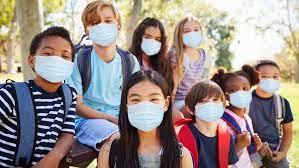
Why enforcing masks in communal areas but not classrooms, where students spend most of time? Why making masks mandatory for primary or secondary pupils but not those who pursued higher education?
By Nazarul Islam
Nearly two years ago, masks entered our lives, in a big way. A small piece of protective fabric covered our mouths and noses. The mask had come to stay, perhaps for a very long time.
This week the governments all over Europe and America officially announced that all elementary and secondary school pupils will once again be ‘strongly advised’ to wear face masks in ‘communal areas’ such as corridors. The Department of Education has said that the guidance is temporary and will be reviewed in three weeks (when most schools break up for the Christmas holidays).
To some of us, a lack of logic behind this policy is infuriating. Why enforce masks in communal areas but not classrooms, where students spend the majority of their time and transmission is most likely? Why make masks mandatory for primary or secondary pupils but not those who pursued higher education.
Between the 10th and 20th of November, almost the exact same percentage of primary school students tested positive for Covid as secondary school ones (3.7 to 3.5), and we already know that primary school staff are just as likely to catch Covid as secondary school staff.
There is of course an argument that we need to be cautious until we know more about the Omicron variant. However, if the Government is genuinely concerned about the transmissibility of Omicron, and its potential to evade vaccine protection, then it should act accordingly.
We know that fabric face masks have very little effect — their inefficacy means they have already been banned in French schools — and this probably explains why Scottish schools have struggled with outbreaks even though face coverings have been mandatory since October half term.
In fact, according to Oxford’s Prof. James Naismith, ONS survey data on Covid prevalence showed that ‘the Scottish and English approach to masking although formally different since July has made no meaningful difference to Delta.’
On the other hand, more filtered face coverings such as surgical or FPP2 masks give much higher levels of protection: up to 94-95%. If we are going to force students to wear masks (which is far from a given), then surely we should at least make them wear masks that actually work?
In the case of UK alone, this policy seems to be yet another example of the British government’s desire to be seen to do ‘something’ when in reality it is doing nothing; an action that is a distraction from their inaction. For months schools have campaigned for carbon dioxide monitors to monitor ventilation levels in classrooms, and despite the government pledging £25 million to improve schools’ ventilation, latest figures suggest that only 2% of schools have received these.
Yet only 40% of secondary school teachers think their classrooms are well-ventilated, and 7% cannot even open their windows.
I also worry about the return of self-isolation for contacts of the new Omicron variant, and the inevitable disruption this will have on teaching and learning as healthy children are forced to quarantine. What’s more it will hardly help vaccine uptake amongst teenagers (of whom only around 20 percent have been jabbed) — how can we tell them to trust the vaccine and yet restrict and disrupt their lives regardless?
When used correctly masks may well serve a useful purpose, but this halfway house is just performative hygiene theatre.
As one student aptly put it to a teacher this morning, “Here we go again, Miss.”