Korea’s Prime Minister underlines importance of journalism in transformation of civilization
The world faces Great Transformation of Civilization and Journalism needs to stand up and light up the way to overcome all challenges that may come under the transformation.

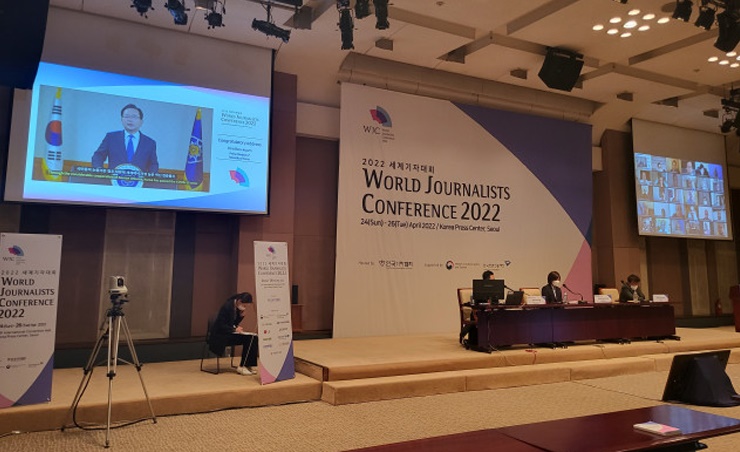
Addressing the World Journalists Conference 2022, organized by Journalists Association of Korea, Prime Minister Boo-kyum Kim says ‘fake news coming through social media is the biggest challenge’.
“Let’s make a new history for journalism and humankind”
Sindh Courier Report
Seoul
Mr. Boo-kyum Kim, Prime Minister of the Republic of Korea, underlined on Monday the importance of role of journalism in the transformation of civilization.
“Now, the world faces the Great Transformation of Civilization. I think, first of all, journalism needs to stand up and light up the way to overcome all challenges that may come under the transformation,” he said in his congratulatory address to the journalists from 34 countries taking part in the World Journalist Conference (WJC2022), which began today.
The World Journalists Conference (WJC2022), organized by the Journalists Association of Korea (JAK) is being held on April 25-26 in a hybrid format in Seoul. Over two days, journalists from various countries are highlighting the significance of fighting disinformation and the need to strengthen support for fact checking and exchanging experiences.

Korea’s Prime Minister quoted Thomas Friedman, a world-renowned journalist, who had said “The biggest challenge we may face will come from fake news through social media, and healthy communities where people connect, protect, and respect each other will lead to changes under the transformation.”
“For the past two years, under the COVID-19 crisis, we have played a critical role in protecting human life by sharing the quarantine system and experience of each nation. It has been over two years since the COVID-19 spread globally,” he said adding that Korea has tided over the crisis of Omicron and slowly recovered its daily life. “Through the considerable cooperation of Korean citizens, Korea has passed the COVID-19 crisis with the highest vaccination rate and the lowest fatality rate in the world.”
“However, COVID-19 has a significantly negative impact on us. This disaster aggravates conflicts and inequality between nations and classes. In addition, people’s distrust of journalism keeps growing due to fake news,” Mr. Boo-kyum Kim said.
“Preposterous claims or provocative false descriptions about vaccines were excitedly reported to increase online hits, and induced confusion to make the public uneasy. This situation should never happen again. We all need to think about what the right conduct is for the future of our community, and what role should journalism play,” Mr. Kim said hoping that all the journalists at this conference will make a way to create a ‘healthy community’.
“We need your knowledge to be collected with the spirit of solidarity and cooperation. With that power, let’s make a new history for journalism and humankind,” he concluded.

Earlier, Mr. Kim Dong Hoon, President, Journalists Association of Korea, in his welcome address said that it’s time for restoring the public trust in journalism.
“We all share commonalities even if our country, gender, skin color, and ideologies are different. It is a fact that all journalists are working hard for freedom and peace and disseminate the truth with a warm heart and cold reasoning,” he said.
The Journalists Association of Korea was established in 1964 and is celebrating its 58th anniversary this year. It is Korea’s largest association of journalists, with about 11,000 members from 199 media companies participating in its activities.
“One of the association’s five principles is to help one another and reinforce ties with other journalists globally. Accordingly, our association joined the International Federation of Journalists in 1966 and has since actively participated in the international journalism community. In particular, since 2013, we have been inviting journalists from all over the world to Korea annually to participate in the World Journalists Conference, which is already marking its 10th anniversary this year,” Mr. Kim Dong said.
“Since the first conference until 2019, journalists worldwide have been invited for seven years to witness the reality within the Korean peninsula as the world’s only divided nation for them to personally experience and realize the importance of peace. Apart from that, we have discussed the future of journalism at the conference and expanded talks of friendly mutual relations. I proudly share that it is becoming one of the major journalism events worldwide.
 “However, we have had to hold it online for three years since the COVID-19 outbreak in 2020 and its continued spread globally. I regret that we were unable to directly show you the beautiful nature and culture of Korea and the reality of our divided nation, but I am relieved that we have prepared an opportunity to contribute to the development of journalism and share the conditions and concerns of each country despite limiting it online”, he said.
The theme of the first day session was “Current Status of Fact-Checking by Global Journalism and the Operation of Media Self-regulatory Organization”. On the second day, the conference will look into each country’s best practices in journalism reporting to reflect on the role of journalism under the theme ‘A Society Changed by Journalism.’
Mr. Kim Dong said, “As distrust in journalism has accelerated since COVID-19, I anticipate the space given to listen to the efforts made to eradicate “fake news” in each country so that we may jointly introduce and supplement them to realize respectable journalism.”
Mr. Ki Yon Kil, President & CEO of the Seoul Tourism Organization, in his congratulatory message said, “The World Journalists Conference” not only promotes Korea to the world, but it is a place of celebration where journalists from countries all around the world come together to have in-depth discussions on important global issues.

On the first day, 30 speakers from 25 countries shared their experiences and diverse views on fact checking. On Tuesday, the second day of the annual conference that has been held since 2013 without interruption, journalists will give speeches on the theme of “A Society Changed by Journalists.” The 23 journalists, from 19 countries, will highlight the role of journalists and how their work has influenced their societies and changed behaviors.
Kyrgyzstan’s Kabar News Agency Director General Kuban Taabaldiev said that “as people stepped into the so-called ‘Internet era’, it became obvious that information flows had the ability to rise above politics.”
“More stories began to be fabricated, with their authors spreading their versions of events that were beneficial to them,” he said.
Sindh Courier Chief Editor Nasir Aijaz said that the widespread availability of content deemed harmful has sparked concern.
“There is no common understanding of the rules that should internationally govern the Internet,” the Karachi-based veteran journalist said.
“Hence self-regulation appears to be a solution to increase online accountability.”
Media Advisor Habib Toumi said that journalists and fact checkers must join hands to write together a more sensible future for the world.
“There is an urgent need to come together to fight the tsunami of misinformation, disinformation, manipulation, and fabrication sweeping across the world,” he said.
“If we do not fight disinformation and its ominous threats, more lives will be lost, more communities will be targeted, races will continue to be abused. We need to minimize disinformation before it is too late. We have no other option.”
Ms. Pooneh Nidae and Ali Raza from Iran, Ms. Neelima Mathur from India, and other journalists from Denmark, USA, Russia, Nepal, Bangladesh, Germany, Cambodia and other countries also spoke on the first day.
_________________