Abu Muhammad then saw Didda riding toward him at the speed of a storm. Her approach across the bodies of the dead seemed to carry a message of death itself. How terrifying she looked—this was not the Didda he had seen just moments before. That Didda’s body language had held gentleness; this Didda was devoid of any softness. She seemed like an arrow of death racing straight toward him.
Maharani Didda: Witch Queen of Kashmir
By Debasree Chakraborti
Both banks were illuminated brilliantly, and to entertain the guests, musicians and dancers rushed in from distant lands. Abhimanyu’s grandfather, Singharaj, and grandmother, Shreelekha, knew no bounds to their joy. On the occasion of their grandson’s coronation, they sent precious gifts, though they themselves could not be present, as they were in Kabul with their family at that time due to Bhimraj’s illness. Didda too was waiting for the completion of Abhimanyu’s coronation, and thus, at that supreme moment in time, the people of Kashmir gathered.
 That day, the royal court of Kashmir was adorned like a new bride. The guests began presenting the young prince with musk, valuable antelope horns, sapphires, and many other priceless offerings. After offering their gifts and paying homage to the prince, Queen Didda rose before all the courtiers, guests, and the people of Kashmir present in the assembly and declared:
“On this most sacred day, bearing witness to all the members of this royal court, all honored guests, and the people of Kashmir, I hereby proclaim Prince Abhimanyu as the King of Kashmir. Abhimanyu, come forth and ascend the throne.”
Abhimanyu stepped toward his mother, intending to touch her feet, but at that moment Didda stopped him and said, “From today, you are the Maharaja of Kashmir. You shall bow before no one.”
Abhimanyu replied, “You are my mother. At this moment, your blessings are what I desire most.”
Didda said firmly, “No. In this royal assembly, I am merely an ordinary member. No personal relationship can be given importance here.”
Holding Abhimanyu’s hand, Didda seated him upon the throne. After chanting sacred mantras and completing the rituals, the royal priest himself placed the crown of Kashmir upon Abhimanyu’s head. Conch shells resounded all around, and everyone cried out in unison, “Victory to Abhimanyu, Lord of Kashmir!” Courtiers, guests, and citizens alike showered flowers upon him.
All were overjoyed that day—except two. Vikramsen and Bhalaga stood in a corner of the royal court, witnessing the death of a great dream they themselves had once seen.
While Kashmir rejoiced in festive celebration upon gaining its new king, Didda, Abhinavagupta, Bhalaga, Narvahan, and the Ekangi Sena were together at that moment
They set out toward Kabul. On the long journey from Srinagar to Kabul, Didda slowly passed beyond the lush green expanses and entered a harsh and rugged natural landscape. The many colors of life gradually faded, turning into a bleak and austere grey. Along this route, they rested for two nights in the Kulas Valley and at Nandana Fort of Bhagwanbala, for Bhimraj’s condition was worsening day by day, and to honor his final wish, they had to reach Kabul with utmost haste.
Abhinavagupta was a deeply spiritual man, and as they traveled, he felt as though some great calamity awaited them ahead. Didda, however, had neither the time nor the inclination to sense anything, for she had become almost mechanical. A woman driven solely by duty and action, she rushed toward Kabul at great speed, determined that her grandfather’s last wish should not remain unfulfilled.
When Didda reached Kabul, a faint pulse still remained in Bhimraj’s body. Singharaj and his wife Shreelekha were overwhelmed upon seeing Didda. The daughter who had never held any value in their eyes had, through the strength of her own deeds, become priceless to them; without Didda, nothing seemed complete. Bhimraj’s condition was so grave that more than two people at a time were not allowed to see him.
Didda went to her grandfather accompanied by Abhinavagupta. The herbal physicians of Kabul were trying to heal him through various herbal remedies. The moment Didda entered his chambers, she was struck by a sharp, pungent scent of medicinal herbs. Ghee lamps burned in every corner of the chamber, and within the ghee of these lamps were mixed various kinds of oils, each possessing medicinal properties.
From a distance, Didda saw Bhimraj lying upon a massive bed, covered with a white silk sheet. The light from the lamps reflected off his snow-white hair, beard, and garments, creating a radiant glow around him. At the sight of him, Abhinavagupta was reminded of his grandfather Bhishma. Didda could wait no longer. Forgetting how neglected she had been by this family all her life, she rushed toward her grandfather, for to her he was that great banyan tree a single branch of that great tree. At every moment she felt that she had inherited many of her grandfather’s virtues by birth—qualities that would never have been possible had she not been born into this lineage. Didda rushed forward and bent over her grandfather’s face, gazing at him. All her life she had seen this man’s arrogance and pride; now, upon his deathbed, the same man appeared utterly helpless. The moment of complete surrender to Mahākāla was drawing near.
Sensing Didda’s presence, Bhimraj opened his eyes. In a broken, faltering voice he tried to say something, but Didda could not understand him. Then Abhinavagupta stepped closer and said gently, “You may speak to me without hesitation.” At another time he might have remained silent, but death renders even the strongest helpless. Bhimraj spoke softly to Abhinavagupta.
After understanding his words, Abhinavagupta turned to Didda and said, “His Majesty has chosen Jaipal as his successor. But he has entrusted you with the responsibility of protecting Jaipal and the entire Hindu Shahi Empire.”
Hearing her grandfather’s final wish, tears welled up in Didda’s eyes. Though she had been a member of this family before her marriage, she had never truly been acknowledged by them; and yet today, such a great responsibility was being placed upon her. It was only because of her grandfather’s profound faith in her that he entrusted her with such a momentous duty.
Tears streamed down Didda’s face. Folding her hands, she bent close to her grandfather’s face and accepted his wish. Didda’s tears merged with Bhimraj’s tears of joy, becoming one.
Bhimraj then looked once more toward Abhinavagupta. Abhinavagupta leaned closer to his face, and Bhimraj again spoke in a very faint and broken voice. When he finished speaking, Abhinavagupta stood stunned for a moment. What he had heard left a deep impression upon him. Then, turning toward Didda with a long sigh, he said, “His Majesty’s final wish is that all the Aghori ascetics from the Shiva temples in and around Kabul be invited. His last wish is the performance of the Mahārudrābhiṣeka Yajña. The Aghori Babas are to conduct this ritual within this very palace.”
A shudder ran through Didda’s entire body. This was akin to a form of chosen death itself. She looked at her grandfather and she had been mistaken. Even upon his deathbed, he had not relinquished a single trace of his pride or arrogance. Even his death seemed to remain under his own command.
Abhinavagupta was a sage who could perceive past, present, and future. Perhaps it was for this very moment that Didda had brought him with her to Kabul. Within two days, the Aghori ascetics from Kabul and the surrounding regions were gathered at Bhimraj’s palace. Then, under the priestly guidance of the supreme Shaiva adept Abhinavagupta, the Mahārudrābhiṣeka Yajña commenced.
From dawn that day, the Aghoris began chanting mantras. As Bhimraj lay asleep, he awoke while listening to the chants. After listening intently for a while, it seemed as though the remaining strength in his body was rekindled. The priests led him to be bathed with milk, honey, rose water, and pañcagavya. Once the ritual bath was completed, Abhinavagupta himself poured a white-colored potion into a vessel and had Bhimraj drink it. Remembering Mahadeva, Bhimraj drank the potion and immediately felt a surge of immense energy course through his body. Within moments, he felt the vigor of his youth return.
He was then led and seated near the sacrificial altar. The Aghoris continued chanting mantras from all sides. Didda sat watching her grandfather with full concentration, along with Ravalaga, Narvahan, and her parents. Before long, the homa fire flared up. Large quantities of ghee, honey, and various offerings were poured into the fire. The flames leapt high into the air, and Bhimraj felt as though Mahadeva, in the form of Nataraja, was dancing before him.
He could no longer remain seated. Rising from his place, Bhimraj advanced toward the fire altar while chanting mantras. No one stopped him at that moment, for such a sight was not unfamiliar to the Aghoris. At that time, Mahadeva filled his heart and soul. Repeating His name, Bhimraj entered the sacrificial fire. Within moments, the Fire God completely consumed him. No part of Bhimraj’s body could be found.
The news of Bhimraj’s death spread like dense fog, shrouding the skies of the surrounding kingdoms. In accordance with the Maharaja’s wishes, Didda began preparations for Jaipal’s coronation. While arrangements for the new king’s enthronement were underway everywhere, clouds of foreboding began to gather in Didda’s mind remained. For Bhimraj had been the great banyan tree of the Hindu Shahi dynasty. And when a massive banyan tree falls to the ground, the earth around it is bound to tremble. Didda’s apprehensions were not unfounded.
At that time, the Ziyarid dynasty ruled in Tabaristan. They had risen to great power within a very short span. For a long time, King Vushmagir of that dynasty had kept his gaze fixed upon the Hindu Shahi kingdom. It was as though he had been waiting for Bhimraj’s death. Once Bhimraj passed away, he wasted no time and dispatched a vast army toward Kabul under the command of his general, Abu Muhammad.
Singharaj and Queen Shreelekha did not wait for Jaipal’s coronation and set out for their own kingdom, for they had lived in Kabul for a long time due to Bhimraj’s illness, and now their daughter had arrived. They placed blind faith in their daughter. One dawn, Didda sent her parents on their way toward the Iron Kingdom, then came and stood in the courtyard of her grandfather’s palace.
Crushed between the millstones of duty and responsibility, Didda seemed to be losing her own hopes and desires. These days, she often felt terribly exhausted. Every person’s life holds something they cherish—but Didda did not even know what she herself cherished. In giving importance to everyone else in life, she had become insignificant herself. Even after traveling the long distance from Kashmir to Kabul, she continued to fulfill her duties relentlessly, with no possibility of peaceful rest.
As Didda sat absorbed in thoughts of her own fate, Narvahan came and stood behind her. Though immersed in countless thoughts, Didda remained acutely aware of her surroundings and circumstances. The presence of those who were always near her was something she could sense even with her eyes closed. Turning back, Didda said, “What is it, Narvahan? What news have you brought so early in the morning?”
The dawn light had not yet fully emerged; in the mingling of light and darkness, Narvahan’s face was not clearly visible. With deep anxiety evident in his voice, he said, “Maharani, I bring grave and troubling news—from Bamiyan. A messenger has arrived from Bamiyan. He says that a vast army from Tabaristan, led by Abu Muhammad, the general of the Ziyarid dynasty, is advancing toward Kabul.”
Didda asked, “Where are the enemy forces positioned now?”
“Not far from Bamiyan.”
“There is no time to waste, Narvahan. I was mentally prepared for this situation. It was for this very day that I came with the Ekangi Sena. Instruct the troops to prepare—we must set out for Bamiyan within moments.”
Narvahan disappeared into the darkness to carry out Didda’s command; soon he was no longer visible. Before departing for Bamiyan, Didda felt it essential to meet Abhinavagupta once, for the plan forming in her mind at that moment could be realized by none other than him.
Abhinavagupta had risen at dawn and had just completed his worship and chanting of his chosen deity’s name when he saw Didda standing before him. Her arrival at such an unusual hour made him instantly understand that an extremely critical moment had arrived, and that the Maharani had come seeking his assistance.
In that half-lit dawn, as the worship of Mahadeva began in the Shiva temples of Kabul, as the resonance of the sacred Om floated through the air and the ringing of temple bells cloaked the surroundings in a strange spiritual aura, Maharani Didda and Abhinavagupta concluded their discussion in utmost secrecy. That day, after entrusting Abhinavagupta with a task of great importance, Didda set out on the road to Bamiyan.
The distance from Kabul to Bamiyan is not great, but the terrain along the way is extremely harsh. Amid the yellow, barren landscape, scattered patches of green appear at intervals, and along narrow streams of blue water stand mud-built houses and small marketplaces.
With the Ekangi Sena at her side, Didda and Narvahan advanced toward Bamiyan in full battle attire. Seeing a woman traveling in martial dress, the people standing along both sides of the road halted in astonishment. Wonder was written across every face—could a woman ever be a warrior?
Didda did not have to go very far. On the banks of the Kunduz River, she came face to face with Abu Muhammad’s army. Abu Muhammad’s force numbered four hundred, and seeing that Didda had come to confront him with barely thirty soldiers, he mocked her, saying, “That is why one should never trust what one hears without seeing it with one’s own eyes. I was terrified when I heard about the mighty Queen Didda of Kashmir—looking at her army now, I must say I’m shaking with fear. Just like their queen, it seems her soldiers are all lame.”
Hearing Abu Muhammad’s words, his soldiers burst into laughter. Indeed, that day Didda’s force looked like a mere drop before an ocean when set against Abu Muhammad’s army. The two armies stood facing each other on the banks of the Kunduz River, unable to understand one another’s language. Therefore, Narvahan approached Abu Muhammad with an interpreter.
Abu Muhammad, meanwhile, was thinking to himself that Didda must have been utterly frightened upon seeing him and his powerful army, and had sent a message of surrender. Entertaining these thoughts, he waited eagerly for that triumphant moment.
Standing before Abu Muhammad, Narvahan spoke in his own tongue, “Greetings. I am Narvahan. I bring a message of peace and friendship on behalf of Maharani Didda. She has been appointed guardian of Prince Jaipal of the Hindu Shahi kingdom; therefore, she bears the authority to take any decision on his behalf. She seeks friendly coexistence with the neighbors of the Hindu Shahi realm, where there is no place for violence or hatred.”
After a brief pause, Narvahan added, “You are our guest. The Maharani invites you to accept her hospitality.”
When the interpreter conveyed Narvahan’s words to Abu Muhammad, he responded with biting sarcasm, “Where does the queen invite me? To her bed?” Finishing his remark, Abu Muhammad burst into loud, mocking laughter.
When the interpreter relayed this statement to Narvahan with great embarrassment, Narvahan’s eyes flared like fire with rage and disgust. Grinding his teeth, he carried this message back to Maharani Didda.
Didda had instructed Narvahan that in any situation he must keep his head absolutely cool, for even a moment of anger would make their defeat inevitable. Narvahan had boundless faith and trust in Didda. He knew very well that Didda was not one to surrender or bow her head.
There was always a precise purpose behind every one of her commands. Therefore, even after hearing such humiliating words, Narvahan returned with a calm mind.
Abu Muhammad saw that Didda’s army withdrew from the middle of the road toward Kabul and lined up on both sides, bowing their heads, while the Maharani herself dismounted from her horse and stood inviting him toward Kabul with both hands. Abu Muhammad understood that his assumption had been correct—that Didda and the Ekangi Sena were surrendering before him. Seeing this sight, Abu Muhammad’s soldiers erupted in celebration, intoxicated with the joy of victory.
Against the yellow landscape, with a blue river and sky forming a striking contrast, Queen Didda stood in special black battle attire, breathtakingly beautiful—more exquisite than even the celestial apsaras. Abu Muhammad thought to himself that once they reached Kabul, he would seize this priceless jewel of the Hindu Shahi dynasty for himself; it was only a matter of a little more time.
In the rhythm of a victor, Abu Muhammad advanced toward Kabul, his vast army following behind him. As they neared Kabul in this manner, suddenly it felt as though swarms of yellow insects poured out from the mountain slopes and ravines, rushing in from all sides to attack Abu Muhammad’s forces.
Abu Muhammad’s army numbered in the hundreds; their attackers numbered in the thousands. As they drew closer, he realized that soldiers clad in yellow garments were assaulting them. Just as a chameleon blends into its surroundings, so too had Didda’s Ekangi Sena concealed themselves by merging with the colors of the Gandhara region’s landscape.
Even as Abu Muhammad’s army was entering Kabul in triumph, they had not realized that they were walking into an enemy chakravyuha. Entry was easy—but escape was impossible, and the outcome was death.
As the Ekangi Sena closed in from all sides, from the direction of the city of Kabul From the direction of Kabul, the thunderous cry of “Har Har Mahadev!” advanced with terrifying force. Abu Muhammad saw matted-haired, ash-smeared, naked ascetics charging toward him, tridents raised in their hands. From all sides, a rain of spears and tridents began to fall. As a result, Abu Muhammad’s soldiers lost all sense of reason and were unable to take coherent decisions; hundreds upon hundreds collapsed into the jaws of death.
Didda had instructed the Ekangi Sena that, no matter what, Abu Muhammad must be kept alive—she would settle accounts with him herself. It was on Didda’s orders that Abhinavagupta had gathered the Aghori Babas against the enemy that day.
Within moments, Abu Muhammad found himself as though standing in a cremation ground. All around him lay the corpses of his soldiers, and he stood alone among them. Those upon whom he had relied only moments earlier as he marched forward in the joy of victory—not a single one of them was alive now. It was like a dreadful nightmare.
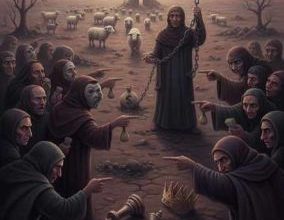
Abu Muhammad then saw Didda riding toward him at the speed of a storm. Her approach across the bodies of the dead seemed to carry a message of death itself. How terrifying she looked—this was not the Didda he had seen just moments before. That Didda’s body language had held gentleness; this Didda was devoid of any softness. She seemed like an arrow of death racing straight toward him.
Abu Muhammad realized that by mistaking Didda for weak, he had stepped into her trap. This queen was a demoness—one who could turn a beautiful landscape into a cremation ground in the blink of an eye.
Didda came and stood face to face with Abu Muhammad. From her eyes, it seemed as though molten lava from a volcano was pouring forth. He had never imagined that a beautiful woman could assume such a fearsome form of Rudrani. At the sight of Didda, something broke within Abu Muhammad. He dismounted and stood on the ground; his sword slipped from his hand and fell to the earth.
From the direction of Kabul, the terrifying ascetics spread across this valley of death, shouting “Har Har Mahadev!”—the sound resonating like the roar of war drums.
Didda leapt down from her horse and charged toward Abu Muhammad. She now appeared like the Hindu goddess Kali herself. Screaming fiercely, Didda advanced, her cry mingling with the surrounding chants of “Har Har Mahadev!”
The merged roar crashed against Abu Muhammad’s chest, choking his breath until it nearly stopped. Of those with whom he had come to conquer this land, not one remained alive. In this valley of death, he stood alone, while his enemies seemed like cremation-ground ghouls. He had heard much of Didda’s ferocity before, and now, imagining his ultimate fate, he shuddered in terror.
Didda struck Abu Muhammad, and his helmet flew from his head and fell to the ground. Grabbing him tightly by the hair, Didda snarled, “You wished to climb into my bed, did you not? Come—let me fulfill your desire.”
Saying this, Didda dragged Abu Muhammad by the hair. Before the gates of Kabul stood Bhimraj’s beloved elephant, Maharaj, trumpeting wildly like a mad beast. Screaming fiercely, Didda flung Abu Muhammad at Maharaj’s feet. With a thunderous cry, Maharaj crushed Abu Muhammad beneath his massive foot. His dream of conquering Kabul was never realized; he would not even enter the city. Before he could step into Kabul, Maharaj ground Abu Muhammad into the earth.
When this brutal event spread to the surrounding kingdoms through spies, all were seized with terror. This single incident carried one unmistakable message: under Didda’s command, the Hindu Shahi kingdom was a living chakravyuha—easy to enter, but certain death for anyone who did so. (Continues)
Click here for Part-1, Part-2, Part-3, Part-4, Part-5, Part-6, Part-7, Part-8, Part-9, Part-10, Part-11, Part-12, Part-13, Part-14, Part-15, Part-16, Part-17, Part-18, Part-19, Part-20, Part-21,
_________________
 Debasree Chakraborti is a renowned novel writer of Bengali language. Based in Kolkata, West Bengal, India, she has done Master’s in Modern History from the Kolkata University, and authored some thirty books, mostly the novels, with historical perspective and themes. Her novel is ‘Maharaja Dahir’ that covers the history of Sindh from 662, the year of first attack on Sindh by the Arab armies till date, was published last year and translated by Nasir Aijaz into Sindhi language.