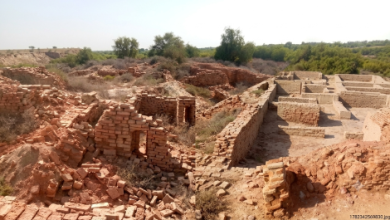
The historical site in Sindh, commonly known as Mankataro, was in fact, Manik Daro
- The site of Mankataro or Manik Daro is located approximately one kilometer from the village of Piyaro Goth in the Dadu District
- This settlement was established by Manik Rai, the son of Jesar Rai Solanki (Solangi), who founded the state and built the site that later came to be known as Manik Daro
By Aziz Kingrani
In Sindh, the historical site commonly known as Mankataro was, in fact, Manik Daro—the state of Manik of the Solanki (Solangi) tribe. This settlement was established by Manik Rai, the son of Jesar Rai Solanki (Solangi), who founded the state and built the site that later came to be known as Manik Daro, meaning “the mound of Manik.” The historian Yousif Merik also mentions Jesar Rai Machhi (Solangi) in Tarikh Mazhar Shah Jahani.
In Persian historical texts, the original name was distorted due to limitations in the Persian script and pronunciation. It was transliterated as Manikdarah or Mankatadrah. When these Persian texts were later translated into Sindhi, translators preserved the letter “n” (Sindhi ڻ) but incorrectly rendered “r” (Sindhi ڙ) as either “r” (Sindhi ڙ), “w”, “v” or “o” (Sindhi و). This led to the corrupted form Mankataro, which came into common usage. The fact that the Persian word “darah” refers to “daro”—meaning a mound or settlement—was overlooked.
The first recorded error appears in Tuhfat-ul-Kiram by Mir Ali Sher Qania, who on page 62 of the Persian manuscript wrote Mankatadrah, misrepresenting the true name. Later Sindhi translators, without questioning the accuracy, rendered this as Maṇkataro. Subsequent historians and researchers continued to reproduce this error, further obscuring the original name. Some even wrote it as Mankataro (ماڻڪٽارو).
However, a close examination of Qania’s writing reveals that “Manak” refers to Manik (the name of ruler or settler), and “darah” refers to daro (the mound or site). Since Persian lacks the letters “n” (Sindhi ڻ) and “r” (Sindhi ڙ), the distorted name Mankadrah or Mankatadrah are actually references to Manik Daro. It is clear that the original and correct name is Manik Daro, but through transliteration errors, it became Mankataro. Some writers even gave the name symbolic meanings, associating it with the Sindhi word “manak” (pearl-like) or “the pupil of the eye.”
The site of Mankataro or Manik Daro is located approximately one kilometer from the village of Piyaro Goth in the Dadu District. According to historians, from the Arab period to the time of the Samma dynasty, there were seven Solanki (Solangi) states in the region, including in the Kachho area, stretching from Dadu to Sibi. During the Arghun era, the last of these states—Manik Daro—along with other Machhi Solangi territories, ceased to exist.
According to the Encyclopedia Sindhiana, at the time of Muhammad bin Qasim’s arrival, Mankataro or Manik Daro was a Solanki (Solangi) state ruled by Jesar Rai, son of Jajja Solanki. Based on the accounts of Mir Ali Sher Qania (author of Tuhfat-ul-Kiram), Raheemdad Khan Molai Shedai (author of Jannat-ul-Sindh), and other historians, Jesar Rai, son of Jajja Solanki, ruled Manik Daro during the reign of Nasiruddin Qabacha (1203–1228 CE).
In my view, while Jesar Rai or Manik Rai Solanki (Solangi) may have been rulers during the Arab period, they were not in power at the time of Muhammad bin Qasim’s invasion. According to Chach Nama, during Bin Qasim’s arrival, the region was referred to as the Buddhya Region, and it was under the rule of Buddhists (Channa tribe), not the Solankis. Associating the Solankis with this period is a historical inaccuracy.
Most historians agree that Manik Daro or Maṇkataro is an ancient site. If that were truly the case, it is unlikely that it would have been missed by archaeologist N. G. Majumdar during his surveys. He did conduct excavations at Lohum Daro, located near the Piyaro Goth Railway Station, which is not far from Manik Daro.
In conclusion, it is essential to correct the historical record: the actual name of the site is Manik Daro, and during the Samma dynasty, this area was under the control of the Solanki (Solangi) tribe.
Read – Pir Lakhio: A Heritage Site Abandoned
_______________
 Aziz Kingrani, hailing from village Haji Manik Kingrani, Johi, Dadu District, Sindh, Pakistan, is poet, short story writer, playwright and a researcher. He has been contributing in the fields of history and literature. He has served as a professor as well. His 17 books are published in English and Sindhi language.