Into Norway’s Enchanted Mountains, Rivers, Lakes, and Valleys
- Goats indeed play a role in tourism. It reminded me of Morocco, where locals make goats climb onto tree branches to attract tourists or even place them on tourists’ shoulders to earn money.
By Abdullah Usman Morai | Sweden
Arrival in Stavanger
Our accommodation was a charming house in a quiet neighborhood of Stavanger, complete with its own parking space. After unloading our luggage, we finally relaxed. Over dinner preparations, we enjoyed a couple more rounds of tea.
The hosts had kindly kept juice and chocolates for us. To our delight, there were also toys for children. I got particularly absorbed in the colorful building blocks, constructing all sorts of little cars from them. It pulled me right back into my childhood, to those days in Nawabshah when my uncle, Muhammad Khan, once bought me similar blocks. Back then, it was no less than a luxury. I fondly remembered him with gratitude.
 The Next Morning, A Cruise Through Lysefjord
Morning came, and after getting ready, we headed out. First on the agenda was catching our booked cruise for Lysefjord. We parked the car in a suitable spot and made our way to the harbor. There was quite a crowd, with most of the passengers being Spanish tourists, which meant announcements were being made both in English and Spanish.
Despite the cloudy weather, our journey began smoothly. Around us stretched mountains, green forests, scattered beautiful houses, and boats gliding over the water. Among these vessels was our own cruise ship, proudly carrying flags of many countries fluttering like garlands.
We followed our usual habit and headed to the upper deck, where the wind and mist added a sense of adventure. At first, we sailed through the inlets of the North Sea, passing by several small yet charming settlements. On the island of Ådnoy, we caught sight of beautiful homes. Soon after, the cruise turned its course towards Lysefjord.
 Returning to Lysefjord
I had been here once before, but this time I was determined to experience it with renewed passion. On my earlier visit, I had trekked all the way up to the mountain of Pulpit Rock or Preikestolen above the fjord, where I gazed down upon Lysefjord from a bird’s-eye view, even spotting the tiny cruise ships below.
But now, the experience was reversed: I was on the cruise itself, sailing through the fjord’s waters, while from above, on those very mountain tops, other tourists must have been looking down upon us.
 Surroundings and Scenery
Well, whenever we saw a beautiful view, we would stop and capture memorable photos and selfies together. Just like on other cruises, passengers on this one could also buy tea, coffee, or other refreshments. After some time, the ship sailed under the bridge built across Lysefjord. That bridge, surrounded by the natural landscape, mountains, and the waters of Lysefjord, looked strikingly beautiful. As the cruise approached and passed beneath it, tourists eagerly took countless photos.
The clouds in the sky grew thicker, though no rain fell. The breeze carried a chill, making people feel slightly cold, but we had our summer jackets with us for protection. After some time, the cruise stopped beneath a cave called Fantehola. We were told that, in earlier times, some rebels used to hide here to escape taxes and police.
I wondered how they even reached there, given that water surrounded us and mountains stood like walls all around. Perhaps they had the skills needed for such tasks. I thought further, maybe even in those days, people didn’t want to pay taxes. But if they were sure the tax money would be spent on their welfare, perhaps they would have accepted it more willingly.
Waterfalls of Lysefjord
From different directions, waterfalls streamed down into the Lysefjord, becoming part of its waters.
 Feeding the Goats
After a while, to entertain the tourists further, the cruise stopped near a spot where the staff fed some goats standing on a rocky slope between the mountain and the water. Tourists applauded and enjoyed the sight. Every passing cruise repeats this little ritual.
I have loved goats since childhood, and the moment reminded me of the goats we raised back then, whom we had even given names, one was called Meni and the other Deni. Whenever I visit Khiari Sharif, near Nawabshah, the village of dear friend Mr. Pir Hamadullah Khiari, my heart fills with joy at seeing their goats and taking pictures with them.
Goats indeed play a role in tourism. It reminded me of Morocco, where locals make goats climb onto tree branches to attract tourists or even place them on tourists’ shoulders to earn money. Not just goats, many animals play a role in tourism: kangaroos and koalas in Australia, camels in deserts, or wild animals across many African countries. The point is simple: people always find ways to earn money, well, let them earn, my friend!
Curiosity about the Goats
When the cruise moved on, curiosity struck me. Who takes care of these goats? Whose goats are they? Why are they here? Unable to resist, I asked the cruise staff. They explained that the goats belong to a farmer. During the summer months, the cruise company pays him to keep his goats there, so tourists can enjoy this experience. That cleared up the mystery.
Meanwhile, a few colorful kayaks floated here and there in the Lysefjord.
Pulpit Rock and Hengjanfossen Waterfall
After some time, we reached directly beneath the world-famous square cliff Preikestolen (Pulpit Rock). From above, we could spot some tourists waving toward our cruise, though they were far up at a dizzying height.
A little further, near the Hengjanfossen waterfall, the cruise stopped again. This waterfall cascades down from a height of about 400 meters into the Lysefjord. The water sprayed heavily onto our faces, and the sound was thunderous. Like the other tourists, we admired the raw beauty and captured plenty of photos.
But every journey must end. Eventually, it was time to return. The cruise followed the same route back and dropped us again at Stavanger.
 Exploring Old Stavanger
Now it was time to wander the city on foot. Roaming here and there, we reached the old part of Stavanger, called Gamle Stavanger.
This area is famous for its 18th-century wooden houses. And famous they should be, what beautifully built houses they are! Most are painted white, with red rooftops, while the narrow alleys are paved with small stones. Outside nearly every house, pots of flowers in various colors were placed, adding charm.
We also noticed some Arab tourists here and there, often accompanied by their wives and children. Vickey thought perhaps, since Arab countries are generally hot, their tourists prefer to visit cooler countries during the summer.
Breivatnet Lake and Playful Birds
Strolling further, we reached Breivatnet Lake, which spans about eight acres. In the middle of the lake, a large fountain rose, enhancing its beauty. Around the lake, we saw a few statues.
At one spot, mothers and children played with hundreds of pigeons. The children tossed grains into the air, and the birds swarmed around them, filling the air with fluttering wings and cheerful sounds.
We, however, had nothing to attract the birds. A woman nearby noticed our interest and kindly handed us a packet of grain, saying, “Here, you feed the birds too.” Well, who would refuse? We grabbed it eagerly, placing grain on our hands, arms, and even on our heads. Soon, we were under a full-on “attack” of pigeons. We laughed, enjoyed ourselves thoroughly, and captured countless photos.
The Colorful Streets of Øvre Holmegate (Fargegata)
With hearts full of joy, we continued walking toward our next destination: Øvre Holmegate, also known today as Fargegata. This vibrant street has become one of Stavanger’s most famous attractions because of its colorful houses, drawing both locals and tourists alike.
Originally, it was just an ordinary street until an artist began painting it in bright, lively shades. That creativity soon turned it into a celebrated spot. Today, the street is exclusively for pedestrians, lined with cafés, restaurants, and souvenir shops.
Tourists and locals alike were enjoying the pleasant weather and atmosphere. Restaurants and cafés were full of people, their chatter filling the air. As we strolled through the lively street, a drizzle began to fall, but that did not deter us; we kept walking, enjoying the surroundings. Truly, the colors gave this street a charm unlike any other.
At that moment, a memory surfaced in my mind of “Kafeel Bhai of Ghotki,” a character who had become famous across Pakistan for painting his name on every truck passing through Ghotki. Just as he left his colorful mark on passing vehicles, here in Stavanger, another artist had used his love of painting to transform this street into a world-renowned landmark. Both men had only brushes and paints in their hands, yet their passion brought color and recognition.
Indeed, we too should add colors to people’s lives instead of making them barren.
Before moving on, we took some memorable photos. Seeing others enjoying meals made us realize we were also hungry. So, I searched for a local restaurant on Google, and it led us to India Tandoori Restaurant, conveniently nearby.
 A Warm Meal in the Cold Weather
“Let’s go for lunch,” We all said. Google helped us find nearby Indian/Pakistani restaurants. The restaurant seemed to be run by Nepalese owners. Imagine this: a cold breeze, a cloudy sky, and hot, traditional South Asian food; it was enough to make us forget we were far from home.
After the meal, we enjoyed desi-style tea, chatting for a while. Then suddenly it struck us, we hadn’t come here to just sit around, but to explore. So, once again, we stepped out to continue discovering the city.
Stavanger Petroleum Museum
This region of Norway is rich in natural oil reserves, and oil rigs can be found nearby. To present the entire process of oil exploration and production in one place, Stavanger has a Petroleum Museum, which is a popular attraction among tourists.
The museum reminded me of my Sarwan Memon, also known as Bobby Memon, who works as an engineer on oil rigs, not in Norway, but in Saudi Arabia.
Since we were short on time, we only explored the open sections of the museum before heading back toward the city center to buy a few souvenirs.
The Journey to Månafossen Waterfall
In Northern Europe, summer days are long, with sunlight stretching late into the evening. That gave us more time to travel, and our next destination was Månafossen Waterfall.
To reach it, we had to trek uphill for about half an hour. The drive from Stavanger to Månafossen took nearly one and a half hours, through beautiful mountain roads and tunnels. Sunil skillfully drives the car through winding routes until we reach the parking area near the waterfall.
There were many tourists around, some with caravans. Owning a caravan, I thought, is a sign of true love for travel. Families bring their mobile homes with them, so they can stop wherever they like, spending nights amidst nature whenever they wish.
We packed our tea, juice, and water, preparing for the trek. Before starting, I asked a German couple who were coming down the trail whether the climb was difficult and how much time it might take. They smiled and replied, “It depends on your pace and energy.”
I thanked them and started walking when suddenly the girl asked, “How will you carry that water bottle and juice in your hands?”
I was surprised, “Why? What’s the issue?”
They explained: “At some points on the trail, you’ll need both hands free to hold onto chains fixed along the rocks for support. It’s important to keep your hands empty.”
Only then did I realize the situation. So, we put everything into our travel bag and began our trek properly.
Slowly, step by step, catching our breath along the way, we kept climbing higher. Sometimes we had to pause to give way to people coming down, and at other times others stopped letting us pass.
Hearing Tales of Hidden Mountains and the Journey to Månafossen Waterfall
I had heard that perhaps even in Lahoot Lamakan, there exists a mountain where people climb up and down with the help of chains. God knows if that is true; I have yet to venture there myself. However, after almost half an hour of trekking, the view that unfolded before us wiped away all fatigue. We were thrilled that the trek had been worthwhile.
We took plenty of photos with the waterfall, where many young Latvian boys and girls had come for sightseeing. We even requested their help to take some group photos of ourselves. I noticed one tourist among them staring intently at the waterfall and the flowing water, perhaps trying to absorb the view deep into his soul.
The Månafossen Waterfall cascades from a height of almost ninety meters, plunging through the mountains as if a hole had been carved in the rock, and water simply pours out from it. God’s creation is truly magnificent, and I was grateful to witness this natural wonder.
We spent a short while sipping tea in front of the waterfall along with some biscuits. There’s a special joy in sharing such memorable moments with friends. The sky had cleared, the sun was out, and while there were other trekking trails leading higher up the mountain, we had to descend from this point. On our way down, we chatted briefly with some young girls from Kurdistan who had been living in Stavanger for quite some time. Speaking a mix of Kurdish and Pakistani languages, we lingered a little longer in conversation before finally bidding them farewell.
 Riverside Encounters and Friendly Locals
After descending, we moved to the other side of the parking area to visit the nearby Månalona River. There, we met the English owner of the caravan. He was cheerful and friendly, and even behind his glasses, his eyes sparkled with warmth. We exchanged pleasantries, and he told us that his son lives in Norway while he and his family were traveling in the caravan for several days. Pointing to his wife, daughter, and son who were standing slightly apart from the caravan, he introduced them as his family.
He had arranged chairs and tables outside the caravan, where we spent some time. At one point, I wanted to take a photo on a large stone in the middle of the river, climbing over smaller rocks. The Englishman offered to take the photo himself, saying, “You go ahead, I’ll take your photo from here.” The river’s water was crystal clear, and though it was evening in the valley, the sunlight still dominated the mountain peaks. He took many photos for us, and Ada Jan spent time chatting with him, as both lived in the UK.
We enjoyed the surroundings and took a memorable selfie in front of the Månafossen Waterfall information board before getting back into the car for our next destination.
The Journey to Seljord and Scenic Mountain Roads
We left the Månafossen area around seven in the evening. Our next stop was Seljord, a small town where we would spend the night. The journey from Månafossen to Seljord was nearly six hours, following winding mountain roads rather than a main highway.
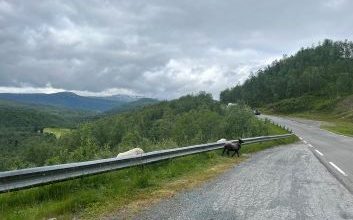
Along the way, we encountered caravans of tourists and flocks of sheep roaming freely on the roads. Some grazed near distant mountains, with no shepherds in sight. In the far-off mountains, we also saw beautiful houses, winding roads leading to them, and modern vehicles parked outside, likely belonging to the owners of the sheep. Such sights are usually seen only in films, postcards, or travel magazines.
At several points, we slowed the car or stopped briefly because of sheep crossing the road. This allowed us to take some great photos of the landscape.
High Mountains, Snow, and Evening Conversations
As we continued, we saw patches of snow, indicating we were traveling high in the mountains. The sun eventually disappeared behind the peaks, and outside views faded. Inside the car, we enjoyed food and drinks, shared stories and jokes, discussed politics, and talked about life in developed countries and the struggles of constant effort.
Late at night, we reached a petrol station, which was closed, but a person informed us that another station slightly ahead was open 24/7. We reached there and realized we had arrived in Seljord. We bought some essentials and noticed that people could also order food from the petrol station’s restaurant, which made things convenient. Several teenagers were there, enjoying a weekend. Despite their rowdiness, one responsible young man ensured everyone traveled safely in a small vehicle.
We bought some supplies for the morning and then arrived at a booked house in Seljord. This would be our last night in Norway for this trip.
Morning Awakening and the Scenic View
When we woke up in the morning, the view unfolded right before us. The town lay in a valley amidst the mountains, and beneath one of the mountains was a beautiful lake. After having breakfast, we got ready, took some memorable photographs, and prepared to leave the town.
A Reminder of Skilled Craftsmen
The town was still quiet. At one place, a worker was painting a house; perhaps he was the owner. This reminded me of Abdul Karim Soomro, also known as Adlo from Moro, who is not only skilled in masonry but also an excellent painter. Adlo is extremely hardworking; whether it is day, night, or even the weekend, he never refuses work. Seeing this worker painting on a weekend, I remarked that he was “the Adlo of Norway.”
Journey to Oslo
Our next destination was Oslo, the capital city of Norway, which was about two and a half hours away from there. Dark clouds had gathered in the sky once again. Along the way, we saw the same stunning views: mountains, beautiful houses, herds of sheep, meadows, and lakes. Eventually, we reached Oslo.
 Exploring Oslo on Foot
After parking the car, we set out on foot to explore the city. In Oslo, we saw the famous Lion statue and visited Central Station. We also admired the exterior of the city’s cathedral. Walking along Karl Johans Street, a pedestrian lane, we explored various souvenir shops. Eventually, we reached the famous Oslo Opera House, where we climbed to its upper levels. From there, we enjoyed the view of ships and boats moving on the surrounding water and the cityscape. On top, there were many tourists and locals, including four Sindhi people on that day.
Observations in the Park
On our way back to the car, we noticed a small house built for pigeons in a park. Outside it, many birds were pecking at grains. It reminded me of the birdhouses at the Dargah Khiari Sharif of Nawabshah. Just like birds need food, water, and shade in summer, in Oslo, they also need such houses to protect them from harsh winters or heavy snowfall.
Encounters and Friendships
In the parking area, we met Dr. Izhar Chaudhry, a friend of Ada Jan . We chatted for a while. He even recognized Sain Ghulam Mujtaba Soomro from Badin, who had lived in the Pakistani Embassy in Oslo for many years. Ada Jan was supposed to stay in Oslo with his friend, Dr. Izhar Chaudhry, for a few days before returning to the UK,
Visiting Grønland, The Immigrant Area
Later, Vickey, Sunil, and I visited Grønland (Greenland in English), the famous immigrant neighborhood in Oslo, which has many desi shops and restaurants. We had lunch at a Pakistani restaurant, where the number of women wearing scarves was higher than the number of men; perhaps some of them were the restaurant owners. We also purchased some desi items from nearby stores. On the way back, near the parking area, we even enjoyed some desi-style kulfi made from milk.
Conclusion of the Journey
Thus, our long passage of nearly three thousand kilometers, woven with the grandeur of mountains, the music of waterfalls, the mystery of tunnels, and the stillness of serene lakes, came gently to its close. With rain tracing quiet patterns upon the windows, Vickey, Sunil, and I continued onward along the E18, carrying with us not just the road to Stockholm, but the silent echoes of all that the journey had given. (Concludes)
Click here for Part-1, Part-2, Part-3
__________________
Abdullah Soomro, penname Abdullah Usman Morai, hailing from Moro town of Sindh, province of Pakistan, is based in Stockholm Sweden. Currently he is working as Groundwater Engineer in Stockholm Sweden. He did BE (Agriculture) from Sindh Agriculture University Tando Jam and MSc water systems technology from KTH Stockholm Sweden as well as MSc Management from Stockholm University. Beside this he also did masters in journalism and economics from Shah Abdul Latif University Khairpur Mirs, Sindh. He is author of a travelogue book named ‘Musafatoon’. His second book is in process. He writes articles from time to time. A frequent traveler, he also does podcast on YouTube with channel name: VASJE Podcast.