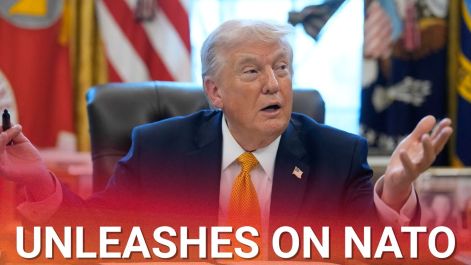
America’s NATO allies are—according to Donald Trump—”cowards” for failing to join his war in Iran.
By Tom Arms | London
America’s NATO allies are—according to Donald Trump—”cowards” for failing to join his war in Iran. He later added that the US would “never forget” the position of the Europeans at this “critical juncture” in world history.
Trump’s anti- NATO rants reveal an astonishing ignorance of the legal and political obstacles facing other world leaders who want to wage an ill- conceived and poorly executed war which threatens to escalate and plunge the world into economic depression.
It is not entirely clear how, but Trump alone the world’s democracies appears to ride roughshod over international and domestic laws to wage a dangerous war.
America’s Founding Fathers foresaw the possibility that a dangerously hubristic individual might one day occupy the White House. That is why Article One of the US constitution gives Congress– not the president—the power to declare war.
There are, however, get-outs for a belligerent president to respond quickly to sudden attacks. For a start the Founding Fathers changed the wording of Article One from “make war” to “declare war.” The change was meant to allow the president to respond to a sudden attack—but not to initiate.
In the wake of the Vietnam War, the president’s war powers were restricted further with the 1973 War Powers Act. This legislation instructs the president to inform Congress within 48 hours of the start of military action. If Congress fails to approve the action then troops have to be withdrawn 60 days. There is room for a further 30-day extension if required—but that’s it.
Congress also has the power of the purse which means that it can simply refuse funds to finance the fighting. The Iran War is costing $1 billion a day which is coming out of the existing defense budget. Trump, however, is said to be planning to ask Congress for an additional $200 billion.
If domestic guardrails against an offensive war are not enough, there are international laws which Trump is supposed to contend with. The main such law is the UN Charter. This prohibits offensive war except in self-defense or under the umbrella of a Security Council resolution. Trump’s attack on Iran is one of many illustrations of Trump’s contempt for the UN and international law.
The democratic middle powers—many of whom are in NATO—do have to contend with both international and internal laws when it comes to war. Failure to do so can have severe and immediate consequences for America’s allies.
Britain and PM Keir Starme is any easy attack for Trump’s anti-NATO rants. The UK is meant to have a “Special Relationship” with the US. That relationship led to British involvement in the Korean War, the Iraq wars of both Bushes, the attack on Libya and, of course, Afghanistan. Commonsense, however, kept the UK out of Vietnam. And American opposition to the Suez War led to its rapid and ignoble end
Having said that, Britain’s unwritten constitution and parliamentary democracy has meant that it was easier for the prime minister to launch a war than most democratic leaders. That is until 2011 when a parliamentary convention took effect. The convention which grew out of opposition to the 2003 Iraq War limits the PM’s power to wage war.
Under the 2011 War Powers Convention MPs agreed to debate and vote on any military action before it happens—except when under attack.
A parliamentary convention is not a law. It is a bit like Britain’s unwritten constitution in that it is designed to provide room for manoeuvre. But at the same time, a British prime minister ignores a convention at their peril. The 2011 convention led to Britain refusing President Obama’s request to join in the bombing of Syria. But then in 2014 parliament voted in favour of war against ISIS.
Across the Channel, the French president is seen by many as having Europe’s strongest executive powers. This is true in almost every political category except defense. President Emmanuel Macron is commander-in-chief of the armed forces which means he has broad operational freedom, especially for rapid deployment. But the French National Assembly must approve any long-term military adventures.
Under Article 35 of the constitution, the president, through their prime minister– must inform parliament within three days of any military intervention. Parliament must approve it if it last more than four months. And if the president fails to secure parliamentary approval than French troop must be withdrawn—immediately.
Restrictions on the German Chancellor to wage war have grown out of the fear of Prussian militarism following two world wars in the 20th century. German’s postwar constitution (the Basic Law or Grundgesetz) is clear: “Acts tending to and undertaking intent to disturb the peaceful relations between nations, especially to prepare for a war, shall be unconstitutional.”
In 1994 this constitutional brake was strengthened by a federal court ruling that any decision to deploy German troops must have the approval of the Bundestag before any deployment. The only exceptions are a national emergency such as flooding or if Germany is attacked.
Germany’s Axis ally—Italy—has similar restrictions. Article Eleven of Italy’s post war constitution renounces war as “an instrument of aggression”. The constitution prohibits using military force for anything other than self-defense, peacekeeping, natural disasters, and fulfilling international obligations. And—as in Germany– parliament must approval the use of the military before deployment.
Postwar restrictions on the Japanese military were the most onerous of the lot. Under the constitution imposed by the Allies, Japan gave up the right to wage war and the right to use force to settle international disputes. Over the years, successive government have “re-interpreted” the constitution to enable Japan to enjoy the world’s tenth largest military establishment. But the “Self-Defense” forces are heavily constrained.
The Japanese government can use the military only for “collective self-defense;” to provide logistical support to allies and to participate UN peacekeeping operations. After 81 years of being Asia’s good boy, the Japanese feel it is time to loosen the military reins. In 2023 the Japanese National Security Strategy struck a slightly more militaristic tone when it declared that Taiwan’s stability is “indispensable to Japanese security.” Since 2024, the Japanese defense budget has risen 21 percent,
Democratic Japan’s main potential enemy is China. Xi Jinping has no restrictions, guardrails, restrains or checks on his control of the military. The Chinese constitution gives the Chinese Communist Party (CCP) and the Central Military Commission (CMC) total control of the People’s Liberation Army (PLA) which reports to the party, not the government. Xi is General Secretary of the communist party, chairman of the CMC and, just for good measure, president of the People’s Republic of China.
Russia—Europe’s main enemy—is similarly unconstrained. President Vladimir Putin has total control of the military—as long as he does not use the word “War.” Letting slip the three-letters would trigger a completely different legal regime inside Russia. Martial law would be declared. A general mobilization would be introduced along with mandatory economic measures. But worst of all, the Russian parliament (the Duma) would assume oversight of any military operations.
Trump has taken a leaf from Vladimir’s playbook and is also shunning the word “War.” In his lexicon, the war with Iran is “major combat operations.” Trump would not encounter legal problems if he used the nasty three-letter word. But his staff reckon he would suffer a political backlash from a base whom he promised: “No more wars.”
Of course, most of Trump’s MAGA base realizes that Trump’s actions in Iran are much more than “major combat operations.” Opinion polls indicate that they also know it is a mistake. Which brings this article to the final constraint that democracies—including the United States—have on their ability to launch wars whenever and wherever they want—public opinion.
Read: Observations of an Expat: Iran
____________________
 Tom Arms is foreign editor of Liberal Democrat Voice. He also contributes to “The New World”, lectures on world affairs and is the author of “The Falklands Crisis,” two editions of “Encyclopedia of the Cold War” and “America Made in Britain.”