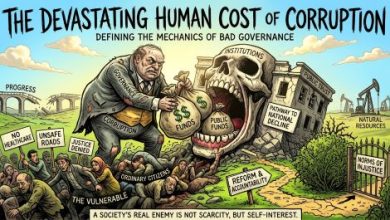
While public focus in Tharparkar frequently centers on poverty and suicides, an overlooked crisis unfolds on its roads each monsoon.
- Administrative negligence—manifested through unlicensed drivers, unregulated private coaches, and absent speed enforcement—transforms preventable traffic incidents into fatal tragedies. Transforming transport oversight from casual dismissal to active legal accountability is essential to stopping this recurring toll.
Zaheer Udin Babar Junejo
Mithi, Tharparkar: Every monsoon, the narrative surrounding Tharparkar’s growing body count unfolds with agonizing regularity. Poverty drives suicides. Lightning strikes fell on people caught in storms. Individual recklessness is the scapegoat for traffic fatalities. The one actor capable of altering these tragic numbers, however, the district administration, rarely receives the necessary focus.
While this year’s monsoon 2026 has so far been relatively subdued, it has already claimed numerous lives in Tharparkar’s districts, including Chachro, Islamkot, Nagarparkar, and Diplo, through events such as lightning strikes, drowning in flooded areas, and electrocutions. Yet, beneath these incidents lies a more consistent and often overlooked pattern: motorcyclists run down by speeding coaches, families obliterated when buses skid or overturn on waterlogged or poorly maintained roads. Even before the wet, slippery roads exacerbated by this year’s rainfall, traffic accidents remained Pakistan’s top cause of trauma-related fatalities. This monsoon alone, the number of people in neighboring regions killed in “weather-related” accidents is staggering, even though most could have been averted with a safe transport system, enforceable speed limits, and properly licensed drivers.
Time and again, in the aftermath of these tragedies, residents of Tharparkar have made it clear that the district authorities remain conspicuously absent in the areas where the deaths occur, whether it be a flooded pond claiming a young life or a roadside that becomes a death trap due to an unlicensed driver. The familiar sequence repeats: a life is lost, condolences are expressed, and no systemic change materializes before the next fatality.
When a Tharparkar resident ends their own life, the narrative is readily available: poverty, debt, hunger, and a state failing to provide. This portrayal is not inaccurate, nor is it unwarranted; it has spurred important discussions about Thar’s economic marginalization.
However, when a motorcyclist is flattened by a speeding bus or a packed coach carrying passengers flips over due to a driver’s incompetence, the incident is casually dismissed as fate or an accident. No one investigates who issued the driver’s license, who was responsible for enforcing speed restrictions, or why the private coach was allowed to operate in the first place. No one holds the transport department accountable in court. Yet, the annual toll of people killed in traffic incidents in Tharparkar, whether as pedestrians, motorcyclists, or passengers in poorly maintained vehicles, potentially surpasses that of suicide, simply by virtue of not commanding the same headlines or public outcry.
This disparity is not a coincidence. Poverty represents a slow-burning structural issue, abstract enough to be pointed to without naming a culpable individual. In contrast, a speeding bus driven by an unlicensed operator involves concrete elements like a license, a route, an owner, and a regulatory body supposed to be overseeing operations. Holding the administration accountable for this is more challenging and potentially inconvenient for those charged with oversight.
If the district administration in Tharparkar is serious about saving lives rather than merely lamenting them, implementing effective measures is not a mystery. These are the same traffic-safety strategies recommended by experts for years, and they require minimal technological intervention, primarily a commitment to enforcement:
- Strict regulation of private vehicles and motorcycles on hazardous corridors – particularly during monsoon season and periods of high traffic like Independence Day, when road usage increases and slippery conditions pose a greater risk.
- Transition from ad hoc private transportation to regulated public transport servicing towns in Tharparkar, directly operated and monitored by the district administration instead of allowing unregulated private coaches to compete and speed.
- Zero-tolerance approach to licensing enforcement for all vehicle types. Drivers of fatal accidents in Sindh this year had expired or invalid licenses, a systemic failure not a chance occurrence.
- Enforceable speed limits with visible police presence on accident-prone routes, rather than mere advisory signs that are largely ignored.
- Unwavering application of enforcement rules for everyone, including politically connected transporters, informal transport services, and holiday traffic. Introducing double standards in enforcement constitutes administrative neglect.
Blame will always be initially directed at individual drivers because it is easier than scrutinizing a licensing regime or investing in public transportation. However, any district that tolerates unlicensed drivers, uncontrolled private coaches, and ignored speed limits is actively choosing to sacrifice lives – a decision repeated each monsoon, each holiday, and each time a family mourns a loved one who should have reached home safely.
Tharparkar requires an administration willing to accept responsibility and be held accountable in court, and courts to run a fair trial, much like any other criminal, when negligence leads to preventable deaths on its roads. These are not acts of fate, but policy failures with a deadly body count that will persist as long as the officials responsible for licensing, road safety, and public transport are not held to the same standard of scrutiny as “reckless drivers.”
Read: Stop the Tears Before They Fall
___________
 Zaheer Udin Babar Junejo is Community Driven Development Specialist based in Hyderabad.