Image Theatre is considered one of the contemporary theatrical trends that has granted the image a fundamental role in constructing the theatrical performance
Souad Khalil | Libya
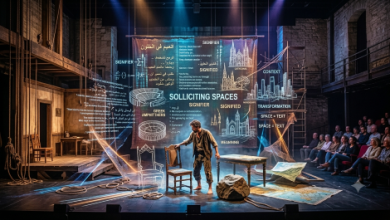
Image Theatre is considered one of the contemporary theatrical trends that has granted the image a fundamental role in constructing the theatrical performance. The word alone is no longer sufficient for expression; rather, it has become part of a broader system of signs. Within this framework, this article examines the concept of vision in Image Theatre based on a study by Dr. Riyad Mousa Kasran, with a focus on the experience of the director Salah Al-Qasab.
Regarding the concept of Image Theatre, this is a brief study. Given the importance of this subject, we address the notion of vision in Image Theatre according to the study conducted by Dr. Riyad Mousa Kasran. It is an in-depth study grounded in references and research on theatrical performance through semiotic approaches, considering performance as a communicative form that encompasses various modes of expression and is closely related to communication studies.
There is a clear emphasis on the primacy of vision as a channel of reception within the basic communication process, due to the multiplicity of its modes of transmission and reception. In his study, the author refers to the works of Salah Al-Qasab as a model.
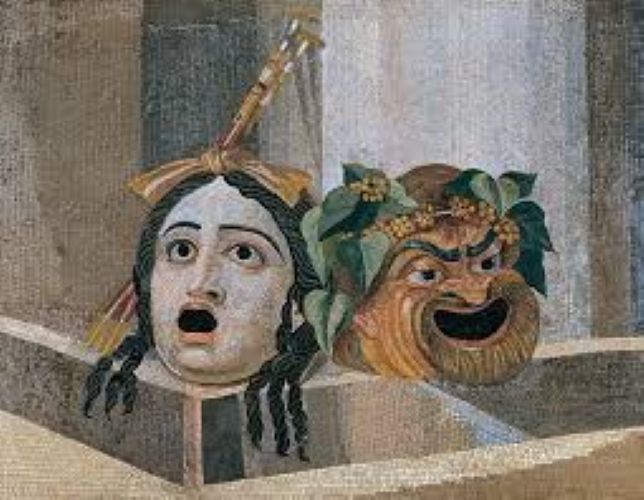 In the field of studies concerned with signs and their classifications, some argue that what prompted Umberto Eco to write The Role of the Reader was Charles Peirce’s concept of the unlimited semiosis of signs. Eco sees the dominant communicative model proposed by information theory as consisting of: sender – message – receiver, where decoding the message depends on the existence of shared codes between the two parties of the communication process. This process begins by stimulating the receiver and motivating them to search for the possible meanings of the elements of the performance.
Thus, the recipient engages with the performance through a multi-layered system of signs. Tadeusz Kowzan classifies thirteen systems operating within theatrical performance: speech, music, facial expression, gesture, movement, makeup, hairstyle, props, costume, décor, lighting, musical score, and sound effects.
Visual signs occupy nine out of these thirteen systems, while auditory signs occupy three, excluding speech, which constitutes a relatively small proportion. Speech includes everything spoken in the performance: dialogue, monologue, and commentary.
The theatrical space is formed only through the interaction of its active elements, and through scenography in the performance of moving components. The importance of this concept of space—referred to as non-formal space—is evident in contemporary theatrical experiments such as Peter Brook’s “empty space,” particularly in the development of modern scenographic innovations, whether through mobilizing space, abstracting it via lighting and actors’ movement, or through the use of light, image, and sound technologies, as seen in the works of Richard Foreman and Robert Wilson.
According to the study by Riyad Mousa Kasran in his reading of the works of director Salah Al-Qasab, which he adopts as a model for vision in Image Theatre, he states:
The spaces of Image Theatre in the work of Dr. Salah Al-Qasab are linked to those domains that semioticians have sought to explore. His directorial vision relies, to a large and vital extent, on the density of signs presented in the performance and on the interwoven relationships among them.
The semiotic act in his work operates through an infinite number of possible structures, involving stimulation, repetition, exclusion, correction, opposition, and the formation of new signs, in a simultaneous and hierarchical manner. In doing so, he establishes a particular relationship between the performance and the recipient, within a framework of strategies that provide the foundation upon which the recipient constructs their own subject.
This mode of reception does not arise solely from the performance, nor solely from the imagination of the recipient; rather, it emerges from a dual-structured process. The recipient is governed by the totality of signals presented by the performance.
Communication is achieved when the recipient encounters what the performance produces as “gaps.” It is at these gaps that the foundation of the relationship between the recipient and the performance is established, through the recipient’s attempt to fill or bridge them.
Here, we approach the operational concept introduced by Wolfgang Iser in the interaction between text and reader, where reading occurs through filling gaps and bridging voids in order to create coherence and a renewed unity of the text.
This process grants the recipient the opportunity to breathe life into the nature of this relationship. For instance, obscuring linguistic meanings inevitably creates structured gaps that compel the recipient to search and interpret.
In this process, the recipient often sets aside relationships that are difficult to grasp until signals emerge that clarify them. Meaning is thus realized within the context in which it appears.
Accordingly, every element within the world constructed by the performance possesses its own significance, and the recipient engages with this complex system of multiple signs.
It becomes evident from this presentation that Image Theatre establishes a new relationship between performance and recipient—one based on interaction and interpretation within a complex system of signs. This vision paves the way for a deeper level of analysis, particularly in its engagement with dramatic texts and their aesthetic formations, which will be explored now.
This article delves deeper into the exploration of vision in Image Theatre, tracing its practical manifestations in the works of director Salah Al-Qasab, particularly in his engagement with Chekhov’s texts. Here, the aesthetic and philosophical dimensions of this theatrical approach become evident, as does the way in which the image functions as a tool for producing meaning and a means of opening interpretive horizons for the audience.
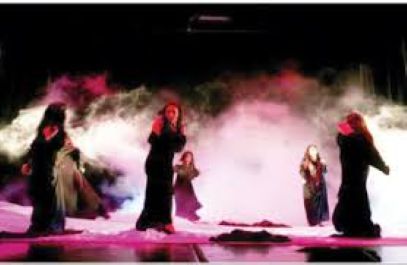
The combination of Al-Qasab’s directorial vision in Uncle Vanya and The Three Sisters, the latter being among the last Image Theatre productions, with Chekhov’s principles, had a profound impact on the presentation of tragedy. The audience is subjected to accumulated feelings of frustration, despair, and oppression, in order to rise, purified from its impurities—if one may use the Aristotelian term metaphorically—through the stimulation of memory and the destabilization of established knowledge.
Chekhov’s theatre is founded on structural and textual paradoxes—paradoxes of resemblance and contrast. Dramatic transformation or the natural development of events entails a fundamental change, not in the form or essence of the character itself, but in their relationships with others, with themselves, and with life.
Due to the elusive nature of Chekhovian plays in general, which conceal their rewards beyond immediate grasp amid a heap of words and details, the emotional energy of Chekhov’s plays does not reveal itself at first reading. It does not speak loudly but rather whispers quietly, rich with meaning.
Uncle Vanya is a play of indirect action; it addresses social failure and frustration, presenting it as a condition to be overcome. Like most of Chekhov’s plays, it diverges from traditional theatre, which focuses on plot and character development, aiming instead to convey something hidden, requiring new dramatic forms and alternative treatment methods.
Chekhov sidelined Aristotle’s logic of causal event sequence, focusing instead on the emotional life of the characters. Real-life crises do not follow a logical order; life, in his view, is a sea full of contradictions.
At another level of textual structure, the text confronts us with Chekhovian dialogue, which carries dual pathways: an apparent track and a hidden one, revealed only through a sense of profound paradox. Uncle Vanya represents a system devoid of meaning, dominating life despite the exposure of its falsity. Similarly, The Three Sisters: Olga, Masha, and Irina, express disdain for the present, nostalgia for the past, and yearning for a different life, all within an environment lacking culture and art.
Transition to Visual Composition
The formations and visual structures in these two productions operate on the rhythm of the image. Characters are not limited to responding to dialogue; they unleash a visual language in which Al-Qasab emphasizes suggestive energy, creating formations pulsing with vitality and rhythm.
The rhythm of the psyche, the event, and the character comes first, followed by the rhythm of words, which, despite its limitation, performs crucial dramatic functions. Moments of silence become essential, transforming into dynamic points of dramatic explosion.
The audience does not perceive the character as a complete entity but rather receives the “spirit of the character.” Al-Qasab breaks down the solid mass of the character into signs and hints, rendering the figures dreamlike, with blurred features that provoke contemplation and awe.
 Relationships and the Human Dimension
Relying on the fluidity of action and avoiding preconceptions, the performance allows characters to reveal their depths through multiple means, exposing the secrets of the psyche in a blend of terror, dream, and emotional participation.
Character relationships are not structured according to event sequence logic; rather, they deepen the internal dimension of each character. Each entity seems to belong to a private world, despite existing within a shared whole. This confirms that Al-Qasab does not view human relationships as external constructs but as expressions of a general human condition characterized by instability and imbalance.
Space and Place
Space in Image Theatre does not represent a physical structure but an open, free dimension without a fixed form, embodying intellectual and historical connotations. It is not mere décor; it is an active element in meaning production, transforming into a space open to interpretation, capable of signifying any place or all places simultaneously.
This grants the performance semantic richness and makes the audience a participant in reproducing meaning through interaction with the evolving space.
Philosophical Dimension and Dream
Image Theatre is linked to the realm of dreams and the unconscious, transcending apparent reality to reveal deeper layers of truth.
The image does not exhaust its semantic potential, as it points to the depths of the psyche, which are inherently ambiguous, rendering the formation more complex and its meanings more interwoven.
Here, the audience experiences the staged world as strange, as if seeing it for the first time, prompting a reconsideration of reality itself.
In light of the above, it is evident that Image Theatre, as manifested in Al-Qasab’s work, does not aim to present a ready-made meaning. Rather, it seeks to stimulate the audience to explore and interpret through a complex visual system that challenges perception and reshapes the relationship with reality.
It is a theatre that engages with dreams as much as it engages with reality, with ambiguity as much as it touches truth, making it an open aesthetic and intellectual experience that invites the audience to discover themselves and the world around them, transcending the boundaries of traditional reception.
Read: Drama and Theatre: Art in multiple forms
___________________
 Souad Khalil, hailing from Benghazi Libya, is a writer, poet, and translator. She has been writing on culture, literature and other general topics.