Is Data Privacy More Important Than National Security?
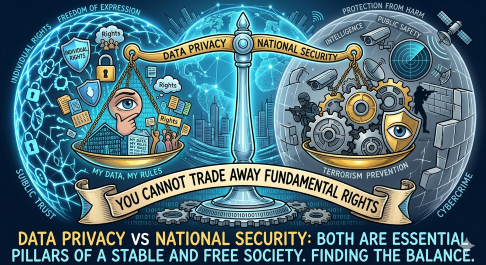
Both are essential pillars of a stable and free society. National security ensures protection from harm, while data privacy safeguards individual rights and freedoms.
Sevara Matnazarova | Uzbekistan
In the 21st century, few debates are as complex and urgent as the question of whether data privacy is more important than national security. Rapid technological advancement has transformed the way societies function, making information one of the most valuable resources in the world. Governments, corporations, and individuals are all deeply connected through digital networks, and with this connectivity comes both opportunity and risk. While states emphasize the need for surveillance and data access to ensure safety, citizens increasingly demand protection of their personal information. The tension between these two priorities lies at the heart of modern democratic discourse.
Data privacy, at its core, is the right of individuals to control their personal information and to decide how it is collected, used, and shared. In today’s digital environment, people leave behind a constant stream of data—through social media activity, online transactions, location tracking, and even biometric systems. This data can reveal highly sensitive details about a person’s identity, preferences, beliefs, and behavior. Without proper safeguards, such information can be exploited for financial gain, political manipulation, or social control. As a result, data privacy is widely regarded as a fundamental human right, closely linked to personal autonomy, freedom of expression, and human dignity.
On the other side of the debate lies national security, a responsibility that governments cannot afford to neglect. States are tasked with protecting their citizens from both internal and external threats, including terrorism, cybercrime, espionage, and organized crime. In an increasingly interconnected world, many of these threats operate through digital channels, making access to data a critical tool for intelligence agencies. Surveillance technologies, data analysis, and communication monitoring can help authorities detect suspicious activities, prevent attacks, and respond quickly to emergencies. Proponents of these measures argue that without them, governments would be operating blindly, unable to fulfill their most basic duty: ensuring public safety.
However, the expansion of surveillance powers raises serious ethical and legal concerns. One of the main dangers is the potential for abuse. When governments have broad access to personal data, there is always a risk that such power may be misused for political purposes, such as targeting opposition groups, suppressing dissent, or controlling the flow of information. Even in democratic societies, oversight mechanisms are not always sufficient to prevent overreach. Furthermore, mass surveillance can create a “chilling effect,” where individuals alter their behavior because they feel constantly watched. This can weaken democratic participation and limit open discussion, which are essential for a healthy society.
Another critical issue is data security itself. Ironically, the collection of large amounts of personal data in the name of national security can create new vulnerabilities. Databases containing sensitive information become attractive targets for hackers and cybercriminals. Data breaches can expose millions of individuals to identity theft, fraud, and other harms. In this sense, excessive data collection may undermine the very safety it aims to protect. The more data is gathered and stored, the greater the responsibility—and the risk—associated with its protection.
Despite these concerns, it would be unrealistic to argue that national security should be entirely separated from data access. The nature of modern threats often requires timely and accurate information. For example, preventing a terrorist attack may depend on analyzing communication patterns or tracking suspicious financial transactions. In such cases, limited and targeted data collection can be justified, especially when it is conducted under strict legal frameworks. The challenge, therefore, is not to eliminate surveillance altogether, but to ensure that it is carried out responsibly and proportionately.
A balanced approach requires strong legal and institutional safeguards. Governments must establish clear laws that define the scope and limits of data collection, ensuring that any intrusion into privacy is necessary and justified. Independent oversight bodies should monitor surveillance activities to prevent abuse and ensure accountability. Transparency is also crucial; citizens should be informed about how their data is used and what protections are in place. Additionally, technological solutions such as encryption and anonymization can help protect privacy while still allowing for effective security measures.
Public trust plays a central role in this balance. When citizens believe that their government respects their rights and acts in their best interests, they are more likely to accept certain security measures. Conversely, a lack of trust can lead to resistance, skepticism, and social tension. Therefore, maintaining an open dialogue between governments and the public is essential. Policies related to data and security should not be imposed without debate; they must reflect the values and priorities of the society they serve.
In conclusion, the question of whether data privacy is more important than national security does not have a simple answer. Both are essential pillars of a stable and free society. National security ensures protection from harm, while data privacy safeguards individual rights and freedoms. Prioritizing one at the complete expense of the other can lead to serious consequences—either a vulnerable state or an oppressive system. The real challenge lies in finding a sustainable balance, where security measures are effective yet limited, and privacy rights are protected yet adaptable to modern realities. Ultimately, a society that successfully harmonizes these two values is one that not only survives but thrives in the digital age.
Read: Consumerism, Data, Hyper Reality and Loss of Ethos: Technological Sphinx
____________________
 Sevara Matnazarova is student at Urgench State University named after Abu Rayhan Beruni in Khorezm, Uzbekistan