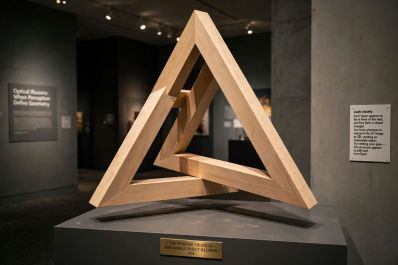
We are human, prone to error. Error becomes misunderstanding, misunderstanding becomes illusion—illusions of greatness, of righteousness, of control. And those illusions ensure the show runs to full houses, night after night, epoch after epoch.
Dr. Jernail S. Anand
How do the gods run this universe? If a small play needs conflict to hold an audience for two hours, can this vast phenomenon run merely for sport?
Drama runs on misunderstanding. Characters stumble into ‘hamartia’—Aristotle’s term for a fatal misreading—and the playwright then spins sixty episodes from that single knot. Actors display craft and character as they untangle it. The play’s engine is pleasure, but its higher function is catharsis: an audience purged, and, if it is tragedy, ennobled.
[Aside: We never ask whether animals need ennobling. Does their absence from the theatre mean they already live noble lives?]The principle is simple: drama feeds on illusion, and ends when the veil lifts, illusion vanishes, and man confronts reality.
Apply that to human life, and the parallel is stark. Life too is a drama fuelled by misunderstanding. In this state—Maya, illusion—we chase mirages born of misreading our own status. We pursue untruths and half-truths, call it knowledge, and grow blind with pride. We chase goals that do not matter, and recognize their hollowness only when we see through our actions. The moment we see our follies, passions, and dreams collapsing into nothingness is the moment of revelation. Beyond it, the drama cannot endure.
Good and evil are personified in men and women who keep this theatre in motion. Each life arrives at its own conclusion. All do not see the same reality. We each have different eyes, different wounds, and different confusions. So revelations differ. But the common disillusionment is this: stripped of pipe dreams, we wish to rest, leaving everything to doctors or divinity. We lie prostrate, powers gone, mind in stupor.
Our greatest weapon is mind, intelligence, knowledge. Yet we forget that a human being is limited, and so is his intelligence. The divine reveals itself only in flashes, in fragments. We mistake the piece of reality before us for the whole. This is the knowledge of which God was suspicious. And this partial knowing brings not peace, but restlessness. So the drama continues, through peaks and troughs.
The world that came to life millions of years ago flows into the present like a river of consciousness. Along its course we meet prophets, poets, and philosophers who tried to simplify the phenomenon so we might grasp the oneness of the divine spread. But knowledge was man’s accomplice, acting like Shakuni—usurping thought, filling the space with jealousy, hatred, anger, revenge, and self-destruction.
On this journey we meet Abraham, Moses, Krishna, Lao Tzu, Pythagoras, Confucius, Zoroaster, Mahavira, Buddha, Jesus, Muhammad, Adi Shankara, Ramanuja, St. Francis of Assisi, Guru Nanak, Khadija, Ram Mohan Roy of the Brahmo Samaj, Ramakrishna, Dayananda, Vivekananda, Gandhi, Sri Aurobindo, the Dalai Lama, and Desmond Tutu.
But every epoch also throws up adversarial figures who make the journey difficult and, perversely, adventurous. Great men often rise in response to great illusion. Without the British Empire’s colonial dream, India might not have forged the philosophy of non-violence, nor produced martyrs and thought-leaders like Bhagat Singh and Mahatma Gandhi. Without Babur’s misplaced passion for destruction, Guru Nanak might not have written in protest, and the world might lack one of its great religions.
The dialectic is clear. From power and partial knowledge tumble hotheads who cause havoc. To restore the divine equation, nature raises counterweights. Ravana, Kamsa, and Duryodhana were embodiments of arrogance, evil in its primal state. To meet them, gods sent Rama and Krishna. Arjuna, the great marksman, needed not just skill but superior vision to understand his position against a vast army.
Other rulers who derailed humanity and epitomized illusion recur across history. The Pharaohs of Egypt used forced labor for pyramids. Qin Shi Huang burned books to freeze time. Herod ordered the massacre of innocents to protect a throne. Caligula declared divinity. Nero blamed Christians for Rome’s fire. Leopold II extracted ten million lives from the Congo. Hitler industrialized death. Stalin engineered famine. Mao’s policies starved tens of millions. Pol Pot emptied cities into killing fields.
How will the gods account for these men, except that they lived in profound illusion—misreading the divine text, bringing misery to innocents, and, in their way, pushing the drama forward, making history a thrilling, terrible account? Drop Duryodhana from the Mahabharata, Ravana from the Ramayana, or any of these rulers from time, and the stage risks going dark.
If great men aid humanity’s spiritual evolution, those on the negative side fill history’s chapters with detail and dread—and with lessons. The greatest lesson is that history repeats. But perhaps it repeats not because we fail to learn, but because illusion is structural. Maya is not a bug in the system; it is the fuel. Remove illusion from man and the theatre goes dark.
We are human, prone to error. Error becomes misunderstanding, misunderstanding becomes illusion—illusions of greatness, of righteousness, of control. And those illusions ensure the show runs to full houses, night after night, epoch after epoch.
Read: Cultivating Global Ethics for Next Generation
__________________
 Dr. Jernail S. Anand is a Chandigarh-based polymath with 200 books, including 20 epics, founding President of the International Academy of Ethics, a laureate of the Charter of Morava, Seneca, Franz Kafka, and Maxim Gorky. His name is etched on the Poets’ Rock in Serbia. He is an Honorary Member of the Serbian Writers Association, Belgrade. [Serbia]
Email: anandjs55@yahoo.com
Bibliography: https://sites.google.com/view/bibliography-dr-jernal-singh/home