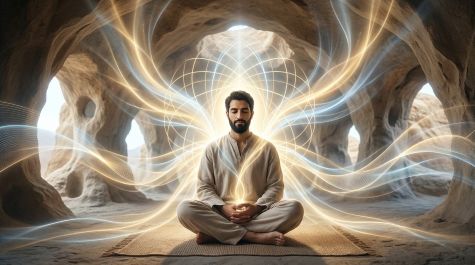
To differentiate them from statements supported by science, these notions can be framed as spiritual or self-development concepts.
Ali K. Lashari
A person’s aura is a faint electromagnetic field that envelops them, according to spiritual traditions. It is commonly linked to feelings, presence, self-assurance, and emotional condition. According to scientific research, there is no proof that people have an aura that influences those around them. The way you carry yourself, express yourself, speak, control your emotions, and exude self-assurance can have a significant impact on how people view and react to you.
Inner relationship with Allah
“Whoever sets right what is between him and Allah, Allah will set right what is between him and the people.”
Reference: Nahj al-Balagha, Wisdom 89 in commonly used editions.
Aura connection: A peaceful and sincere inner state can influence how a person interacts with others.
An essential spiritual rule is brought to light in this story: the way we act in the world reflects how we feel inside. Your everyday existence undergoes a sea change when you decide to pursue divine joy rather than human expectations.
The Transition from Pleading with Others to Serving a Higher Power
You can escape the never-ending quest for human approval when you make Allah’s approval (Taqwa) your first priority. When one is secure within themselves, they exude an honest and trustworthy attitude.
Taqwa as inner strength
“Taqwa is the best protection.”
Reference: Nahj al-Balagha, Wisdom 3, in commonly cited translations.
Aura connection: Spiritual strength comes from consciousness of Allah, self-control, and ethical conduct—not from external appearance.
“Low feminine energy”; gorgeousness
Rather than being a scientific measurement, “feminine energy” is a notion from contemporary spirituality and self-development. Receptivity, warmth, emotional openness, elegance, serenity, and self-assurance are commonly linked to it in this framework. Disconnection from these attributes can have an indirect impact on beauty. This is not due to some unseen force, but rather to the fact that factors like stress, uncertainty, guardedness, or a negative self-image can alter one’s social presence, communication skills, and posture.
Not only is there no hard and fast rule about what constitutes a feminine energy type, but there is also no rule about what constitutes an appealing personality type.
Activating the third eye
Communication, honesty, self-expression, and awareness are all linked to the throat chakra (Vishuddha) in yogic and spiritual traditions. Tradition has it that one can “open” or balance it through practices like meditation, chanting, attentive breathing, writing, and speaking publicly.
The idea that one can physically open a chakra has not been supported by scientific research. Nonetheless, confidence, self-awareness, and the ability to articulate one’s emotions are all areas that might benefit from these techniques.
A realistic approach to bridging all three:
Psychological well-being → nonverbal cues → expression → interpersonal impact.
Confidence, emotional awareness, and interpersonal presence can be fostered by underlying activities, even in the absence of scientifically validated spiritual terms.
Patience is strength
“Patience is a kind of courage.”
Reference: Nahj al-Balagha, Wisdom 3.
Aura connection: A calm person who can control reactions projects inner strength and stability.
While maintaining a clear separation between Islamic teachings and the modern “aura/energy” idea, these can be included into a faith-based framework for human development.
Establishing a Connection with Allah Enhances Your Inner Being
A person’s inner condition and character can be changed by a closer connection with Allah through Salah, Dhikr, Qur’an, Dua, Tawakkul, and real repentance. “Surely, in the remembrance of Allah do hearts find comfort” (Qur’an 13:28), as emphasized by Muslims, offers peace to the heart.
Worship does not really create a tangible “aura,” but rather spiritual illumination, tranquility, self-assurance, modesty, and good character.
The Influence of the Aura on One’s Vital Energy
Although the concept of an aura is present in several faiths, it has not yet been proven to be a real scientific phenomena. It is preferable, from an Islamic point of view, not to portray aura as a theological teaching.
Instead, we can delve into the ways in which a person’s presence and actions are shaped by their emotional state, motivations, character, and behavior, as well as their iman. Someone who is peaceful, appreciative, empathetic, and spiritually stable may have an innate ability to make others feel welcome.
Knowledge and wisdom
“Wisdom is the best inheritance, and knowledge is the best distinction.”
Reference: Nahj al-Balagha, commonly numbered among the short Wisdoms.
Aura connection: A person’s presence becomes meaningful through knowledge, wisdom, and character.
Reaching Harmony via Seven Energy Paths
Rather of being rooted in Islamic doctrine, the idea of seven energy pathways or chakras originates in Hinduism and other spiritual traditions.
For an Islamic take, we could reframe it as seven aspects of inner harmony, for instance:
- (faith) Iman
- The prayer — a link to Allah
- Dhikr, meaning remembering
- Shukra, or thankfulness
- “Sabr” means persistence.
- Akhlaq
- Tawakkul – trusting in Allah
Without promoting chakras as an Islamic belief, this would greatly strengthen the Islamic framework.
Kids’ Mental Health Benefits from Being Grateful
Children can learn to be grateful, humble, resilient emotionally, generous, and content by practicing Shukr (thanks). Saying “Alhamdulillah,” keeping a thankfulness diary, thanking parents and teachers, sharing with others, and appreciating nature are all simple ways to educate children to recognize Allah’s benefits.
A more accurate way to put it is that practicing thankfulness helps a youngster feel better emotionally and spiritually, rather than altering their aura.
The Fall of Gratitude and Shaytan
The Qur’an provides a solid foundation for this. Shaytan said he would try to deceive people from all angles and take them astray from the true path. His technique was explicitly tied to thankfulness, as he pointed out.
Shaytan predicts in Qur’an 7:16–17 that he will approach humanity from all sides, and that the majority of them will be ungrateful.
Shukr becomes more than just uttering “Alhamdulillah” because of this. It becomes a method of appreciating Allah’s gifts, making good use of those gifts, and fighting against the temptation to let jealousy, comparison, arrogance, or unhappiness rule one’s life.
A strong central idea
Embracing Faith, Gratitude, and Conscious Living: “A Path from Aura to Noor”
When we establish a relationship with Allah in our hearts, we are able to improve our outlook through thankfulness, our inner peace by remembering, and our impact on the world through good character.
Building on the idea that “aura” is more of a metaphor for one’s inner presence, emotional condition, character, and spiritual well-being than a scientifically observable energy field, they can form a cohesive faith-based personal development series.
Uncover and Hone Your Special Abilities
Because they are seldom if ever used, every person possesses latent talents, interests, and strengths. Turning raw talent into marketable skills requires introspection, study, training, self-control, and perseverance. Acknowledging your talent is just the first step; achieving greatness requires constant work to hone it.
Read: Rethinking emotional intelligence
__________________
 Ali Lashari is an Assistant Director (Excavation & Exploration) & Cultural Heritage Advocate, Directorate of Archaeology & Antiquities Wing, Culture, Tourism, Antiquities & Archives Department, Government of Sindh.