


In the heart of Tharparkar’s desert, amid recurring droughts and dusty roads, primary school teacher Ashraf Samoon has spent over three decades building a sanctuary of knowledge. What began as a childhood fascination has grown into the Shaheed Makhdoom Bilawal Samoon Library—a self-funded collection of over 16,200 books that serves as a rare beacon of learning, research, and community intellectual life in Islamkot.
Ali Nawaz Rahimoo
Islamkot is famously known as the “City of Neem Trees”, with thousands of lush neem trees giving the town its distinctive character. Yet, another landmark is quietly putting Islamkot on the map the Shaheed Makhdoom Bilawal Samoon Library. Amid the arid landscape of Tharparkar, the library stands as a rare sanctuary of books, learning and intellectual curiosity, offering a place where the thirst for knowledge can flourish.
Books have long overflowed shelves and cupboards in the modest residence of book-collector in Islamkot town, filling two rooms to the ceiling, occupying all the corners of his home.
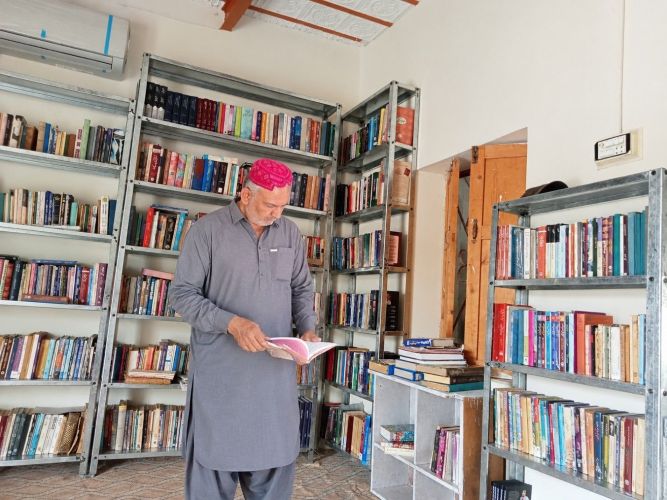 A 55-year-old Tharparkar-resident with a passion for books travelled to India to attend the World Book Fair, organized by India’s National Book Trust, where 1,380 stalls and publishers from 14 countries had gathered under one roof. For Samoon, the trip was less a luxury than a pilgrimage. He returned carrying books worth more than Rs.150, 000 close to the same amount that he had borrowed. His collection, popularly known as the Shaheed Makhdoom Bilawal Samoon Library, Islamkot, contains over 16,200 books now. Mostly bought from bookshops and book fairs in Karachi, Lahore and Rawalpindi, the books include fiction, poetry, history, philosophy, biography and religious materials; some of them he acquired after traveling long distances and spent a significant part of his limited savings to bring home.
For Samoon, however, this journey of collecting books is just as important as the endgame. In 2016, his search for books took him to India where he attended the world book fair. That journey, however, came with some personal costs; he had borrowed money to make the trip and upon his return to Pakistan, was suspended from his government job for traveling to another country without official permission. He was eventually reinstated after 32 months of suspension.
Yet, the experience did little to diminish his lifelong attachment to books. Born in a religious family in a village called Peeloro Samaan, now called Ahmedabad, in the vicinity of Islamkot, Samoon started his formal education in Diplo, completed his matriculation from Jhuddo and college from Mithi. His fascination with books began at home. His elder brother, Molvi Muhammad Ahmed, studied religion and maintained a small collection of religious books. As a child, Samoon started to read books and was often intrigued by their contents, which became a lifelong passion. Even as a student, he would sometimes save his money for food and attire to buy books. He used to wear old second-hand clothes and sometimes forego his meals. “Books became more important than comfort,” he says.
 His love affair with books began in 1987, when he started purchasing books with his own resources. What began as a personal passion gradually grew into a remarkable lifelong collection
This started affecting his health and eventually, he contracted tuberculosis. Samoon joined the government as a primary school teacher in 1989, earning a modest salary, which provided him a steady flow of income to expand his collection.
He began purchasing books in 1990 and gradually transformed his growing collection into the Shaheed Makhdoom Bilawal Samoon Library in Islamkot. People come to borrow books from Shaheed Makhdoom Bilawal Samoon, while others come to spend time reading in this oasis of books in the otherwise formal desert landscape of Islamkot.
 He has about 80 registered and permanent borrowers and perhaps another dozen visits the library regularly. It has become an informal library meant for a much wider community in the town.
He continues to visit dozens of bookshops and fairs almost every year in Pakistan’s largest cities, Lahore and Karachi, as well as Rawalpindi; he has attended 17 editions of the Karachi Expo book fair so far. An unlimited list and yet, some titles still remain high on his priority list: he is yet to buy the complete sets of Will Durant’s “The Story of Civilization”, and the entire collection of the Encyclopedia Britannica. All that is easily available in Western countries and at book fairs in Pakistan.
The collection of books includes Seerat (Biographies of the Prophet), Exegesis (Tafsir), autobiographies and international literature. Autobiographies, Personalities, Character Sketches, History of Sindh, History, International History, Sindh Archaeology, Sindh Chach Nama, Economics, World Literature, Maulana Abul Kalam Azad, Ghalib, Iqbal, Latif Studies, Mir Taqi Mir, Shah Inyat, Mirza Galab, Short stories, Farhang-e-Farsi (Persian Dictionary) and Thari Lughat, Oxford Dictionaries. The collection spans Sindhi, Urdu, Persian and English literature, Maulana Abul Kalam Azad books, Al-Hilal Newspaper was published 1912-1914 three Editions, as well as magazines and books covering a wide range of subjects.
Despite years of effort, he has never received financial assistance or institutional support for his library. Every book, every shelf and every addition to the collection has been arranged through his own limited resources. What began as a personal passion has gradually grown into a quiet labor of love built not with grants or sponsorships, but with his own dedication and an unwavering belief in the power of books.
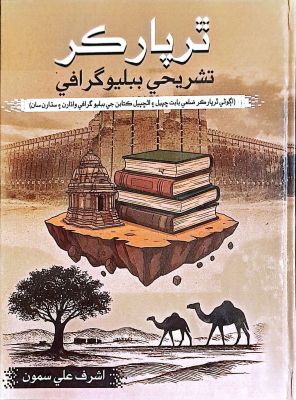
Not only reading books, he also writes and translates, including Abdel Halim Sharar’s “Tareekh-i-Sindh” into Sindhi. His books include Tharparkar: An Annotated Bibliography which discusses over 500 books and references over 700 articles concerning Tharparkar. His purpose, he says, is to help students and researchers locate relevant material about the region.
While maintaining such a large collection of books is not always affordable, he has refused financial help on a number of occasions, and instead, bought books with his own funds. For him, books are not merely material possessions; they are a repository of the ‘greater knowledge’ and an obligation to another sphere, which he believes he must fulfill.
Collections have built up over the course of decades, painfully, volume by volume. Outside, in Islamkot, the town remains a place of recurring drought, migration, dusty roads and expanding open-pit coal mine causing growing concerns about the natural environment. Inside his house, a different world has emerged built from thousands of books, purchased from bazaars and fairs, and traveling from one place to another.
This is a lesson for many that a library doesn’t have to be a huge institution or managed by authorities; it can simply be a reader with a small income and an inability to stop looking. Tharparkar’s repeated droughts and severe conditions have never stopped Samoon from his lifelong pursuit of searching for books. He has continually traveled and bought books whenever possible.
What began as a childhood hobby has become a mission to bring knowledge to the desert and to make it accessible to everyone.
Ismail, a teacher from Islamkot, said Ashraf Samoon’s decades-long passion for collecting books reflects a deep and enduring thirst for knowledge. He described the library’s diverse collection as a rare intellectual resource for the town, attracting students, researchers and readers who are eager to explore its shelves.
 “In a city like Islamkot, where opportunities for reading are limited, this library has created a special space for people who love books and seek knowledge,” Ismail said. He noted that the library has become a distinctive part of the town’s intellectual life and, with the closure of other libraries, remains the only dedicated library of its kind in Islamkot.
Yet Samoon’s vision extends beyond the existing space. He now plans to construct a spacious reading hall providing a quiet and comfortable environment where more visitors can sit, read and immerse themselves in the world of books. For him, the planned expansion is not merely about adding space, but about making knowledge and reading more accessible to the community.
Shahid Hussain Laghari, a development practitioner, shared the Shaheed Makhdoom Bilawal Samoon Library as a distinctive repository of books and knowledge in Tharparkar. He said the collection has particular value for researchers and students, while also offering general readers an opportunity to explore literature, history and ideas that might otherwise remain beyond their reach. In a region where access to books and reading spaces can be limited, he said, the library represents a valuable resource for nurturing curiosity and keeping the culture of reading alive.
May this library inspire other peoples to establish public and personal libraries, in local villages and big cities, so that the culture of reading is spread all across, he hopes. He explains that books for him are not simply items on shelves; they are portals to other worlds, to different places in space and time, and other modes of thinking. May hope that this library will encourage others to establish similar spaces in villages and cities,” he says. “We need to promote a culture of reading and make books and knowledge accessible to more people, particularly in communities where such facilities are limited.
Read: Chaunra – Resilient Thar Desert Homes
___________
 Ali Nawaz Rahimoo, based in Umerkot, Sindh is a social development professional. He can be contacted on anrahimoo@gmail.com


Great work
What vision of desert people. A good library in islamkot city.