Read History, Not Mythology
10 Critical History Books Every Pakistani Youth Should Read

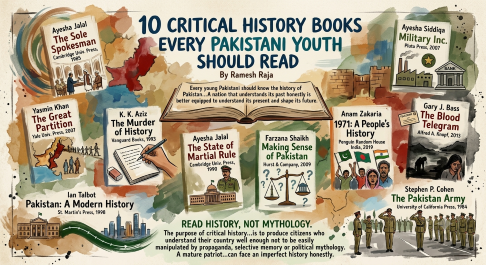
The purpose of critical history is not to produce young Pakistanis who dislike their country. It is to produce citizens who understand their country well enough not to be easily manipulated by propaganda, selective memory or political mythology.
By Ramesh Raja
Every young Pakistani should know the history of Pakistan, not only the history that is easy to celebrate, but also the history that is difficult to confront.
Pakistan’s story did not suddenly begin on 14 August 1947. It grew out of British colonial rule, Muslim political concerns, competing ideas of nationhood, provincial interests, constitutional struggles and the turbulent politics of Partition. Independence itself came with one of the largest and bloodiest migrations of the twentieth century.
The decades that followed brought equally important questions: constitutional instability, regional inequality, civil-military tensions, the separation of East Pakistan, wars with India, Islamisation, authoritarian rule and continuing disagreement over Pakistan’s political and national identity.
Studying these issues critically is not an act of disloyalty. A nation that understands its past honestly is better equipped to understand its present and shape its future.
The following ten books do not offer one final version of Pakistan’s history. Their authors sometimes disagree sharply. That is precisely their value.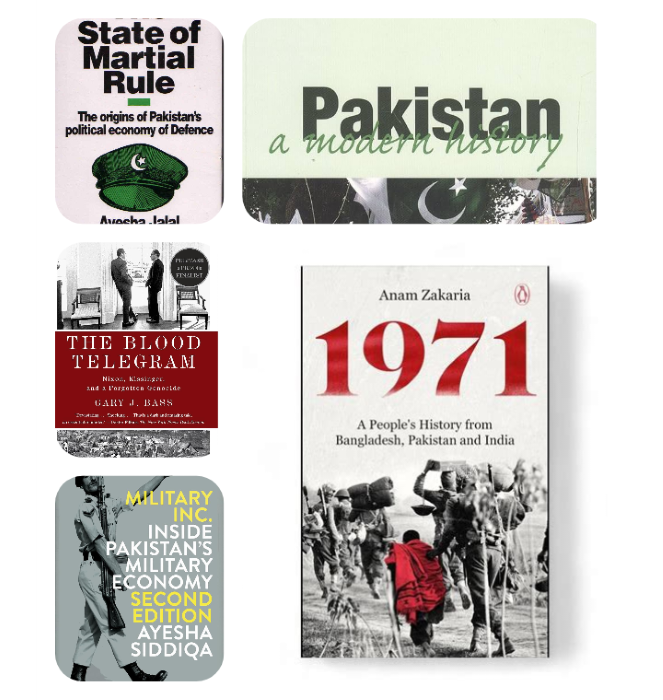
- The Sole Spokesman: Jinnah, the Muslim League and the Demand for Pakistan
Ayesha Jalal | Cambridge University Press | 1985
Ayesha Jalal is a Pakistani-American historian and professor at Tufts University, widely known for her scholarship on Jinnah, Muslim political identity, Partition and modern South Asia.
One of the most influential studies of Jinnah and the Pakistan Movement, The Sole Spokesman examines Jinnah’s political strategy and negotiations with Congress and the British. It challenges the assumption that Pakistan emerged through a simple, predetermined path and provides a deeper understanding of the constitutional politics behind its creation.
- The Great Partition: The Making of India and Pakistan
Yasmin Khan | Yale University Press | 2007
Yasmin Khan is a British historian of Pakistani heritage and Professor of Modern History at the University of Oxford, specializing in British India, decolonization, Partition and migration.
Khan takes Partition beyond the conference rooms of Jinnah, Nehru and Mountbatten and into the lives of ordinary people. She examines hurried borders, communal violence, mass migration and displacement while assessing failures and miscalculations across British, Congress and Muslim League leadership. The book reminds us that 1947 represented both the birth of Pakistan and an immense human tragedy.
- The Murder of History: A Critique of History Textbooks Used in Pakistan
- K. Aziz | Vanguard Books | 1993
- K. Aziz was a prominent Pakistani historian, academic and prolific author known for critically examining the writing and teaching of South Asian and Pakistani history.
Aziz subjects Pakistani history textbooks to rigorous criticism, identifying what he regarded as factual errors, omissions, exaggerations and ideologically driven interpretations. More importantly, the book teaches young readers an essential habit: never confuse an officially approved narrative with unquestionable historical truth.
- The State of Martial Rule: The Origins of Pakistan’s Political Economy of Defence
Ayesha Jalal | Cambridge University Press | 1990
Ayesha Jalal is a leading historian of modern South Asia whose scholarship has extensively examined Pakistan’s creation, political development and civil-military relations.
Why did Pakistan develop such a powerful military-bureaucratic structure? Jalal traces the answer to the country’s formative years, examining political instability, bureaucracy, defence priorities and international alliances. She demonstrates that military dominance did not simply begin with Ayub Khan’s 1958 coup. Its institutional foundations had developed much earlier.
- Military Inc.: Inside Pakistan’s Military Economy
Ayesha Siddiqa | Pluto Press | 2007
Ayesha Siddiqa is a Pakistani political scientist and military analyst with a PhD in War Studies from King’s College London, known particularly for her research on Pakistan’s military and civil-military relations.
Siddiqa examines the military establishment not only as a security and political institution but also as an economic actor. Her concept of “Milbus” explores military-linked businesses, land, welfare organisations and capital. The book is controversial, which makes critical reading even more important. Its evidence and arguments should be compared with competing scholarship.
- Making Sense of Pakistan
Farzana Shaikh | Hurst & Company | 2009
Farzana Shaikh is a Pakistani scholar and Associate Fellow at Chatham House whose research focuses on Pakistan, Muslim nationalism and the relationship between Islam and the state.
What exactly was Pakistan intended to represent? Shaikh examines the unresolved relationship between Islam, Muslim nationalism, democracy and the state. She connects many contemporary political disputes to debates that existed before independence, helping readers understand why questions about Pakistan’s identity and constitutional direction repeatedly return.
- 1971: A People’s History from Bangladesh, Pakistan and India
Anam Zakaria | Penguin Random House India | 2019
Anam Zakaria is a Pakistani author, researcher and oral historian whose work explores Partition, conflict, memory and competing national narratives in South Asia.
Zakaria approaches 1971 through memories from Pakistan, Bangladesh and India rather than relying solely on official histories. Bengali grievances, Pakistani political and military actions, Indian intervention and the experiences of ordinary people emerge through competing memories. For Pakistani youth, confronting 1971 is indispensable to understanding how and why East Pakistan became Bangladesh.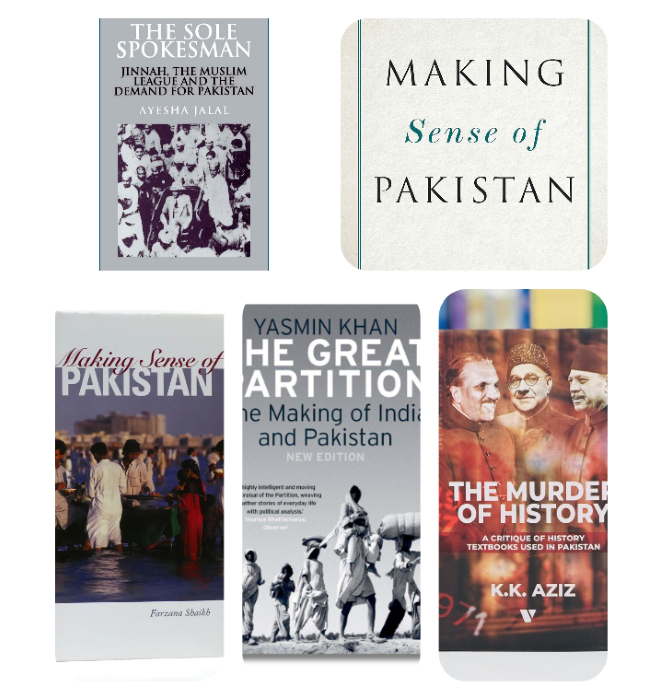
- The Blood Telegram: Nixon, Kissinger, and a Forgotten Genocide
Gary J. Bass | Alfred A. Knopf | 2013
Gary J. Bass is an American scholar of international politics and Professor at Princeton University whose research focuses on war, diplomacy, human rights and international crises.
Bass examines the 1971 crisis through American diplomatic records and international politics, including reports from US diplomats alarmed by the violence in East Pakistan and the Nixon administration’s policies toward Pakistan. Its interpretation should be compared with Pakistani, Bangladeshi and other scholarship, but it exposes readers to important evidence often absent from conventional Pakistani accounts.
- Pakistan: A Modern History
Ian Talbot | St. Martin’s Press | 1998
Ian Talbot is a British historian and Emeritus Professor at the University of Southampton, recognized for extensive scholarship on Pakistan, Punjab, Partition and modern South Asian history.
Talbot provides the broad chronological framework into which many of these debates fit. From independence and constitutional crises to military rule, regional tensions and political transformation, the book helps readers connect individual events with Pakistan’s longer institutional development. It is an excellent foundation before moving to more specialized studies.
- The Pakistan Army
Stephen P. Cohen | University of California Press | 1984
Stephen P. Cohen was an influential American scholar of South Asian security whose research focused extensively on Pakistan, India, their armed forces and regional strategic affairs.
Cohen examines the origins, institutional culture, officer corps, strategic thinking and political role of Pakistan’s army. The book helps explain how the military came to see itself as a guardian of national interests and why it acquired such a central position in Pakistan’s political and security system.
Read History, Not Mythology
Pakistan’s history should not be studied merely to identify heroes and villains. It should help us understand how the country was created, why its institutions developed as they did, why political crises repeatedly occurred, how ordinary people experienced national upheavals, and how official narratives themselves were constructed.
These ten books do not tell the same story. That is their greatest strength.
Read Jinnah critically without reducing him to either a flawless hero or a villain. Study Partition without ignoring either the political grievances behind Pakistan or the terrible human cost of 1947. Examine military rule without confusing an institution with every individual who serves in it. Study 1971 without denying Bengali suffering or ignoring its wider regional and international context. Question textbooks, but do not assume that every alternative account is automatically correct.
The purpose of critical history is not to produce young Pakistanis who dislike their country. It is to produce citizens who understand their country well enough not to be easily manipulated by propaganda, selective memory or political mythology.
A mature patriot does not need a perfect history. A mature patriot can face an imperfect history honestly.
Read: Recovering the Sanskrit Record
________________
 Hailing from Gambat town of Sindh, Engr. Ramesh Raja, is a Civil Engineer, visionary planner, PMP certified and literary enthusiast with a passion for art and recreation. He can be reached at engineer.raja@gmail.com