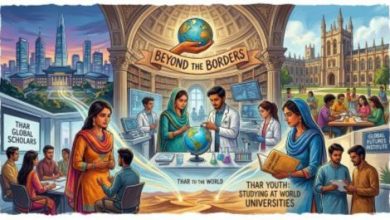
The world’s youth are not a problem to be solved; they are the greatest opportunity of our time. If we give them the skills, confidence and space to lead, they will build the future we all need.
- To avoid a wasted generation, we need bold, scalable solutions that empower young people to earn a living and contribute meaningfully to their communities.
By Nazarul Islam | USA
We hold our dreams and ideals close to our hearts, where the promises are made to the future generations. In this age of ours it’s hard to say with certainty that having lived was better than not having been born in the first.
I lament the fact that the most unlucky generation is the one which couldn’t produce a hero to look up to. We need to understand this in the context of our own society which boasts of huge number young people, in search for opportunities.
The current global report issued by the International Labor Organization has indicated that one in five young people are neither employed nor they pursue education or training at recognized institutions. The stark reality is that tens of millions of young people are being denied the opportunity to realize their potential with independence and dignity. The pace of job creation is simply not keeping up with the number of young people reaching working age. As a result, dreams are being deferred, aspirations go unrealized and talent is being wasted.
Demographic shifts, unfortunately described as “youth bulges,” are reshaping economies worldwide. By 2050, Africa’s youth population alone is expected to account for more than a third of the world’s young people. Meanwhile, almost half of the 1.9 billion population in South Asia are under 24, the highest number of any region in the world.
To put this into context, nearly 100,000 young people in developed societies, enter the job market every day. This surge presents immense opportunity, but also enormous challenges. How does this compare with Pakistani society? To avoid a wasted generation, we need bold, scalable solutions that empower young people to earn a living and contribute meaningfully to their communities.
However, it is encouraging to note that global leaders are paying attention to the malaise. Ajay Banga, president of the World Bank Group, recently observed: “These young people — with their energy and ideas — will define the next century. With the right investments — focused not on need but opportunity — we can unlock a powerful engine of global growth.”
Without purposeful effort, their optimism will likely risk turning into despair — fueling instability, unrest and mass migration — with implications for every region and every economy. This is why jobs must be at the center of any development, economic or national security strategy.
Yet, we must be honest about the scale of the challenge: Formal employment alone cannot absorb the millions of young people entering the workforce each year. An estimated 12 million young Africans keep joining the labor market every year, with only 3 million securing formal employment. Alternative routes such as self-employment and entrepreneurship are no longer an alternative career path; they are a necessity to secure a livelihood.
Research by well-known King’s Trust International shows that this is also a desirable career path for many young people across the world. In 2023, it was discovered that seven in ten young people worldwide are interested in starting their own business. However, nearly half believe doing so would be difficult, citing a lack of confidence, skills and access to resources.
Turning ambition into action requires investment in people, not just jobs. Young people need practical skills, tailored support and real opportunities. This means programs that build entrepreneurial capability, alongside essential skills for work and life such as resilience, teamwork and the ability to communicate clearly.
As artificial intelligence has continued to reshape industries and the transition to a greener economy, it accelerates digital skills and climate literacy. These efforts are no longer optional, because these are based on years of human efforts.
These capabilities also sit at the heart of King’s Trust International’s work. Last year, our “Enterprise Challenge” program supported aspiring entrepreneurs, helping them to understand business fundamentals, develop viable ideas and see entrepreneurship as a credible and attainable career path.
A partnership with the European Bank of Reconstruction and Development has supported young people in scaling their businesses through the organization’s “Youth in Business” initiative. Delivered by local partners on the ground, our entrepreneurship programs are supporting young people’s startups from Kingston in Jamaica to Kano in Nigeria.
The impact is tangible. One participant, Joshua, who took part in our Enterprise Challenge program in Nigeria, launched his business, BuyScrap, last year to tackle waste collection and encourage recycling. Within six months of launch, his team had recycled three tons of waste, demonstrating that when young people are equipped with the right tools, they do not just create businesses, they create positive change in their communities.
Governments, the private sector and philanthropy must work together to scale what works. Platforms such as the Global Labor Market Conference play a critical role in aligning policy, capital and innovation around a shared goal: placing young people at the center of inclusive economic growth.
The world’s youth are not a problem to be solved; they are the greatest opportunity of our time. If we give them the skills, confidence and space to lead, they will build the future we all need. When young people thrive, societies prosper.
Read: Our Failure To Address Autism
________________
 The Bengal-born writer Nazarul Islam is a senior educationist based in USA. He writes for Sindh Courier and the newspapers of Bangladesh, India and America. He is author of a recently published book ‘Chasing Hope’ – a compilation of his articles.