Hearing this news, Didda’s own faith even in her own blood was shattered. The whole world might rise against her, but her own nephew too—he had joined hands with the enemies out of greed for power.
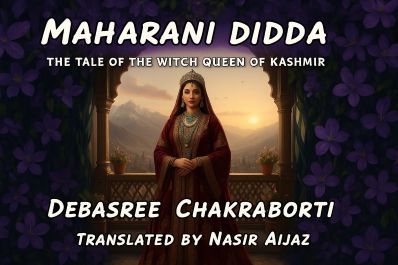
Maharani Didda: Witch Queen of Kashmir
By Debasree Chakraborti
When the evening ārati began at the Shankaracharya Temple, the atmosphere of the shrine became vibrant with the fragrance of incense, resin, and hemp. At that very moment, from the temple परिसर the whole of Srinagar appeared like a radiant evening star, whose luminous presence seemed to represent Queen Didda herself.
 But over the surrounding hills of this glittering city, dark clouds of danger were gathering. The shadow of those black clouds slowly spread over the entire Kashmir Valley. From all directions of the valley, the drumbeats of the Damar rebellion began to resound. They had been ruthlessly crushed during the time of Kṣemagupta. Yet, they could not be completely annihilated. Taking refuge in the kingdoms around Kashmir, they gradually reorganized themselves, and one day declared rebellion once again.
In this Damar uprising, Kashmiri Brahmins also joined. For they had never been able to accept Didda wholeheartedly ever since her ascension to the throne. The Kashmiri Brahmins had always wanted a male ruler on the throne of Kashmir. On the one hand she was physically disabled, and on the other hand a woman—both of which they found intolerable in a ruler.
Didda’s enemies collectively gave her the name “the Witch Queen.” They even began spreading propaganda against her, claiming that Didda was a woman of loose character who maintained her power by forming physical relationships with the men around her. Some even started saying that she was a Tantric practitioner and that she had established her authority through tantric practices. Ever since the death of her son Abhimanyu, efforts to defame Didda in this manner had begun.
Moreover, Kashmir had always been regarded as an extremely coveted land by its neighboring kingdoms. Taking advantage of internal disorder, the kings of neighboring states also began to advance to lay their hands on Kashmir.
One evening, Queen Didda sat talking with Bhalaga and Nandigupta were talking. For after Abhimanyu’s death, Nandigupta became the supreme vow of her life. Just as she had shaped Abhimanyu for the sake of Kashmir, in the same way she was now raising and training Nandigupta with the single aim of making him the ruler of Kashmir.
Bhalaga said to Didda, “In a few days we must send word to Vikramsena. Nandi too will receive military training from Vikramsena, just as your grandmother and father once did.”
Didda agreed and said, “If I can place him in the hands of both you and Gurujī, I will be at peace. But Gurujī may never come to Srinagar again.”
Bhalaga let out a long sigh and said, “Yes, he had many dreams centered on you. He envisioned you as an empress. When you voluntarily gave up power, it deeply wounded his heart. You could not honor your guru’s dream.”
Didda replied, “Because I value Kashmir even more than myself. Kashmir wanted a male ruler on the throne.”
Bhalaga was about to say something, but Didda stopped him and said, “I know what you will say—that many people wanted me on the throne. But they were very few in number. The will of the greater multitude must be acknowledged. Let me see—this time I myself shall go to him for Nandi’s sake.”
In the midst of Didda and Bhalaga’s conversation, Yashodhara entered. Yashodhara was a powerful feudal lord of Kashmir. At first, he had joined hands with the Brahmins and taken part in the rebellion against Didda. Gradually, Didda won him over to her side by offering wealth and power, and then appointed him as the commander-in-chief of the Kashmiri army.
Having gained absolute authority like Naravāhana, Yashodhara was extremely pleased. At that time, the number of power-hungry men in Kashmir was very great. But Didda should have understood that greed leaves no room for humanity in a person. People of such nature change their colors when opportunity arises.
Yashodhara’s untimely arrival in Didda’s inner chambers made her uneasy.
Yashodhara said, “Your Majesty, the enemy has attacked the frontier. The neighboring
The king of the neighboring state of Thakkana had attacked Kashmir, and the internal rebels had allegedly joined hands with him.
Didda always kept command of her elite personal troops in her own hands. Whenever she realized that the time had come for her to descend into the battlefield, she went forth with this special force herself, for no one but Didda was capable of leading this army.
She said, “Yashodhara, I have complete faith in your forces. You must advance today itself against Thakkana with your army.”
On the frontier between Kashmir and the province of Gandhara, the final battle between Thakkana and Yashodhara began. As Yashodhara advanced toward victory in this battle, his desire for the throne of Kashmir grew ever stronger. Thakkana had no real idea of Didda’s power. Thinking of her as a cripple, he attacked with only a small force. Yashodhara’s soldiers quickly surrounded Thakkana’s troops and began to slaughter them. Thakkana was unprepared for such an onslaught. When the cries of dying soldiers rose around him and he saw heaps of corpses piling up on every side, he was seized with terror—and Yashodhara’s sword severed his head from his body.
Having defeated Thakkana, Yashodhara proclaimed himself king of Kashmir right there on the battlefield. His soldiers, shouting victory in Yashodhara’s name, began marching toward Srinagar. At that moment, everything around Yashodhara seemed to vanish; he could see nothing but the royal throne and the crown of Kashmir.
But Yashodhara was not allowed to enter the palace of Kashmir. Before that could happen, Didda’s elite troops surrounded his army from all sides and cut them down. Yashodhara had no idea of the depth of Didda’s intellect. She trusted no one but herself. Never could she rest easy by entrusting responsibility to another.
Even within Yashodhara’s army were soldiers from Didda’s own elite force. At the very moment of entering Kashmir, they uttered various coded signals to alert the elite guards stationed in Srinagar about Yashodhara’s …true intention was revealed. The massacre that took place that day before the royal palace of Kashmir was witnessed by Didda herself, standing at the window of her palace. On that day, every one of Didda’s opponents felt the terror of her power.
Yashodhara was taken prisoner and confined in the royal jail. That day Didda realized that relying on the people around her was an act of folly. To extinguish the fire of rebellion that had flared up in Kashmir, she herself would have to descend into the battlefield.
After Yashodhara was imprisoned, the rebels gathered together and began advancing toward the royal palace. At that moment, cries of “Har Har Mahadev” rushed toward them like a trident. Once again, at first they could not understand what was happening. Nor could they comprehend the battle strategy of the elite force. Didda knew that once Yashodhara was captured, the rebels might unite and attack the palace.
The mountain road leading from the city of Srinagar to the palace was flanked on both sides by dense forests. The elite troops, dressed in garments that blended with the forest, lay hidden there. Another group kept watch from the palace below. When news of the enemy’s approach reached Didda, she came out of the palace with her soldiers, and from both sides of the jungle her troops surrounded the enemy and launched their attack.
That day a dreadful battle was fought in the heart of Srinagar. In this battle, Didda and her elite force were victorious, and the rebel leaders were captured. Afterwards, they were all hanged together in rows in the courtyard of the Kashmiri palace.
Thus time passed on, yet the fire of the Damar rebellion could not be extinguished. From time to time it flared up in different parts of the valley. Meanwhile, the young Nandigupta was growing up.
One day Bhalaga said to Didda, “Time is slipping away rapidly. By now Vikramsena must be appointed as the crown prince’s military instructor; otherwise it will be too late.”
Understanding the logic of Bhalaga’s words, Didda replied, “As the Damars grow stronger day by day, it will become impossible for Nandi to control them merely from the throne.”
“Valaga, this At that moment, she remembered Naravahana with deep intensity. No one had ever stood by her with such selfless devotion as he had. Bhalaga let out a long sigh and said, “No one ever loved you the way Naravahana did.”
To hide her tears, Didda moved toward the window. She knew that for a queen, showing weakness was a crime. But from Bhalaga, nothing could be concealed. Didda said, “Bhalaga, for a queen, even accepting the love of a subordinate is a crime. If I had encouraged Naravahana’s feelings, it would not have brought good to Kashmir.”
Valaga replied, “Your slightest encouragement would have saved a life.”
This time Didda could no longer restrain her emotions. She said, “I made a mistake, Bhalaga. I will never make this mistake again. Do not say another word about it. Now we must focus on bringing Vikramsena back.”
Hearing Didda’s words, Bhalaga said, “Let us see whether he returns. He too left in anger because of your behavior.”
“I did what I did for the good of Kashmir.”
“But it has brought more harm than good. During Abhimanyu’s reign, the rebels became organized.”
Didda understood the weight of Valaga’s words. Indeed, by handing over the responsibility of Kashmir to an unworthy successor, she had indirectly harmed the kingdom. Because of many of her wrong decisions, her loved ones had departed from her one by one. No—there was no time to waste anymore. Vikramsena had to be brought back. He alone could be the helmsman of her present time.
From Didda’s kingdom to the region of Lohara, where Vikramsena lived during her father’s reign, the route passed through a vast and dense forest. On the very night of her conversation with Bhalaga, Didda set out for Vikramsena with her elite troops.
The road was hemmed in by deep forest, and the thought that she would meet her revered guru after so many days filled Didda’s heart with a strange and quiet joy …was filling her heart. Only a few moments more of waiting, and with the sunrise she would be able to behold her revered guru. As she walked on with such thoughts, suddenly a shower of arrows began to fall from all sides. Didda was grievously wounded and fell from her horse. From within the wild bushes and trees, she watched her soldiers being killed. Of the few soldiers who had accompanied her, half perished that night in an attack by unknown enemies.
Didda could not identify who these attackers were. In the darkness she could only feel death raging all around her, and it seemed to her that everything was finished—that there was no longer any way for her to protect Kashmir.
When the frenzy of killing ended, she tried to rise to her feet, but with advancing age the strength in her legs had greatly diminished. Through yogic discipline she had once overcome her physical disability, but from long neglect of practice and the burden of years, that disability now seemed to return. She could not stand up at all.
At that moment, she saw the light of torches. The light appeared to be moving toward her. Soon she was surrounded on all sides. She had neither the physical nor the mental will left to fight the enemy.
She became like a helpless object. As a captive, she was taken to an unfamiliar camp. Though Didda did not recognize them, the enemies, seeing her physical disability and her beauty, realized that they had captured Queen Didda.
After a while, two strong-built men came and stood before her. Seeing them, Didda understood that they were the leaders of this group. Both of them came and begged her forgiveness. One of them said, “I am Tunga, and he is Kashi. By mistake, we have committed a most shameful act. After our father’s death, we took leadership of the forest-dwelling tribal people of this region. Seeing a group of unfamiliar soldiers enter our territory in the darkness of night, we thought that perhaps the enemy had attacked under cover of night. We have committed a grave injustice we have committed a grave wrong. Whatever punishment you give us for this, we shall accept it with bowed heads.”
At that moment, Didda seemed like an emotionless object. Before her eyes so many of her elite soldiers had been killed, and she had been able to do nothing. Those who had killed them were now standing before her, begging for forgiveness. She realized that what had happened the previous night had dealt a severe blow to Kashmir’s military strength. Now she did not even have the time to raise a new army.
For she was already shattered by one internal rebellion after another. Didda became like hard stone. Crushing all grief and pain beneath that stone, she thought only of Kashmir. Tunga and Kashi were pleading with her for punishment.
Placing her hands upon the heads of both of them, Didda said, “I entrust to you the responsibility of protecting Kashmir. This shall be your punishment.”
On witnessing the mercy of Queen Didda’s heart, everyone burst into cries of victory. Tunga said, “People call you the Witch Queen, but can a witch’s heart be so compassionate? As long as life remains in me and my brother Kashi, Kashi with his soldiers will guard the frontier regions of Kashmir, and I shall remain your shadow-companion for life. My troops will repel any internal troubles within Kashmir.”
Because Didda fell gravely ill, she could not go to Vikramsena herself. Kashi went in person to Vikramsena’s hermitage but could not find him. When he questioned the people nearby, they said that Vikramsena had left Kashmir long ago. Where he had gone, no one knew.
When news of Vikramsena’s disappearance finally reached Didda after so long, she was deeply shaken. On the one hand was the news of Vikramsena’s disappearance, and on the other hand Tunga’s spies reported that the news of the slaughter of the elite troops and of Didda’s death had reached Srinagar. The rebels were said to be celebrating victory together in Srinagar, and were planning to place Didda’s nephew, Vigraharaja, on the throne of Kashmir.
Hearing this news, Didda’s own faith even in her own blood was shattered. The whole world might rise against her, but her own nephew too—he had joined hands with the enemies out of greed for power. This news deeply alarmed Didda, because Vigraharaja shared a very close and friendly bond with Nandigupta. In Didda’s absence, it would be very easy to manipulate the young Nandigupta’s mind.
Yet there was one reassurance—that Bhalaga was present there. Bhalaga had been devoted to Didda all his life. His entire existence revolved around her. Therefore, Didda was certain that the news of her death would affect Bhalaga the most.
Here, four times a day, a physician of herbs came to treat Didda. Tunga served her day and night without rest. After coming here, Didda realized something: the kind of battle strategy that Bhalaga had taught her and the Ekangi troops was also followed by these tribal people. In fact, they were far stronger than the Ekangi soldiers, and that was why so many soldiers had been killed in their attack.
After some time, Didda could no longer see Tunga. His absence made her restless, because she had been thinking of using them as instruments to make Kashmir strong once again.
While Didda was growing increasingly anxious, the rebels were busy preparing for the coronation of Vigraharaja. Members of the rebel factions began arriving in Srinagar with all kinds of gifts. They immersed themselves in celebration to welcome the king of their choice.
Thus, when the climactic moment of Vigraharaja’s coronation arrived—when the priest chosen by the rebels began chanting mantras and was about to place the royal mark upon Vigraharaja’s forehead—a sudden shower of arrows began to rain down. Assassins, disguised and seated inside the royal assembly, launched their attack at the appointed moment. In this assault, Vigraharaja and many of the rebels were killed.
Tunga himself was present in the royal court that day and announced to everyone that Queen Didda was still alive.
Then, two days later, he set out with Bhalaga and Nandigupta to bring them to Didda They returned. Bhalaga did not believe the news of Didda’s death, because all the astrologers who had examined her birth chart had said that she would be long-lived. The report of her death so soon had no effect on Bhalaga’s mind. Even then, they remained within the strict security cordon of the Ekangi troops, and, wrapping themselves in a veil of mourning, confined themselves inside Didda’s quarters. At that time, Valaga did not allow anyone to meet Nandigupta.
Meanwhile, Tunga formed an understanding of the Ekangi commanders stationed in Srinagar from Didda. These men were not easy to meet. When Tunga was discussing the Ekangi officers with Didda, she began to grasp his intentions.
Therefore, she mentioned different intermediaries at different stages and also specified certain coded words by which messages could be conveyed to them. Perhaps Didda wished to trust someone for the last time; that may be why she revealed these secret matters to Tunga. The commanders to whom she showed Tunga the path were from the lower ranks of the Ekangi force. Only the queen herself could speak directly to the highest-ranking commanders.
Tunga and his soldiers entered Srinagar in disguise. They brought weapons hidden among gifts as they entered the city. Although the entire city of Srinagar had fallen into the hands of the rebels at that time, the royal palace of Kashmir was still under the control of the Ekangi troops. On Bhalaga’s orders, they were waiting for the right moment, for like Bhalaga, they too believed that Didda had not died and that she would surely return.
Tunga tried to enter the Kashmiri palace with weapons concealed on his body, but he was caught. He had adopted this method in order to deliver Didda’s message to the Ekangi soldiers. After being captured, he informed them that Didda was alive. Then began a secret conspiracy against the rebels. In great secrecy, plans were made with them to launch an attack on Vigraharaja and the rebels. They decided to strike at the very moment of Vigraharaja’s coronation.
Therefore, on behalf of the Ekangi troops, the royal court was opened before the rebels for this coronation. Without the support of the Ekangi soldiers, it would never have been possible for Tunga to achieve such a great victory. Tunga’s men, together with the Ekangi troops, surrounded the rebels in disguise. Then, at the chosen moment, they launched their attack.
Seeing Tunga’s presence of mind, Didda was deeply moved that day. It seemed to her as though Naravahana had returned to her in a new form. If the doctrine of rebirth in Hindu belief were true, then given Tunga’s age, it would not be unnatural for him to be Naravahana reborn. That he had brought Bhalaga and Nandigupta safely to her at such a critical moment felt to Didda like a priceless blessing.
Gradually, the whole focus of Tunga’s life—his meditation, his thoughts, everything—became centered on Didda. Even in the twilight of her life, people around her were greatly drawn to the radiance of her beauty. People of that time would often discuss what she must have been like in her youth, if she was so extraordinarily beautiful even in old age. She was a woman accomplished in tantric practice, and it was believed that through tantra one could preserve one’s beauty and youth. Thus Tunga became deeply attracted to Didda’s personality and beauty. Day and night, he devoted himself solely to keeping her well.
Didda felt as though Naravahana had appeared again through another terrible death.
After recovering, Didda decided that she would offer worship once to Mother Khir Bhavani. Considering Nandigupta’s safety, she returned to the royal palace shortly after regaining her health. With her return to Srinagar, a new chapter of Didda’s life began. Tunga had arrived as death itself, yet today that same Tunga became the chief protector of her life and of Kashmir.
Kashi took charge of guarding the frontier regions of Kashmir, while Tunga, within Kashmir, sought to maintain internal peace through negotiations with the rebels. In this way, he succeeded in bringing fearsome rebel leaders such as Bhimagupta and Rakka under Didda’s allegiance.
Thus, in this manner, time passed on. With the passage of time, the fire of internal rebellion in Kashmir gradually died down. Except for a few scattered Damar uprisings, no major rebellion appeared anymore. At such a time, Didda decided that she would offer worship to Mother Kshir Bhavani. Until the situation had stabilized, Tunga had not allowed her to go anywhere outside the royal palace. When stability returned, Tunga took Didda to worship at the shrine of Mother Kshir Bhavani.
Didda would enter the sanctum of the temple and close the door behind her. Within those closed doors, it seemed as though she conversed with the goddess herself. This time too, the same happened. When Didda entered the sanctum and shut the door, Tunga sat down in front of it while his soldiers kept guard all around.
Winter was approaching in Kashmir—the season of snow. The sky was overcast with clouds, and cold winds rushed about carrying fallen leaves with them. In this region, there were forests of chinar trees all around, and chinar leaves gathered upon the temple courtyard. That day, the courtyard of the temple looked like a map of Kashmir itself.
Tunga sat there with bow and arrow in hand, like the protector of Kashmir, while inside the sanctum was Queen Didda, the embodiment of Kashmir, as Mother Bhavani. The friction of wind and dry leaves produced a strange sound. An unusual peace prevailed there, and Tunga felt that peace with his whole heart.
Suddenly, a band of dacoits attacked them from the surrounding forest. Tunga’s soldiers were prepared at every moment. A fierce battle began between the two sides. Sensing the attack from within the sanctum, Didda came out with a sword in her hand. She always carried a sword with her, for no one could say when it might be needed.
By then she was heavily burdened by age and no longer possessed the strength to fight as she once had. In that battle, Didda was victorious, but while protecting her, Tunga was wounded. That day, standing in the temple of Mother Kshir Bhavani, Didda felt that whoever came close to her and loved her was destined to be driven away.
Didda did not wish to lose Tunga as well. That day, much blood was shed from Tunga’s body in the temple of Kshir Bhavani. Later she learned that Bhimagupta and Rakka were behind this attack.
She realized how active the rebels still were and that these two had once again joined hands with them. Didda decided that once Tunga recovered completely, she would send him to her uncle’s kingdom of Hindushahi, for Tunga had become the chief enemy of the rebels. Another attack could come upon him at any time, and this time he might not survive—of this Didda was certain.
After nursing Tunga back to health, Didda sent him to Kabul. A few days after this incident, Rakka and Bhimagupta met with unnatural deaths. Both died in their sleep, and the cause of death remained unknown. (Continues)
Click here for Part-1, Part-2, Part-3, Part-4, Part-5, Part-6, Part-7, Part-8, Part-9, Part-10, Part-11, Part-12, Part-13, Part-14, Part-15, Part-16, Part-17, Part-18, Part-19, Part-20, Part-21, Part-22, Part-23, Part-24, Part-25, Part-26,
_________________________
 Debasree Chakraborti is a renowned novel writer of Bengali language. Based in Kolkata, West Bengal, India, she has done Master’s in Modern History from the Kolkata University, and authored some thirty books, mostly the novels, with historical perspective and themes. Her novel is ‘Maharaja Dahir’ that covers the history of Sindh from 662, the year of first attack on Sindh by the Arab armies till date, was published last year and translated by Nasir Aijaz into Sindhi language.