After Didda’s arrival the anarchy in Kashmir had been reduced to some extent. She had gifted Kashmir a young prince. Therefore, everyone began to dream anew with Didda and the young prince at the center.
Maharani Didda: Witch Queen of Kashmir
By Debasree Chakraborti
The birth of Abhimanyu created an atmosphere of joy throughout Kashmir. The people of Kashmir began to dream anew about their young prince.
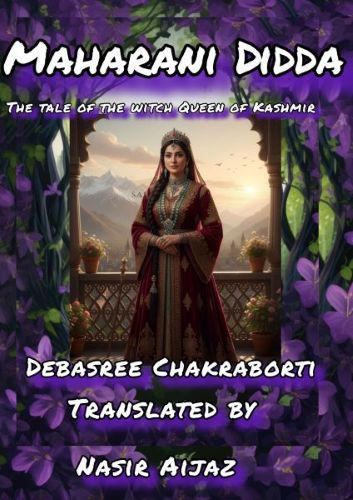 The reason was that the mother who gave birth to this prince was Didda—one who had taken the reins of Kashmir’s administration into her own hands and was striving to establish a sound system of governance. Tales of the queen mother’s courage had now spread from mouth to mouth like legends from folklore. Ordinary Kashmiris regarded Didda as an incarnation of the goddess Bhavani. From the womb of such a divine mother, they believed, would surely be born a ruler of extraordinary stature.
Like everyone else, Didda’s maternal grandfather, Bhimaraja, also began to dream anew. In his dreams he saw the new heir of the Hindushahi dynasty, riding on horseback across distant lands, and wherever he reached, the banner of the Hindushahi lineage was being raised. To give form to this dream in reality, he offered his gratitude to God by establishing the Bhimakeshvara temple near the Martand Sun Temple. King Simharaja and Queen Shrilékha, eager to behold their grandson’s face, presented elephants, horses, and several prosperous villages as gifts. Simharaja had, in truth, lost all hope in his own sons; at a certain point he had clearly realized that it would be impossible for them to protect such a vast empire. For this reason, he gradually became mentally dependent on his daughter Didda and his grandson Abhimanyu. Overjoyed at the birth of her grandson, the queen mother began giving donations generously with both hands. From the day of Abhimanyu’s arrival, by the queen mother’s order, arrangements were made daily for feeding the poor as an act of charity. People even from far-off villages came forward to take part in this service. It was as if, after long snow-covered days, the spring season had arrived in Kashmir.
The queen mother immersed herself in caring not only for her grandson but also for her daughter-in-law Didda. Bhalaga worked day and night, tending to the newborn and his mother. Yet, despite extreme physical weakness, Didda herself continued to care for her child as much as she could. At times Bhalaga, greatly concerned, would say, “We are here; nothing will happen to the young prince. You must take rest yourself, because if you do not rest properly at this time, your body will become completely unwell.” In a very gentle voice Bhalaga would add, “You were not born into this world solely to raise one child. Your son will grow up to be a fine human being, but the responsibility of holding Kashmir firmly rests on your shoulders alone. Therefore, it is better not to waste your strength unnecessarily.”
In response, Didda would say, “One should never neglect one’s duty, Bhalaga. Whatever responsibilities I have as a mother toward this newborn child, I will fulfill them all. The neglect that I had to endure—I will never allow my child to suffer that.”
Hearing these words, tears came to Bhalaga’s eyes. Indeed, Bhalaga alone had been the witness to that terrifying phase of Didda’s life. From the depths of her heart, Bhalaga regarded Didda’s feelings with profound respect. Didda’s sense of duty toward her own son deeply satisfied the queen mother. It filled the realm of her heart with contentment Didda gradually took complete control of everything. In this way, the young prince slowly grew up. On the day of the prince’s annaprasana (first ceremonial feeding of solid food), a grand sacrificial ritual was organized at the Shankaracharya Temple. Maharaja Kshemagupta sat for the ritual together with his wife Didda and his son Abhimanyu. Scholars and priests came from far and wide to participate in this yajna. The great ritual was arranged both for the welfare of the prince and for the prosperity of the kingdom. After the yajna was completed, consecrated food was placed in the prince’s mouth. On that day, the young prince of Kashmir was worshipped in the form of Kartikeya.
After Abhimanyu’s birth, a strange transformation became visible in Kshemagupta. Gradually freeing himself from worldly attachment and illusion, he immersed himself in religious observances and rituals. Spending his days in the company of ascetics and in worship, he established the Kshemagaurishvara Temple. Dense forests surrounded the Kshemagaurishvara Temple, and this forested environment deeply attracted the king. It seemed to him that the true joy of life lay hidden in this wilderness. Once he had taken pleasure in the killing of harmless animals, but now he seemed to feel a sense of oneness with these forest creatures. After the establishment of the temple, he would occasionally come here to reside.
One such day, after his midday meal, the king heard the melodious call of a cuckoo from the temple courtyard. Gazing at the surrounding nature, he felt as if nature itself had adorned the guise of an enchantress that day. Drawn by this allure, he slowly stepped outside the temple precincts. Coming out, the king saw dense clouds gathering in the sky; as their shadows fell upon the forest floor, the wilderness took on a deep green hue.
Cuckoos called from branch to branch, and in every corner of the forest peacocks spread their feathers and danced. Noticing a herd of deer, the king entered the forest. The deer ran like magical creatures, and the king followed them closely. He had no power to resist this attraction. Walking on and on in this manner, he did not even realize when he had entered deep into the forest. Reaching there, he felt himself completely alone—no deer were to be seen anywhere. The king stood alone in the depths of the forest. But he had forgotten the path by which he had come. Lost and disoriented, the king began searching for a way through the jungle, when suddenly He saw a jackal in the middle of the forest. The jackal stood directly before him, staring steadily at the king, and the king became so deeply mesmerized by the enchantment in the jackal’s eyes that he could not break free. For a while everything stood still—an intense calm prevailed in nature. Suddenly, the jackal let out a piercing cry. The king saw as if fire were bursting forth from the jackal’s mouth. Terrified by the sight, the king ran for his life, and while running, he eventually entered the temple courtyard, collapsed on the stone platform, and lost consciousness.
From that moment onward, the king became gravely ill. Lakshmana consulted a local herbal physician, who informed him that the king had been afflicted by a deadly and life-threatening form of luta disease. Confronted with the certainty of death, the king departed for Varahakshetra. After the birth of the young prince, he had established the Shrikanta Matha and the Kshetra Matha at this place. The king took refuge in the Kshetra Matha. Naravahana informed Didda about the king’s illness. Didda knew well how terrible and fatal this disease was. Even so, she summoned the royal physician to seek counsel. During these days, the queen mother had become completely dependent on Didda emotionally; therefore, every step Didda took was of great importance to her.
Late that night, when Naravahana came with news of the king, Didda sent for the royal physician. In the darkness of night, only the faint glow of lamps burned in Didda’s palace. Didda did not allow Naravahana to remain in her chambers for long. After Naravahana left, she ordered the maidservants to burn neem leaves, camphor, and incense and to spread the smoke throughout the entire palace. Soon after, the royal physician arrived. The queen mother and Bhalaga were present there. Both of them waited anxiously for Didda’s decision.
After hearing everything, the royal physician declared with deep sorrow that the disease was fatal and spread very rapidly. Therefore, for the welfare of the young prince, everyone would have to maintain distance from the king. That very night, Didda decided that she would not be able to remain with the king in his final moments, because for the sake of protecting the prince’s life, she would have to make at least this much sacrifice. To the queen mother as well, the life of the young prince was dearer than that of her own son, because due to Kshemagupta’s licentiousness the system of governance in Kashmir had almost collapsed. After Didda’s arrival the anarchy in Kashmir had been reduced to some extent. She had gifted Kashmir a young prince. Therefore, everyone began to dream anew with Didda and the young prince at the center. By that time, Kshemagupta had already been pushed to the margins of expenditure and authority; perhaps that is why he wished to spend the final phase of his life immersed in religious duties and rituals.
Kshemagupta had given Didda a new life—such a life as she had never even dreamed of. This life gave her a beautiful family, a kingdom, and self-respect. Didda had not forgotten this. Even though she could not be present beside the king herself, she made all arrangements for his care. All the herbal physicians in the villages of Varaha Kshetra were appointed for the king’s treatment. Naravahana himself stayed in Varaha Kshetra to supervise the king’s medical care.
During this time, the greatest act of sacrifice was shown by Queen Chandralekha. Prime Minister Phalguna calculated that if the king were to die, Chandralekha would have to become sahamarita (a widow who dies with her husband). He thought that if this opportunity were used properly, he would gain popularity through his daughter’s sacrifice. With these thoughts in mind, he rushed to his daughter Chandralekha’s palace and found her gazing thoughtfully at nature, lost in contemplation. At her father’s arrival, Chandralekha came out of her reverie, ran to him, and broke down in tears. In such a terrifying time for the king, she was living an extremely lonely life, with no one present there to care for him. Thinking of this, Chandralekha was deeply distressed.
Taking advantage of his daughter’s vulnerability, Prime Minister Phalguna said, “Daughter, you are a woman like Sati-Savitri. This is the true time to prove yourself. Go and restore the king to health through your service and care. Only a truly virtuous and devoted wife can accomplish this. I will make all arrangements for your journey to Kshem Matha.”
Chandralekha was a highly emotional woman; without thinking of the consequences, she agreed to her father’s proposal. But as the time to leave approached, she remembered her two young daughters and began to hesitate. Seeing this change of heart, Phalguna feared that his winning move might fail. Chandralekha said, “Father, what will happen to my two daughters in my absence? They will become orphans.” Phalguna then explained to her that if Kshemagupta were to die, she would have to become sati anyway; therefore, saving her husband’s life was her foremost duty. And if death had to be embraced, she should rest assured, because her father was there. Just as he had raised Chandralekha after her mother’s death, in the same way he would raise Chandralekha’s daughters as well—she could place that much trust in him. Chandralekha did have that trust in her father. Perhaps that is why, on that day, she was able to renounce even her maternal attachment to her children.
No—Chandralekha could not save her husband. Within a few days of reaching Kshem Matha, she too became afflicted by the disease. Within days, their bodies became covered with pustule-like, blistering eruptions of the luta disease. Then, in the month of Pausha, on the ninth day of the bright fortnight, Maharaja Kshemagupta breathed his last, and the ailing Chandralekha, still alive, began to wait to be burned and to become sati. (Continues)
Click here for Part-1, Part-2, Part-3, Part-4, Part-5, Part-6, Part-7, Part-8, Part-9, Part-10, Part-11, Part-12, Part-13, Part-14, Part-15, Part-16, Part-17,
_________________
 Debasree Chakraborti is a renowned novel writer of Bengali language. Based in Kolkata, West Bengal, India, she has done Master’s in Modern History from the Kolkata University, and authored some thirty books, mostly the novels, with historical perspective and themes. Her novel is ‘Maharaja Dahir’ that covers the history of Sindh from 662, the year of first attack on Sindh by the Arab armies till date, was published last year and translated by Nasir Aijaz into Sindhi language.