To build the Kashmiri army, Didda adopted several special methods. She selected for this force individuals who possessed certain unique qualities—those who could imitate the sounds of animals and birds, whose minds were as alert as their bodies, and who could understand the languages of enemy kingdoms
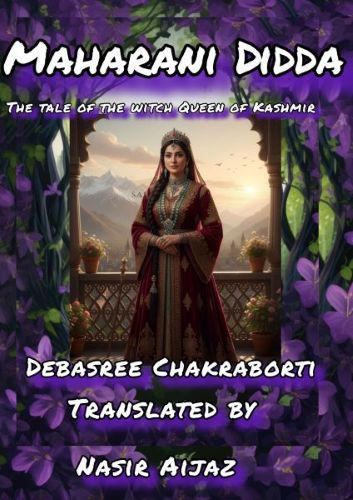
Maharani Didda: Witch Queen of Kashmir
By Debasree Chakraborti
Thus, caught between duty and action, the wheel of time kept turning in Didda’s life. Then one day, in the dead of night amid the deep forests of Mount Meru, the sound of horses’ hooves was heard. A group was racing through the dense woodland. Some distance away, from within the forest, coiled smoke was rising upward; from afar its smell and signal could be sensed. The newcomers realized that their destination was not far anymore.
 Riding swiftly through the pine forest, the horsemen caught sight of the royal standard of the Kingdom of Kashmir. They heard a sound like the crackling noise produced when wood burns in fire—meaning they had reached their destination. Everyone stood silent for a moment. Just then, they saw a man approaching them with a torch in his hand. Understanding the signal, they raised the cry of “Jai Ma Bhavani,” and the torchbearer too welcomed them with the same chant.
Then the horsemen dismounted and began to move forward, following the torchbearer. After going some distance, they saw many people wearing garments made of tree leaves. There were camps all around, each one covered with branches and leaves so that no one could notice them. From one such camp emerged a strikingly beautiful, middle-aged woman. She bowed down before one of the horsemen and said, “Welcome, Gurudev. With your arrival, this land has become blessed.” After that, the woman led her Gurudev into a camp.
In one corner of the camp a torch was burning; its light fell upon the Guru’s face, while the disciple remained half in light and half in shadow. Servants came, served him drinks and various kinds of food, and then withdrew. The Gurudev then spoke, “Didda, besides me there are many others—far younger and more capable than I am. Why, without considering them, are you placing such a grave responsibility upon me?”
In reply, Didda said, “Gurudev, nearly ten years have passed since the Maharaja’s death. Throughout this long period, at every moment, I have relived those terrifying days of my childhood. The throne of present-day Kashmir is surrounded by enemies, yet the Kashmiri army is extremely weak. Merely through wealth
It is not possible to keep enemies under control for long by tempting them with greed. If the army becomes strong, I can spend this money on my royal officials and soldiers.
What do you want from me?
Gurudev, I want you to bestow upon the army of Kashmir the knowledge you have imparted to me. Alongside you, Bhalaga will also be there; he will impart his secret training in warfare to them.
Vikramsen said, “Didda, I have come all this way thinking of your welfare. From childhood you have fought alone and raised yourself to the position you hold today. I do not want any new danger to enter your life now. Therefore, with all the strength of my life, I will build the army of Kashmir.”
With Vikramsen’s consent, it felt as if a great burden was lifted from Didda’s head. She closed her eyes and breathed a sigh of relief.
From the very next day, military training began deep within the forests of Mount Meru. The training continued throughout the day—Vikramsen conducted training during daylight hours, and then after sunset, in the darkness of night, Bhalaga’s training would begin. Bhalaga started teaching the soldiers the art of fighting while remaining concealed. No ruler of any other kingdom, except Didda, was aware of this special training of Bhalaga. Thus began a long period of training. Even during snowfall, when the entire land of Kashmir lay covered in snow, the training continued. They learned how to fight by uniting body and mind and remaining integrated with nature. The principal rule of this method of warfare was to conduct battle by making mind, body, and nature one. Gradually, the army of Kashmir became terrifyingly invincible. Didda named this force the “Ekangi Sena” (The Unified Army).
To build the Kashmiri army, Didda adopted several special methods. She selected for this force individuals who possessed certain unique qualities—those who could imitate the sounds of animals and birds, whose minds were as alert as their bodies, and who could understand the languages of enemy kingdoms. Along with being trained by Vikramsen and Bhalaga, these individuals were also used as instructors to teach their special skills to others in the army. Those who joined Didda’s army were given all facilities free of cost for their families, and their salaries were three times higher than those of soldiers in other kingdoms. In this way, she transformed Kashmir into a state entirely dependent on military strength.
After the establishment of the “Ekangi Sena,” Didda created a special class of people who worked as spies, living in deep secrecy while blending in with the people of Kashmir and the neighboring kingdoms. Thus, little by little, Didda encased Kashmir in a suit of impenetrable armor. Over this long period, Didda herself became thunderously stern and unstoppable. The emotions and feelings that once lay deep within her heart, once centered on a few individuals, gradually came to be focused solely on the state. For the welfare of Kashmir, she assigned to each person only the value they were required to serve; once that need was exhausted, that person held no further value in Didda’s eyes.
As she continued to organize and strengthen Kashmir over these many years, her son Abhimanyu grew from childhood into adolescence. Didda realized that the time had come to hand over the reins of the kingdom to her son. There was very little time left, for in the years spent organizing Kashmir after the Maharaja’s death, time had slipped by in the blink of an eye. A human being may control many things in this world—but time! Time can never be controlled.
Didda understood that before entrusting the kingdom to Abhimanyu, she must provide him with proper political and military education; otherwise, the era of Kshema Gupta would return to Kashmir once again. First and foremost, Didda sent Abhimanyu to Vikramsen for military training.
At a time when the kingdom had finally been made strong with great effort, spies, through the shepherds of Kashmir, brought news that along the banks of the Vitasta River in the forests of Baramulla, a group of Turkish soldiers had established a camp. These Turkish troops were reportedly advancing gradually toward Srinagar. When this news reached Queen Didda, she appointed Bajrabahu as the commander of the Ekangi Sena and dispatched him to the Baramulla forests to launch an abhijan against the Turks.
This campaign was extremely perilous, for at every step within the forests of Baramulla, danger lay in wait. English Translation:
Danger lay in wait there; this forest lay on both sides of a bend of the Vitasta River. Black leopards inhabited this deodar forest, leaping down upon intruders from the trees. For this reason, outsiders feared entering the region. Around this area lived some hill shepherds who brought their herds to graze at the foothills outside the forest. They were already familiar with the clothing and language of the Turkish soldiers, because Mahim and Patal had earlier drawn the Turkish king Himmak into their conspiracies. As a result, for a long time these Turks had been secretly moving in and out of Kashmir. The shepherds saw them around the forest, and then, from a few villagers who fished from boats on the Vitasta, the shepherds learned that Himmak’s forces had established a camp along a branch of the Vitasta flowing deep inside the jungle.
It was the season of spring when leaves were falling. After sunset, when the crimson glow of the sinking sun merged into the darkness of night and the forest seemed intoxicated in a terrifying, primal revelry, at that very moment Bajrabahu’s forces entered the forest, their clothing camouflaged with dry leaves. At every corner of this path, death waited for them—on one side the threat of black leopards and massive pythons, and on the other the fear of the Turkish soldiers. Moving slowly through heaps of fallen deodar leaves, the troops gradually spread deeper into the jungle, proceeding with extreme caution. For as they moved over dry leaves, the friction of bodies against leaves could create sound; they remained constantly alert to ensure that no such noise was made.
By evening, torches had been lit in the Turkish camp. To signal one another about enemy positions, the soldiers of the Ekangi Sena communicated using the calls of various birds. The Turkish king Himmak, along with his commander and a few soldiers, was discussing in his camp the direction of the planned attack on Srinagar. At that moment, fire suddenly flared up all around the camp. Before the soldiers could grasp what was happening, flames began to race across the dry leaves toward their encampment, and then, with the speed of a storm, blazing torches started raining down upon the camp. Some of the soldiers rushed toward the river even by fleeing, they could not save their lives, because the fire was also raging toward the river; to cross it and leap into the water meant certain death. Some soldiers attempted this and were burned alive, meeting their end in agony. Within a very short time, the god of fire consumed the entire camp. Although the enemy forces were destroyed in this incident, a vast region of the Baramulla forest was severely damaged. Countless trees, animals, and birds were destroyed. Among the villagers living around the forest, resentment against Didda began to grow. As nature suffered immense devastation, they began to call Didda the “Witch Queen of Kashmir.” With the defeat of the enemy, all of Srinagar was saved from foreign invasion, and the entire city erupted in celebration.
While the whole city was immersed in festivities, Narabahan arrived before Didda. At that time, Didda sat in her bedchamber in deep gloom. Her state of mind was far from well; only a single lamp burned in one corner of the room, and she would occasionally close her eyes while gazing at its flame. For she was witnessing a sequence of visions, in which a huge, gleaming sword repeatedly tried to strike her down. Didda’s sixth sense was extraordinarily active, and she felt that Vikramsen’s presence in her life was bringing a terrible infamy upon her.
Despite sensing all this, she could take no action against her guru. At that moment, Narabahan entered her chamber. The moment Didda saw his face, she understood that he was deeply troubled for some reason. She did not need to ask anything; Narabahan spoke on his own, “Maharani, the news is not good. Under Bajrabahu’s leadership, the Ekangi Sena has repelled the Turkish attack with exceptional skill. But—”
Didda, now extremely anxious, said, “But what, Narabahan? Tell me everything clearly.”
Narabahan said, “Maharani, as a result of this attack, the forest has suffered enormous damage. The people of the surrounding villages are accusing you of being a Witch Queen. The method of attack used by the army is solely responsible for this; this attack could have been carried out in another way “It could have been done differently, but Vikramsen instructed Bajrabahu to carry out the attack in this manner.
Vikramsen suffered no loss because of this; on the contrary, it was your reputation that was ruined. After such immense effort, you had only just succeeded in organizing the kingdom, and in the meantime such a great loss has occurred—something that cannot be accepted under any circumstances.”
Didda said, “Narabahan, Abhimanyu is now fully prepared to ascend the throne. At this moment, the people of Kashmir are waiting for their new king. The only way to handle this situation is Abhimanyu’s coronation. You must arrange this coronation as quickly as possible.”
Narabahan stood silently for a while, feeling as though the ground beneath his feet was slipping away, for he knew very well that there was no one more suitable for the throne of Kashmir than Didda herself. Narabahan shared a deep psychological bond with Didda. Even without speaking, Didda could read his thoughts through his body language. Understanding the meaning of his silence, she said, “There is nothing to worry about. This throne is not mine; if not today, then tomorrow the crown prince would have to sit on it. Besides, I am still here—without my will, not even a migratory bird will be able to enter the borders of Kashmir.”
Understanding Didda’s hint, Narabahan took his leave.
The day of Abhimanyu’s coronation was fixed for the coming full-moon day. In celebration of the crown prince’s ascent to the throne, all of Kashmir was adorned like a new bride. Abhimanyu’s grandmother was overwhelmed with joy; she told her relatives that she was still alive only to witness this day. After suffering such immense grief over her son, she had spent all these years living only by looking at her grandson’s face. Though everyone was happy, Vikramsen was not happy at all, because the dream with which he had educated Didda would come to an end once Abhimanyu ascended the throne. Didda could not live her life as an ordinary woman; she possessed all the qualities required to become an empress. While speculation and discussions about Abhimanyu’s coronation filled the air, one night a messenger arrived from Kabul …arrived at the palace of Kashmir. Didda was resting in her palace at the time; a lamp burned in one corner of the room. Just then, Bhalaga entered. Bhalaga was Didda’s constant shadow; at the end of the day, the two of them would sit together and pass time in conversation. Didda greatly enjoyed spending time with Bhalaga—speaking with him dispelled all her worries and anxieties.
Bhalaga came and stood before Didda in deep gloom; it seemed as though a dark cloud hung over his face. Seeing him like this filled Didda with apprehension. Bhalaga said, “Ranima, the envoy from Kabul has brought extremely bad news.
Your maternal uncle, Bhimsen, is in very poor health. He lies on his deathbed, waiting for your arrival.”
Didda said in astonishment, “Waiting for me?”
Bhalaga replied, “Yes. There is no one else truly worthy, so perhaps before his death he wishes to place his kingdom in your hands.”
Didda said, “To keep Kashmir safe, the security of the Gandhara province must be strengthened. Since my uncle’s time, the condition of the Hindu Shahi dynasty has been far from good. Gradually, many territories have slipped out of our hands. If this continues, one day the entire Gandhara province will pass beyond our control, and the consequences for Kashmir will be extremely grave.”
Pacing within the chamber, Didda continued, “It is a matter of only two more days. Once Abhimanyu’s coronation is complete, I will set out for Gandhara province. On this journey, you will accompany me, along with Abhinavagupta, Narabahan, and the Ekangi Sena. Vikramsen will remain in Kashmir to protect Abhimanyu. Bhalaga, tonight itself ask Narabahan to take my message to Abhinavagupta. Narabahan must tell him that for the welfare of Kashmir, he must accompany me on this journey. He should also mention that this is my final request; after this, Queen Didda will never again seek his refuge.”
From about a week before Abhimanyu’s coronation, kings of neighboring realms began arriving in Kashmir with various precious gifts. Lavish arrangements were made for their stay in the capital, Srinagar. From the remote villages of Kashmir, artisans came with the wealth of their handcrafted creations to line the royal roads
…illuminating both sides of the roads. For the entertainment of the guests, musicians and dancers rushed in from distant lands. Abhimanyu’s maternal uncle Singharaj and his grandmother Shreelekha knew no bounds to their joy; on the occasion of their grandson’s coronation they sent precious gifts, though they themselves could not be present, as due to Bhimraj’s illness they were in Kabul with their entire family at that time. Didda herself was waiting for the completion of Abhimanyu’s coronation, and thus the people of Kashmir reached that supreme moment in time.
On that day, the royal court of Kashmir was adorned like a new bride. The guests continued to present the young prince with musk, valuable nilgai horns, blue sapphire gemstones, and many other precious offerings. After presenting gifts and paying homage to the crown prince, Maharani Didda stood before everyone present in the court and said, “On this most sacred day, in the presence of all the courtiers, all the guests, and the people of Kashmir gathered here as witnesses, I hereby proclaim Crown Prince Abhimanyu as the King of Kashmir. Abhimanyu, come forth and ascend the throne.”
Abhimanyu stepped toward his mother, about to touch her feet, when Didda stopped him and said, “From today, you are the Maharaja of Kashmir. You will bow before no one.”
Abhimanyu said, “You are my mother; at this moment, above all else, I desire your blessing.”
Didda replied, “No. In this royal court, I am merely an ordinary member. No personal relationship can be given importance here.”
Holding Abhimanyu’s hand, Didda seated him upon the throne. After the recitation of mantras and the completion of the rituals, the royal priest placed the crown of Kashmir upon his head with his own hands. Conch shells resounded in all directions, and everyone proclaimed, “Victory to King Abhimanyu, Lord of Kashmir!” Courtiers, guests, and citizens alike began to shower Abhimanyu with flowers.
That day, everyone was joyous—except two. In one corner of the royal court, Vikramsen and Bhalaga stood silently, watching the death of a great dream they had once envisioned. (Continues)
Click here for Part-1, Part-2, Part-3, Part-4, Part-5, Part-6, Part-7, Part-8, Part-9, Part-10, Part-11, Part-12, Part-13, Part-14, Part-15, Part-16, Part-17, Part-18, Part-19, Part-20,
________________
 Debasree Chakraborti is a renowned novel writer of Bengali language. Based in Kolkata, West Bengal, India, she has done Master’s in Modern History from the Kolkata University, and authored some thirty books, mostly the novels, with historical perspective and themes. Her novel is ‘Maharaja Dahir’ that covers the history of Sindh from 662, the year of first attack on Sindh by the Arab armies till date, was published last year and translated by Nasir Aijaz into Sindhi language.