Before we redraw the map of Pakistan, we should ask a simple question: Are our existing institutions working effectively?
- In my view, Pakistan’s main problem is not simply the number of provinces. It is the quality of governance.
Hamid Khan | Islamabad
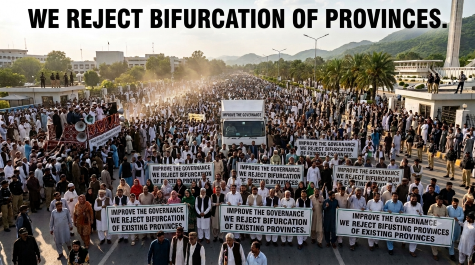
Pakistan’s debate over new provinces has returned once again. Supporters argue that smaller provinces can bring government closer to the people and improve administration. This may be true in some cases. But before we redraw the map of Pakistan, we should ask a simple question: Are our existing institutions working effectively? In my view, Pakistan’s main problem is not simply the number of provinces. It is the quality of governance. If the same weak institutions remain we may create new provinces but keep the old problems.
Pakistan’s weak governance is reflected in international rankings. The World Justice Project’s 2025 Rule of Law Index ranks Pakistan 130th out of 143 countries. This shows that our challenge goes beyond administrative boundaries. Whether Pakistan has four provinces, citizens still need effective police speedy justice good schools healthcare and an accountable government.
The problem is also visible in human development. The World Bank’s Human Capital Index places Pakistan at around 0.41, meaning that a child born today is expected to achieve only about 40 percent of his or her potential under conditions of complete education and full health. Provincial differences are also significant with estimates of around 0.42 for Punjab, 0.39 for KP, 0.36 for Sindh and 0.32 for Balochistan. These figures tell us that the real challenge is not only the size of provinces but the unequal quality of public services.
The same problem can be seen in education. According to the Pakistan Economic Survey (2025–26) Pakistan’s literacy rate is around 63 percent with male literacy at 73 percent and female literacy at 54 percent. Millions of children remain out of school. This raises a basic question: Should our first priority be creating new provincial offices or making sure that every child has access to a quality school?
The answer should be obvious. We need governance reforms first.
Take policing. In many remote areas, one police station has to cover a very large geographical area with limited personnel vehicles and resources. When a small number of police officers are responsible for a large population and territory, controlling crime and responding quickly to emergencies becomes extremely difficult. Instead of simply creating new provinces we should strengthen the police increase personnel, improve mobility, and divide police jurisdictions according to population, geography and crime levels.
The justice system presents an even bigger challenge. According to the Law and Justice Commission of Pakistan, more than 2.27 million cases were pending in the superior and district courts by June 2025. For an ordinary citizen justice that takes years can feel like justice denied. Courts need more capacity, better case management stronger investigation and prosecution and greater use of digital systems and alternative dispute resolution.
Another major solution is to empower local governments. Pakistan’s Constitution, through Article (140-A) already requires provinces to devolve political administrative and financial authority to elected local governments. Yet local governments often remain financially and administratively dependent on provincial governments. If we genuinely want government closer to the people, we should give local governments regular elections adequate funds and real decision-making powers.
The financial relationship between the federation and provinces also needs attention. Article 160 of the Constitution provides the framework for the National Finance Commission (NFC) and distribution of resources. Khyber Pakhtunkhwa, like other provinces, frequently raises concerns about its financial share and timely transfers. Instead of allowing the NFC issue to become a permanent federal provincial dispute, Pakistan needs a transparent and fair mechanism for resource distribution. A new NFC arrangement should consider population poverty backwardness geographical challenges and the special needs of different provinces.
Creating new provinces is therefore not a simple administrative decision. It would require constitutional changes and would also affect political representation, bureaucracy finances and the structure of the Senate. Under Article 239(4) changing provincial boundaries requires a two thirds majority of the relevant Provincial Assembly. The Senate as the House of the Federation would also face questions about representation if the number of provinces increased.
Before creating a new province we should ask, ‘Will it improve education? Will it improve healthcare? Will it strengthen policing? Will it speed up justice? Will it give citizens better access to government?’
If the answer is uncertain, then changing the map will not solve the problem.
Pakistan should first focus on strong institutions empowered local governments better policing speedy justice quality education improved healthcare and transparent financial arrangements between the federation and provinces.
The real issue is not how many provinces Pakistan has. The real issue is how effectively the state serves its citizens.
We should bring government closer to the people not simply create more governments.
Pakistan does not necessarily need more administrative units; it needs more effective institutions.
Read: New Provinces: Promise or Peril?
_________________
Hamid Khan is a BS Political Science Student at the International Islamic University Islamabad (IIUI) & Research Intern at the Institute of Regional Studies (IRS), Islamabad.