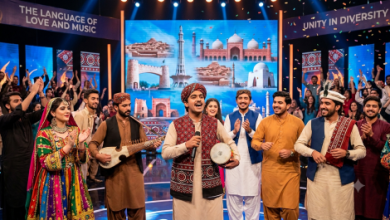
Exploring the vibrant cultural tapestries of the Sawan Teej festivals in the Thar Desert.
- As monsoon rains transform the arid landscape into lush greenery, desert women gather to celebrate devotion, marital bonds, and sisterhood through sacred fasts, intricate henna, and decorated tree swings.
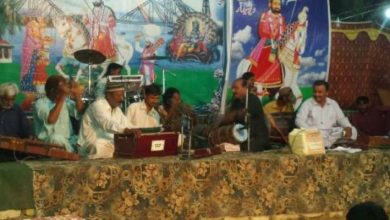
- Blending religious folklore with poignant Sindhi folk music, the piece captures both the joyful spirit of reunion and the bittersweet longing of women yearning for home and loved ones.
By Bharumal Amrani
In the vast desert of South Asia, three major festivals of Sawan Teej are celebrated. The first is known as Hariyali (Green) Teej, the second as Kajari/Kajli Teej, and the third as Hartalika Teej.
In the Thar Desert, two festivals of Sawan Teej are widely popular. The first takes place on the third day after sighting the moon of the month of Sawan, known as Chhoti Teej or Gajwa Teej. The second festival occurs on the third day following the full moon, known as Badi Teej or Sawan Teej, which is celebrated on a grand scale as a festival centered around desert women. Women adorning themselves with traditional makeup and jewelry, swinging on decorated swings, delivering sweets and fruits to friends and relatives, along with folk music and folk dances, define this day. It is also celebrated as a festival of goodwill and romance.
 During Chhoti Teej, the monsoon rains reach their peak, carpeting the entire desert in lush greenery; hence, it is called Hariyali Teej. The day of Hariyali Teej primarily instills hope for greenery and a bountiful harvest. According to Hindu tradition, this festival marks the union of Goddess Parvati and Lord Shiva. On this day, Mother Parvati undertook rigorous penance and observed a strict fast for Mahadev Ji. Devotees also refer to Mother Parvati as Teej Mata.
Kajari Teej or Kajli Teej is the Badi (Grand) Teej. Women celebrate this day by decorating their homes with beautiful swings and dancing to the tunes of folk melodies. At night, women gather at a village household to adorn their hands with henna while singing special folk songs dedicated to the Teej festival. During the day, dressed in vibrant red and green sarees and traditional jewelry, they perform ritual prayers (pooja) to Goddess Parvati and Goddess Nimdi (also known as Nimdi Mata).
During Sawan Teej, women observe a fast (vrat). Unmarried girls observe this fast to attain a suitable husband, while married women fast for the long life of their husbands and the prosperity of their families. The fast is broken at night upon sighting the moon.
A day prior to the festival, betrothed girls receive gifts sent by their prospective in-laws. These gifts include henna, bangles, traditional attire, and sweets. The signature sweet of Teej is Satu, made from roasted gram flour; hence, this gifting tradition is called Satu Bhejna (sending Satu). Married daughters receive gifts, clothes, and sweets from their mothers. Special dishes made of wheat (paddy), gram, and rice are prepared for the festival. Upon the arrival of the first Sawan after marriage, newlywed brides are invited back from their in-laws’ home.
 With the arrival of Sawan rains, scenes of joy spread across the desert, and nature sways in delight. On the arrival of Sawan Teej, swings are tied to the branches of large trees. Swinging is considered an integral part of the Teej festivities, as village maidens sing traditional Sawan Teej songs while swaying on tree swings. There are many genres of these Sawan Teej songs. The lyrics express the emotions of married girls living away from home. A newlywed bride sends a message full of complaints about her mother-in-law to her mother. In another song, she pleads with her brother to come and take her back home while gazing wistfully toward her maternal village. Elsewhere, women, young maidens, and lovers sing songs of separation (Viraha/Biyog) missing their husbands and beloveds.
The music and rhythm of ‘Sawan Teej songs’ carry profound grace. Previously, the celebrations lasted for a full week, but today, these beautiful rituals, traditions, and songs of Teej are gradually fading away, and social gatherings have lost their former warmth.
Among modern Sindhi poets, Sheikh Ayaz, Tajal Bewas, and Swaroop Chandra Shad have also penned folk songs for Teej.
 Folk Songs
Song 1
Translation:
My companions! I too have heard that Sawan has arrived,
The intense heat of Jeth persists, yet a steady stream of rain has begun to fall.
O my brother, come and sit in my courtyard,
In this season, do not ask about the state of my heart,
A steady stream of rain has begun to fall.
O my brother! I shall call for fine clay, build four stoves, and prepare Lapsi on one and temper lentils on the other,
On the third stove, I shall cook Khichdi, and on the fourth, Choolai greens,
Sit together, brother-in-law and brother, and share this meal.
Do not ask about the state of my heart,
A steady stream of rain has begun to fall,
A steady stream of rain has begun to fall.
Song 2
This Teej folk song is widely famous and popular across the Thar region; everyone knows it by heart. Mentioning Sawan and Teej instantly brings these lyrics to one’s lips.
Translation:
O my brother, come quickly to fetch me, Sawan’s Teej has arrived,
So I may tie a rope to a large tree and sway on the swing.
O my brother, come quickly to fetch me, Sawan’s Teej has arrived.
O brother, your sister climbed to the top of the sand dune and looked out,
Our native village remains so far away.
O my brother, come quickly to fetch me, Sawan’s Teej has arrived.
O my dear brother, henna adorns my hands,
And bright red Majeeth dye colors my bangles.
Brother, come quickly to fetch me, Sawan’s Teej has arrived.
Sawan has arrived, Bhadon has arrived, and the notes of the Megh Malhar ragam echo across the sky.
O my brother, come quickly to fetch me, Sawan’s Teej has arrived.
Song 3
Translation:
Hearing of the Teej festival, my beloved, please return home,
Dark, heavy clouds have gathered over the sky,
Leave your distant job and return home…
In which direction lies your job?
My king, toward which direction should I keep waiting for you?
Hearing of Teej, return home…
Your job lies in the East,
My beloved, and I wait for you looking toward the West.
Hearing of Sawan’s Teej, return home.
Your job earns five rupees,
My beloved,
Yet this Hariyali Teej is worth hundreds of thousands of gold coins.
Hearing of the Teej festival, my beloved, please return home.
Read: We, the Builders of Civilization
_____________
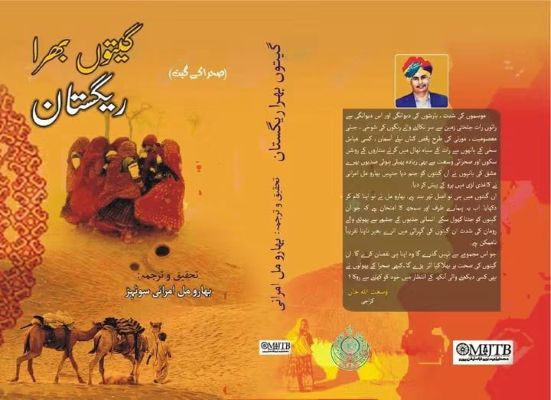
 Bharu Mal Amrani is a distinguished folklorist, poet, writer, researcher, journalist, script writer & compere of Radio Pakistan, and social–environmental activist from Tharparkar, Sindh, who has devoted more than two decades to the preservation, documentation, and promotion of Thari dialect, folklore, culture, and heritage. Currently he is working as a subject specialist of Sindhi at Raichand Rathore Government Higher Secondary School, Chelhar.