Indus River’s Elegy traces how centuries of colonial engineering, post-independence dams, and entrenched political corruption decimated the Indus River’s vital riparian forests. It calls for the urgent depoliticization and scientific restoration of these ecological systems to safeguard clean air as a fundamental right.
By Mohammad Zafar Wassan
In present time we are suffering the loss of nature. It is loss of biological systems. The biological systems, runs with different recurring and inherent cycles to maintain sustainability. It reminds to rethink about the biological means to recover the lost nature. In present times, our country is suffering and repenting about the loss of tree cover.. The deforestation is the dilemma of our country.. We are losing the oxygen factories endowed by nature. These biomass reserves grown on mother earth are meant to Produce oxygen and neutralize the Carbon emissions recurrently. Being aggrieved and sensitized from the contaminated environment, the legislators added the provision about the pollution free environment and clean air. The clean air legislated as basic right of every citizen under the constitutional provisions.
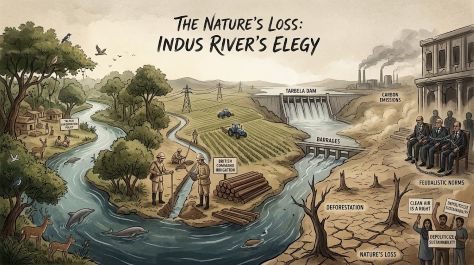
Now, let us talk about the tree cover loss history along the River Indus. It starts after when Britishers took over the reign of power on Sindh’s territories, after the fall of Talpur rulers of Sindh. In Talpur era, the tree swatches were encompassing over three million acres around, which were regularly maintained and protected by Talpur Regime under a conservation policy. The tree swatches were conserved as habitat for a diverse life associated with river and endemic Indus Forest ecosystems. The state was regularly seeding, and growing up trees to perpetuate biodiversity. These Riparian areas were biodiversity hotspots with a rich life. These were the game reserves and were being operated under state sponsorship and the supervision of local rulers. This was the best model of community participation with cultural practices of tree plantations coupled with best protection mechanisms. As the Britishers took over the lands of Sindh, they introduced the command irrigation system to divert the river water to other arable areas. Hundreds of thousands acres were brought under Agriculture crops. It enriched the coffers of British state by contributing land and water taxes.. The land-use was changed.. But, Nature was disturbed. Ecological Systems were collapsed.
In second term of anthropogenic interventions in the name of economic development it was decided to store the water with a view to overcome the water scarcity, as the flow of three waters was diverted to east Punjab. Eventually, Tarbela Dam was constructed to reserve water and divert the supply to arable lands. Then numerous barrages constructed on the river Indus to expand the irrigation systems. These interventions caused to lessen the water supplies in river Indus. Eventually, the endemic Indus ecosystems, dated hundred years back on the ecological timelines were vanished. The river forests got their ultimate end in the name of development, green revolution and strengthened economy.
It is the tragedy of our times that we are experiencing the worst governance system in the name of democracy. In real letter and spirit, the democracy is meant to govern for the people with some set of principles for human equality, dignity and societal development under a legal framework. These frameworks are meant to ensure the perpetuity of basic principle meant for a democratic rule. In this connection, adult franchise voting system ensures the participation. It is quite pathetic to observe that democracy has not borne fruits as the European societies achieved the landmarks in governance mechanisms to revere the humanity. In modern world, the elected parliaments are meant to make the laws for a collective betterment of society and people. The state is meant to safeguard the justice under the principles of equality and human dignity. Our political landscape is quite different from European democratic standards. Our political standards are subservient to obsolete feudalistic norms. We are still suffering from aggressive and subjective psychology. The equality and societal justice has no place in our mindset. The parallel judicial systems are in operation without any break of time. It brought an end to anticipated fruits of democracy in our country. The leaders are involved in corrupt practices. The bureaucratic structure which is obliged to deliver, are turned to look after the personal fiefdoms of politicians rather than to work in their prescribed service delivery ambit. Eventually, the politics has got the inefficient and unscrupulous role in governance mechanisms… The political interference weakened the institutions meant to increase the tree cover and safeguard the vegetative covers.
In such a critical state of affairs, it is urgently required to depoliticize the institutions which are meant to be instrumental in process of infinite sustainability. The resources should be scientifically managed on technical parameters rather than to conform it to unscrupulous political agenda to secure more and votes at the cost of public ecological resources.
Read: Women’s Inheritance: Breaking Feudal Chains
_______________
 Hailing from Sanghar district of Sindh, the author is a freelance writer. He writes for different newspapers on the subjects of Governance, Climate Change, Current Affairs and Natural Resources Management.