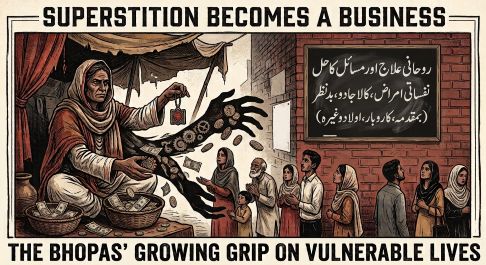
The Bhopas’ or so-called Faith Healers’ Growing Grip on Vulnerable Lives
- The government should map and investigate complaints against practitioners who operate as fraudulent healers.
By: Ramesh Raja
There is something deeply unsettling about a business that advertises itself on the walls of our towns. A name, a mobile number and a promise: cure illness, remove black magic, break a “bandish”, bring back a lover, save a marriage, solve family problems or change a person’s destiny. Such advertisements can be found not only in the remote areas of Tharparkar, Umerkot and Mirpurkhas, but across Sindh and increasingly in major urban centers. Karachi, too, is visibly crowded with such wall chalking and advertisements.
This is not merely a story about superstition. It is a story about fear, desperation, poverty, weak scientific literacy, failures of healthcare and the commercial exploitation of human vulnerability.
The Business of Human Desperation
Who goes to a bhopa? The answer is more complicated than simply saying “uneducated people”. A young man desperately trying to marry the woman he loves may go there after facing family opposition. A woman trapped in a troubled marriage may seek help because she cannot discuss her private problems openly. Parents may take a child whose behaviour has changed. A couple struggling with infertility may search for an explanation after exhausting their savings on treatment. Someone suffering from anxiety, depression, sleeplessness or an unexplained illness may be told that they are under the influence of black magic or an evil force.
At the moment of desperation, certainty becomes powerful. The bhopa offers an explanation where the patient has none, attention where institutions may have offered little, and hope where the family sees despair.
That is where a spiritual practice can become a commercial enterprise.
The initial visit may lead to repeated consultations, amulets, rituals, special prayers or other paid remedies. Fear can create dependency, and dependency can create a steady source of income. When a person’s most intimate anxieties become the raw material of a business, the matter moves beyond personal belief and enters the territory of public protection.
Why Are People Turning Away from Doctors?
It would be intellectually dishonest to blame everything on superstition while ignoring the failures of the formal healthcare system.
Many ordinary citizens feel that doctors do not have enough time to listen. Consultations can be hurried. Diagnostic tests and medicines are expensive. Patients may move from one doctor to another, spend money they cannot afford and still remain uncertain about what is wrong with them. For a poor family already struggling with inflation, even a routine medical consultation can become a financial decision.
Read: Labelled As Witches In Rajasthan, Women Face Harassment, Torture And Ostracism
There is another problem: dignity. A person who walks into a doctor’s office may receive ten minutes of clinical attention. A person who visits a bhopa may be listened to for an hour. The latter may ask about the family, relationships, dreams, fears and private troubles. The explanation may be scientifically wrong, but the emotional attention is real.
This is an uncomfortable lesson for modern healthcare: when institutions stop listening, people begin listening to anyone who will.
Women and Young People Are Particularly Vulnerable
The most sensitive cases often involve women and young people. Love, marriage, infertility, domestic disputes and family opposition are subjects that many cannot discuss freely. Social stigma can make professional counselling inaccessible or unacceptable.
A young couple facing resistance to marriage may be promised that a ritual will change the family’s mind. A woman experiencing marital difficulties may be told that another person has cast a spell on her husband. A distressed family may interpret psychological illness as possession.
Once fear enters the household, rational discussion becomes difficult.
The consequences can be serious. At their worst, such beliefs may lead to humiliation, physical violence, financial exploitation, abandonment of medical treatment and severe psychological trauma. There have also been tragic reports of deaths associated with alleged supernatural or faith-healing practices. Every such case deserves proper investigation rather than being dismissed as a private family matter.
This Is Not an Attack on Faith
There must be a clear distinction between faith and fraud.
Sindh possesses an extraordinary history of religious tolerance, Sufi traditions and cultural pluralism. Religious belief, prayer, spiritual comfort and traditional practices are part of the social fabric of the region. The issue is not whether people should be allowed to pray or seek spiritual guidance.
The issue begins when any person, whether presenting himself as a bhopa, religious figure, traditional healer or spiritual practitioner, uses supernatural claims to deceive people, extract money, threaten them, encourage violence or prevent them from obtaining legitimate medical treatment.
Nor should every mullah, pundit or religious scholar be labelled a bhopa. Such sweeping accusations are neither fair nor useful. The standard should be conduct, evidence and the law.
The Walls Are Telling Us Something
Perhaps the most remarkable feature of this phenomenon is its openness. These practitioners do not necessarily operate from hidden locations. Their names and telephone numbers are often written prominently on walls, poles and public spaces. Their locations may be widely known within neighborhoods.
That raises a simple but uncomfortable question: if the business is visible to ordinary citizens, why does it remain so difficult for the state to see it?
The recent initiative of Sindh Assembly Member Surendar Valasai, who has urged the Chief Minister of Sindh to act against fraudulent and exploitative bhopas, is therefore timely. But the issue must not be treated as a problem belonging only to Tharparkar, Umerkot or Mirpurkhas. It is a much wider social problem. From small rural settlements to Karachi, the same advertisements and claims can be found.
Education Alone Will Not Be Enough
Scientific education is essential, but simply telling people to “stop believing” will not solve the problem. A person needs an alternative.
If affordable healthcare is unavailable, provide it. If doctors do not have enough time to listen, improve patient care. If psychological problems are routinely misunderstood, expand counselling and mental-health services. If women cannot discuss sensitive matters safely, create confidential support systems. If inflation is making healthcare unaffordable, strengthen public hospitals and primary healthcare.
People do not abandon superstition merely because a scientist gives them a lecture. They abandon harmful practices when knowledge becomes accessible, healthcare becomes affordable, institutions become trustworthy and society provides safer answers to difficult questions.
The State Must Break the Chain of Exploitation
The government should map and investigate complaints against practitioners who operate as fraudulent healers, monitor misleading public advertisements, and take stern legal action wherever fraud, coercion, violence, financial exploitation or obstruction of legitimate medical treatment is established. Police and district administrations should not wait for a tragedy before acting.
But policing must be accompanied by prevention. Schools should strengthen scientific and critical thinking. Health departments should conduct public-awareness campaigns. Media organizations should expose fraudulent claims responsibly. Religious and community leaders who reject exploitation should be encouraged to speak clearly against practices that endanger human life.
The objective should not be to wage a war against faith. It should be to protect people from those who turn faith into fear and fear into money.
The Real Question
The growing presence of bhopas tells us something uncomfortable about our society. People are not simply buying supernatural cures. They are buying certainty, attention, confidentiality and hope. And if a desperate citizen finds all four more readily from an unqualified practitioner than from a doctor, counsellor or public institution, then the problem is bigger than the practitioner. It is a failure of the system around that person.
The time has come to stop treating every tragic incident as an isolated case. Sindh needs a coordinated response that combines law enforcement, affordable healthcare, scientific education, counselling, public awareness and social reform.
Because superstition becomes truly dangerous when it stops being merely a belief and becomes an organized business exploiting vulnerable human beings.
And when that business is openly advertised on our walls, perhaps the first question we should ask is not why people are going there, but why we have allowed the road to remain open.
Read: Nara Expressway: Lifeline of Progress
_________________
 The author of this article, Engr. Ramesh Raja, is a Civil Engineer, visionary planner, PMP certified and literary enthusiast with a passion for art and recreation. He can be reached at engineer.raja@gmail.com