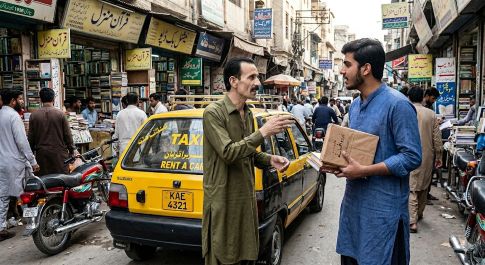
Stories of Karachi’s Taxi Drivers from 1993 to 2000
Zaffar Junejo
[Author’s Note: I joined a non-government organization in mid-1993. In those days, we were frequent travelers to other Asian countries, and during that period I maintained a diary. I once showed the notes to Muhammad Ibrahim Joyo — the legendary scholar, translator, and intellectual giant of the Sindhi world — who suggested categorizing the entries by theme and getting them published. He recalled that long ago, perhaps in 1955, the Sindhi journal Mehran had launched a similar idea titled ‘Hik Deenh Ji Ghaleh’ (The Story of a Day), even offering a prize for it. He himself had submitted the first story, he told me with a smile, just to set a standard for other writers. Later, Maulana Ghulam Muhammad Girami, a scholar of high standing and journalist; Shamsher ul Haidri, a distinguished Sindhi poet, journalist, and playwright; and Siraj ul Haq Memon, an iconic novelist, linguist, and journalist, all contributed their observations of a single day. These writings were published until 1968.
I agreed with Joyo Sahib that I would group the write-ups by subject and get them published, but I failed to do so. Recently, I sat down to organize my notes. I found various entries about the taxi drivers of Karachi city. Some were very brief and incomplete; others were short but held a finished truth. I have chosen five stories from each year, all of them gathered from the drivers of those cars. In total, there will be thirty-five stories covering the period from 1993 to 2000.
On the surface, these pieces appear to be simple narratives. However, beneath the prose, they depict the complex socio-political and cultural landscape of Karachi during those turbulent days. They are the echoes of a city in motion.]
The America of Poor Men
The sun was a cold, flat coin dropping behind the concrete of Urdu Bazar. The winter days in Karachi do not linger; they end before you are ready.
I came out of the bookshop with the old volume under my arm. My shoulders were tight with the fatigue of the crowds, and the thought of the long road back to Gulshan-e-Iqbal made the air feel heavier.
A taxi stood by the curb. It looked empty.
I walked over and waited by the rusted door. A man approached from the shadows of a tea stall. He was thin, moving with a deliberate, measured step. He wore a gray shalwar kameez and leather Peshawari sandals. He did not look like a man who drove a car for a living.
He stopped a foot away.
“Where to?” he asked.
“Gulshan-e-Iqbal,” I said. “Near the Sunday Bazar.”
He nodded once. “Get in.”
He climbed into the driver’s seat. I watched him from the back. Before he turned the key, he gathered the fabric of his shalwar with both hands, easing himself onto the cracked vinyl with a sharp, catching breath. His movements were too slow for Karachi. The city demanded speed, and he had none.
I sat back, distrust growing in the quiet.
“Are you from Peshawar?” I asked.
“Abbottabad,” he said, shifting into first gear. The taxi groaned forward into the traffic. “I am not Pathan.”
“No?”
He did not elaborate. His face in the rearview mirror looked the color of old parchment.
“You look pale,” I said.
The car crawled past the evening stalls. He glanced at the mirror, catching my eye.
“It is the kidneys,” he said. He reached down with his left hand, lifting the hem of his shirt just enough for me to see the clear plastic tubing and the yellow fluid in the bag pinned to his waist. “I must sit carefully. The tubes pull if I move too fast.”
The engine whined as he found second gear.
“Is it not difficult?” I asked. “Driving like this?”
“It is difficult,” he said. His hands were steady on the wheel. “But the treatment takes time. Nine months, maybe a year. The doctors at the urology department told me to wait. First it was fifteen days. Then a month. Now they want me back in six months. A man cannot live in a hospital.”
He cleared his throat. The honking of rickshaws filled the gaps in his voice.
“So I brought the family from the village,” he continued. “We stayed with my wife’s people first. Then the men from Abbottabad found me this taxi. Now my eldest boy goes to the government school. The second one is at the madrasah.”
“Why the madrasah?” I asked.
“He is simple,” the driver said softly. “Sadha hai. He does not have the mind for the other school.”
I looked out the window at the blurred neon signs of the shops.
“Was it hard? Settling here?”
“No,” he said. “Half our village is already here.”
We crossed Kala Board. The traffic thinned, and the air grew cooler as we approached Gulshan. The driver kept his eyes on the asphalt ahead.
“Karachi is America for the poor people of Pakistan,” he said. He did not smile. “For us, the poor. You arrive, you find a corner, and no one asks you who you are.”
I told him to pull over near the market.
The taxi stopped with a jerk. I handed him the notes through the front seats. He took the money, nodded, and began the slow, agonizing process of shifting his weight to adjust the plastic bag before the next fare.
I stepped onto the gravelly curb. The winter wind was sharp now, carrying the smell of exhaust and fried fish. The taxi merged back into the stream of red taillights, disappearing toward the center of the city.
Karachi is America for the poor people of Pakistan.
The words stayed in the cold air long after the car was gone.
***
The Storm Over Karachi
The sky over Karachi was the color of a bruised iron pot. It was July, the height of the monsoon, and the wind blew hard off the Arabian Sea, gusting in erratic, violent bursts that made the palm trees along the avenue hiss. Black squall clouds hung low and heavy with water, blotting out the afternoon sun.
The office closed thirty minutes early. The air felt thick, charged with the sudden electricity that comes just before a deluge. I held my leather briefcase tight against my ribs, stepped out onto 26th Street, and walked quickly toward the petrol pump.
The first fat, heavy drops of rain hit the road like gravel. By the time I reached the shelter of the station, the downpour had begun in earnest, bouncing inches high off the concrete.
A row of yellow taxis sat idling near the pumps. I walked up to the first car in the queue, and the driver rolled down his window an inch. Water streamed from the brim of his prayer cap.
“Hasan Square,” I shouted over the roar of the rain.
He looked at my wet shoulders, then at the sky. “Four hundred and fifty rupees.”
It was too much. But the rainwater was already pooling around the soles of my shoes. “Get in,” he said.
He pulled out into the storm. The regular route was blocked by a stalled rickshaw, so he cut past the shrine of Abdullah Shah Ghazi, the wind rocking the old body of the car. We skirted past the Marriott, the rain now a solid white sheet against the glass. The wipers snapped a frantic, useless rhythm. By the time we rounded the Metropole and cleared the Avari Towers to join Shahrah-e-Faisal, the gale was screaming. The wind caught the rain, hurling it sideways against the passenger doors.
I leaned forward. The driver’s eyes were not on the flooded tarmac ahead. His gaze kept darting upward, tracking the skyline.
“Keep your eyes on the road,” I said. “The water is rising.”
“The water is nothing,” he said, his voice flat, his knuckles white on the steering wheel. “Look up, sahib.”
Above us, giant commercial billboards and iron-framed hoardings groaned in the wind. They loomed over the highway like heavy sails. Some showed the glossy, smiling faces of models selling lawn suits and tea; others bore the giant, painted portraits of political leaders belonging to the PPP, the PML-N, and the MQM.
“They do not bolt them right,” the driver said. “In the monsoon, those boards are death.”
As he spoke, a sudden, violent downburst ripped through the avenue. A hundred yards ahead, a massive steel billboard advertising a cellular network multichannel shuddered, snapped from its moorings, and plunged into the traffic. It struck the hood of a white sedan with a heavy, metallic crunch. The windscreen blew outward in a shower of glittering glass.
Brakes shrieked. The line of cars ground to a sudden, smoking halt. Shahrah-e-Faisal was blocked. Cloth banners, torn from the electric poles, flew through the air like dying kites, flapping wildly before slapping wetly against the road.
“We should pull into a petrol pump,” I said, my chest tight. “Wait it out.”
“No,” the driver said, shifting into reverse to clear a fallen branch. “Soon the roads will become ponds, and then it will be difficult to move.”
He found a gap near the curb, steering through the rising gray water. He drove with a cold, steady precision, dodging the low-hanging wires and the swinging metal frames.
By the time we bypassed the Drigh Road Station and turned toward the National Stadium, the pressure of the gale began to ease. The heavy sheets of rain thinned into a steady, quiet drizzle. The sky remained dark, but the wind had lost its teeth.
The taxi crawled into Hasan Square and came to a stop near the flyover.
“We are here,” the driver said.
I counted out the notes and handed them to him. He took them with a brief nod.
“Thank you,” I said. “You drive well.”
“The city is heavy in all seasons,” he said, looking up at the torn banners still clinging to the poles. “But in the monsoon, it tries to kill you.”
I stepped out into the damp air, and the taxi rolled away into the gray mist.
__________________
 Dr. Zaffar Junejo has a Ph.D in History from the University of Malaya. His areas of interest are post-colonial history, social history and peasants’ history. He may be reached at junejozi@gmail.com