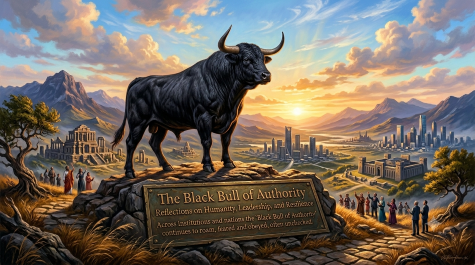
Across institutions and nations the “Black Bull of Authority” continues to roam, feared and obeyed, often unchecked.
- The future of a young person cannot be determined by a single institution, a single punishment, or a single authority figure.
Dr. Nisar Ahmed Solangi
“Across lands and kingdoms, the Black Bull of Authority still bellows.”
During the 1980s, while pursuing our medical education, an incident occurred that profoundly shaped the lives of six young students. It not only disrupted our academic journey but also transformed my understanding of institutional power, moral leadership, and the nature of justice itself.
The incident was our rustication from Liaquat Medical College.
The Principal at the time was a renowned professor—may God grant peace to his soul. History, however, carries its own ironies. During his own student years, he had once faced a similar disciplinary action and rustication. Yet fate had been kinder to him; he and a fellow student were allowed to continue their education through a transfer to a college in another province.
Our ordeal began with a seemingly minor grievance. A practical record book belonging to one of our colleagues had been damaged, giving rise to a dispute. During the ensuing exchange, a companion who was not a student of the college discharged a firearm into the air in a moment of heightened emotion.
No one was injured.
No property was damaged.
No life was endangered.
Yet the sound of that gunshot awakened the machinery of institutional authority, and swift punitive action followed, just to please big bosses of the time.
None of us had any prior record of misconduct. Senior faculty members, departmental heads, and respected figures from society attempted to mediate and resolve the matter amicably. Their efforts, however, proved futile. However, in order to please higher ups of those days, the Principal remained unwavering, and all six of us were rusticated.
During those difficult days, when our educational and professional futures hung in uncertainty, the most profound guidance I received came not from institutions, professors, or administrators, but from my father.
When I returned to my village burdened with disappointment and anxiety, my father met me with a rare combination of empathy, courage, and wisdom. He understood my suffering. He gave me complete freedom to change my career if the environment became unbearable. Yet at the same time, he urged me to remain steadfast in the defiance of truth, justice, and the rights of the oppressed.
Invoking the eternal example of Imam Hussain (peace be upon him), he reminded me that the path of truth often demands sacrifice, but ultimately becomes the foundation upon which human dignity rests.
His compassion and moral clarity stood in striking contrast to the rigidity and punitive spirit of the college administration.
His words also raise a timeless question:
If our children find themselves trapped in an unbearable environment, do we possess the wisdom and courage to help them choose a different path, rather than forcing them to endure suffering for the sake of convention?
When the matter reached the High Court of Sindh, the fragility of the administration’s decision became evident. The Court granted me a stay order, observing that there was neither a police report nor a public complaint, and that the individual responsible for the firing was not even a student of the institution.
Under judicial scrutiny, the administration eventually withdrew the rustication orders against the other five students, provided they offered formal apologies.
“There is an old saying that courts do not speak; their judgments speak for them”.
“One cannot help but wonder whether that wisdom still holds true in our own times”.
Yet even after judicial intervention, the pressure did not entirely cease. Attempts were allegedly made to influence examination outcomes in order to ensure my academic failure.
What prevented such efforts from succeeding was the integrity of a number of my professors. Their commitment to professional ethics, intellectual honesty, and principled conduct proved stronger than administrative pressure. Because they refused to compromise their conscience, I was able to complete my medical education.
Years later, life presented a remarkable irony.
The same former Principal had become Secretary of the Health Department. At an academic cum public gathering, while criticizing the medical profession and younger doctors, he referred to our decades-old rustication as well as frequent visits of junior doctors to his secretariat as an example.
Rather than allowing the moment to pass in silence, I chose to clarify the truth.
Addressing the gathering, I posed a simple yet fundamental question:
What is the true meaning of a mentorship and leadership?
I argued that the responsibility of a leader, mentor, teacher, or an administrator is not to “wield authority” as a weapon against those entrusted to their care. Rather, leadership should resemble parenthood: guiding, encouraging, nurturing, and viewing mistakes not as grounds for punishment but as opportunities for growth and learning.
Yet what can one say?
Even today, across institutions and nations the “Black Bull of Authority” continues to roam, feared and obeyed, often unchecked.
This story is therefore more than a personal memory. It is an invitation to reflect upon the essence of leadership and mentorship itself.
Whether within the corridors of a medical college, the offices of public institutions, or the chambers of government, authority acquires legitimacy only when tempered by justice, compassion, patience, and humanity.
The foundations of my professional and ethical philosophy were not laid by textbooks or official titles. They were laid by my father’s wisdom.
I remain convinced that leadership does not emerge suddenly when one acquires power. The seeds of leadership are planted much earlier—in childhood during formative years and beyond —through the moral guidance of parents, the mentorship of teachers, and the companionship of principled colleagues.
Perhaps the most remarkable aspect of this story is what became of the six young students once deemed unworthy of remaining in medical school.
Time did not turn us into symbols of failure.
Quite the opposite.
Each of us eventually achieved distinction in our respective fields. Some became renowned medical specialists. Others rose to serve as national secretary level, senior administrators, and the directors-general. Some built successful businesses, while others went on to contribute their expertise within the United Nations and other international organizations.
The lesson is both simple and profound:
The future of a young person cannot be determined by a single institution, a single punishment, or a single authority figure.
When an individual possesses courage, moral conviction, and access to enlightened guidance, even adversity can become a staircase leading toward achievement.
These reflections are offered as a humble tribute to my late father, whose wisdom, compassion, and moral courage remain the guiding light of my thoughts and actions.
And yet, despite all that history teaches us, one reality remains stubbornly familiar:
Across lands and kingdoms, the Black Bull of Authority still bellows.
Read: Lessons from the Indus Valley Civilization
_________________
Dr. Nisar Ahmed Ali Nawaz Solangi is a distinguished Public Health Specialist with over 28 years of experience in primary healthcare, health management, and policy development. Throughout his career, he has served in leadership capacities, He holds MBBS from the University of Sindh and a Master of Public Health from Griffith University, Australia. He is a dedicated polymath committed to the intersection of ancient civilization and emerging technology. He is deeply engaged in the study of the Indus Valley Civilization—focusing on its maritime history, trade networks, and egalitarian governance. Currently based in Saudi Arabia, Dr. Solangi is a tireless advocate for the digital preservation and global dissemination of the Sindhi language and culture. He is actively involved in pioneering initiatives on social media” Our Digital World”. By bridging the gap between historical heritage and digital innovation, he aims to create a new paradigm for cultural representation in the AI era.