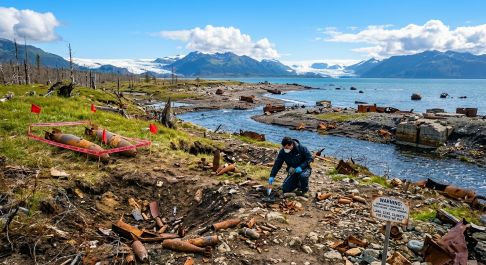
The wars ended but their toxic legacy still poisons our land, seas, climate and future.
By: Ramesh Raja
From radioactive remnants and unexploded bombs to polluted seas, rising temperatures and melting glaciers, the environmental legacy of modern warfare is being inherited by people and nature. The countries that created and used these destructive weapons must acknowledge their responsibility, stop producing them and help clean up the toxic legacy they left behind.
War is normally remembered through battles, victories, defeats, borders and political settlements. History tells us when a war began and when peace was declared, but much less attention is given to what remains after the soldiers leave the battlefield. Every major war leaves behind another, largely invisible history: the history of ammunition, explosives, contaminated land, polluted water, damaged ecosystems and hazardous materials that can survive long after the conflict itself has disappeared from memory. A war may last a few years, while its ammunition may remain dangerous for a century and its chemical and environmental consequences may continue for generations. The world is now discovering that war does not necessarily end when the guns fall silent.
From Arrows to Industrial Ammunition
Human warfare began with relatively simple weapons such as stones, spears, arrows, swords and axes. These weapons could cause enormous human suffering, but their environmental legacy was comparatively limited. The arrival of gunpowder changed warfare by increasing the range and destructive capacity of armies through muskets and cannon. The Industrial Revolution transformed warfare again, allowing factories to manufacture weapons and ammunition on a scale previously unimaginable. The nineteenth century saw increasingly powerful rifles, machine guns, artillery and naval guns, and wars such as the Crimean War, American Civil War and Franco-Prussian War demonstrated the growing importance of industrially produced ammunition. Then came the twentieth century, when war became an industrial process. Factories could produce millions of cartridges, artillery shells, bombs, rockets, mines and other weapons and deliver them across enormous battlefields. As the quantity and power of ammunition increased, so did the environmental consequences.
World War I: When the Battlefield Became a Waste Site
The First World War was a decisive turning point in the environmental history of warfare. Between 1914 and 1918, artillery dominated much of the Western Front. Germany, France, Britain, Belgium and other combatant nations employed enormous quantities of artillery shells, machine-gun ammunition, grenades, mines, aircraft bombs and chemical weapons. The landscape itself was transformed into trenches, craters, destroyed settlements and contaminated ground. But not every shell exploded. More than a century later, unexploded ammunition is still being recovered from former battlefields in France and Belgium. The war ended in 1918, but its ammunition did not disappear with the peace treaty. It remained buried in the soil, waiting to be discovered by farmers, construction workers and local authorities.
World War II: Destruction on an Industrial Scale
The Second World War expanded the problem enormously. Germany, the United States, the United Kingdom, Japan, France, Italy and other combatant nations mobilized their industrial economies to manufacture artillery, tanks, aircraft, bombs, rockets, naval weapons, mines and small arms. Cities were bombed from the air and battles were fought across Europe, Africa, Asia and the Pacific. Vast quantities of military material were consumed, destroyed or abandoned. Mines and unexploded bombs remained across Europe and Asia, while sunken ships containing fuel, ammunition and other hazardous materials became part of the marine environment. But World War II also introduced humanity to something fundamentally different: the atomic bomb.
Hiroshima and Nagasaki: When the Aftermath Became Part of the Weapon
On 6 August 1945, the United States dropped an atomic bomb on Hiroshima, and three days later, on 9 August, another atomic bomb was used against Nagasaki. The destruction was immediate and unprecedented. Buildings were destroyed, fires spread through the cities and enormous numbers of civilians were killed or injured. But the atomic bomb introduced a dimension that conventional ammunition could not produce on the same scale: ionizing radiation. The consequences therefore extended beyond the moment of explosion. Survivors exposed to radiation suffered acute health effects, while long-term studies documented increased risks of cancer and other diseases. Hiroshima and Nagasaki became more than historical symbols of destruction; they became a warning about what happens when technological power advances beyond society’s ability to manage its consequences.
The nuclear age that followed produced enormous arsenals and nuclear testing programs. The United States, Soviet Union, United Kingdom, France, China and other nuclear powers conducted tests in the atmosphere, underground or underwater, creating radioactive contamination in locations far removed from the original battlefields. The environmental legacy of warfare had therefore moved beyond metal, explosives and damaged buildings to radioactive contamination and long-term planetary risk. Hiroshima and Nagasaki demonstrated that the aftermath of a weapon can itself become part of its destructive legacy.
Vietnam and Indochina: The Battlefield beneath the Soil
The Vietnam War demonstrated another dimension of the problem. Large quantities of bombs, artillery, rockets, mines and other explosives were used across Vietnam, Laos and Cambodia, and a proportion of this ordnance failed to detonate. The United States conducted an enormous aerial bombing campaign during the Indochina conflicts, leaving behind vast quantities of unexploded ordnance. Decades later, unexploded bombs and other ordnance continue to pose risks to communities and restrict the safe use of land. Laos, in particular, remains heavily affected by unexploded cluster munitions and other remnants of war.
The farmer, child or construction worker who encounters an old explosive device is not experiencing an old war; they are experiencing its present-day consequence. In this way, military ammunition becomes an inherited environmental hazard.
The Weapon That Waits: Landmines
Few weapons demonstrate the persistence of war better than the landmine. A bullet is normally fired once and an artillery shell is intended to explode once, but a landmine is designed to wait. It can remain hidden beneath soil and vegetation for years or decades, becoming increasingly difficult to locate as landscapes change. Countries including Cambodia, Laos, Afghanistan, Angola, Bosnia and Herzegovina, Iraq and Vietnam have faced extensive mine contamination. For these societies, ending the war is only the first stage; finding, removing and safely disposing of the weapons and restoring the land can take decades. Landmines also prevent farmers from using productive land, restrict movement, delay infrastructure development and make the return of displaced populations more difficult.
The Unending Effects of War
A war may have a beginning and an official end, but its consequences rarely follow the same calendar. The signing of a peace agreement can stop the fighting, yet it cannot immediately remove the weapons, explosives, contamination and destruction left across the battlefield. There is physical destruction of roads, bridges, railways, ports, dams, homes, hospitals and industrial facilities; chemical pollution from explosives, propellants, fuels, heavy metals and industrial substances; water contamination caused by damaged infrastructure and polluted soils; ecological destruction through fires, deforestation, damaged wetlands and contaminated agricultural land; and enormous quantities of military waste consisting of destroyed tanks, aircraft, vehicles, weapons, ammunition, plastics, composites, concrete and steel. Beyond the physical environment, war leaves displacement, disability, trauma, economic hardship and social disruption that can continue for generations. The war may be over, but environmental recovery may have only begun.
The Countries That Made War Industrial
The enormous scale of modern warfare was not created by a single country. Several states developed powerful military industries and used enormous quantities of ammunition in major wars and overseas campaigns. Among the most historically significant were Germany, the United States, the United Kingdom, Japan, France, Italy, Belgium, the Netherlands, Spain and Portugal, although the scale and nature of their involvement differed greatly across periods and conflicts.
Germany became central to both World Wars and employed vast quantities of artillery, aircraft bombs, tank ammunition, rockets, mines and small arms. The United States became one of the world’s largest producers and users of military ammunition during the twentieth century, with major involvement in World War I, World War II, Korea, Vietnam, the Gulf War, Afghanistan and Iraq. The United Kingdom and France participated in major European and overseas conflicts and developed extensive military-industrial capabilities. Japan conducted major military campaigns across Asia and the Pacific, while Italy fought major campaigns in Europe and North Africa. Belgium and the Netherlands were deeply involved in European and colonial conflicts, while Spain and Portugal accumulated substantial military legacies through earlier European and colonial warfare.
This history should not be reduced to a simple ranking of which country was “most aggressive” or which country used the greatest amount of ammunition. Wars differed enormously in duration, geography, technology and military objectives. More importantly, the environmental consequences often appeared far from the country where the weapon was manufactured.
That distinction is fundamental. The country that produces or uses the weapon and the country that inherits its environmental consequences may be completely different.
The Environmental Debt of War
There is therefore an uncomfortable contradiction in modern history. Some of the countries that developed the most powerful military industries and participated in the largest industrial wars later became among the strongest advocates of international environmental standards, restrictions on hazardous materials, marine protection and controls on certain weapons.
These modern rules are necessary and should be strengthened. But today’s regulations cannot erase yesterday’s contamination.
The unexploded bomb does not know that international law has changed. The buried mine does not recognize a peace treaty. The contaminated soil does not distinguish between the generation that created the pollution and the generation that inherited it. The sea does not recognize national borders. This creates what can reasonably be called an environmental debt of war.
Countries such as Vietnam, Laos, Cambodia, Iraq, Afghanistan, Bosnia and Herzegovina and others have inherited enormous burdens from conflicts in which they became battlefields or theatres of military operations. Their populations continue to face unexploded ordnance, contaminated land, damaged ecosystems and the cost of clearance and restoration.
The question of responsibility therefore deserves a broader international discussion. If a powerful country manufactures, supplies or uses enormous quantities of ammunition in a foreign conflict, should its responsibility end when its soldiers leave or when the peace agreement is signed? Or should responsibility extend to helping the affected country clear unexploded ammunition, restore contaminated land, rehabilitate ecosystems and make communities safe again?
This is not simply a question of assigning blame to present generations for historical conflicts. It is a question of environmental responsibility and intergenerational justice.
The countries that possess the greatest financial, technological and engineering capacity are also in the strongest position to help address the consequences of the wars in which their weapons were used. Assistance could include funding mine action, unexploded-ordnance clearance, contaminated-land remediation, marine monitoring, environmental restoration and long-term scientific research.
The principle should be straightforward: peace should include responsibility for the physical and environmental consequences left behind by war.
The Seas: The World’s Forgotten Battlefield
The oceans deserve particular attention because they have been theatres of naval warfare as well as repositories for military material. Ships, aircraft, mines, fuel, ammunition and other hazardous materials have been sunk, lost or abandoned beneath the water. Some remain there for decades.
The recent investigation of radioactive waste dumped in the Northeast Atlantic provides an extraordinary example of how yesterday’s disposal decisions can become today’s environmental research. Between 1950 and 1990, more than 200,000 barrels of radioactive waste were dumped in the deep Northeast Atlantic, and scientists are now examining the condition of the seabed and the interaction between deteriorating containers, sediments and marine ecosystems.
This particular case was not battlefield ammunition, but it demonstrates a broader principle relevant to military waste: placing hazardous material out of sight does not make it disappear. The seabed cannot simply be treated as an infinite waste repository.
Military history contains many other examples of ammunition and hazardous materials lost or abandoned at sea. Their deterioration raises difficult questions about marine pollution, corrosion, toxic releases and the long-term monitoring of underwater military sites.
Climate Change Is Reopening the Battlefield
There is another emerging danger. Climate change is altering the physical conditions that once buried or concealed wartime ammunition. Extreme heat can affect old ammunition stockpiles, drought can expose objects beneath drying rivers and lakes, and wildfires can remove vegetation that has hidden unexploded ordnance for generations.
Recent European fires have demonstrated the uncomfortable interaction between climate change and the legacy of war, with old bombs and mines exposed or detonated as heat, drought and fires alter former battlefields. Climate change is therefore not only creating new environmental hazards; it can also reactivate hazards created by previous generations.
The environmental legacy of war and the climate crisis are increasingly becoming interconnected problems.
Ukraine: The Modern Ammunition Battlefield
The Russia-Ukraine war demonstrates the scale and complexity of modern ammunition warfare. Artillery shells, rockets, missiles, mines, bombs, tank ammunition and drones have turned large areas into future clearance and remediation zones. The environmental consequences include damaged agricultural land, polluted soil and waterways, destroyed industrial facilities and extensive explosive remnants.
Rebuilding Ukraine will therefore not simply mean reconstructing buildings and roads. It will also mean making the land safe again, clearing unexploded ordnance and dealing with contaminated areas before they can safely return to productive civilian use.
The Hidden Weight of War
The physical scale of ammunition is difficult to comprehend. A rifle cartridge weighs only a few grams, a mortar bomb may weigh several kilograms, an artillery shell can weigh tens of kilograms, a large aircraft bomb can weigh hundreds or even thousands of kilograms, and a missile may weigh several tons. When these individual weapons are multiplied by millions of rounds and years of warfare, the result is an extraordinary flow of material through the environment.
War therefore creates not only human casualties but also a vast stream of metals, explosives, propellants, fuels, chemicals, plastics, composites, concrete and hazardous residues. In environmental terms, war is also a gigantic material and waste-management problem.
Who Pays the Environmental Bill?
The true cost of war should therefore be calculated differently. It should include lives lost, infrastructure destroyed, economic damage, ammunition consumed, unexploded ordnance, environmental contamination, clearance costs, restoration costs and intergenerational consequences. Only then can we begin to understand the real price of war.
The cost of a weapon should not be considered complete when it leaves a factory or when it explodes. Its environmental life may continue long after its military purpose has ended.
If an ammunition-producing or weapon-using country has the technological and financial capacity to participate in war, it should also have the capacity to contribute to the cleanup of its legacy. This does not mean that every historical conflict can be assigned a simple bill to a single country. Responsibility will often be shared among combatants, suppliers, users and successive governments. But the principle of assistance should become stronger, particularly where the environmental burden has fallen disproportionately on poorer countries and civilian populations.
From Military Engineering to Environmental Responsibility
This challenge has an important lesson for engineers. Civil engineering traditionally asks how to design infrastructure safely, economically and efficiently, but modern engineering increasingly asks what happens at the end of a material’s life. That principle lies behind life-cycle assessment, circular economy, material passports and sustainable design.
The same thinking should ultimately be applied to military materials. A weapon has a life cycle that begins with raw materials and manufacturing, continues through transportation, storage and deployment, and may end not with an explosion but with abandonment, residual contamination, clearance, disposal, recycling and environmental restoration.
Responsibility should not stop at the moment the weapon is fired.
If engineers are expected to design a bridge for a hundred-year life, society should also ask what happens to a weapon, ammunition depot, military vehicle or military facility after its operational life ends. The question is not whether war material can be produced efficiently; it is whether its complete environmental life cycle has been considered.
The Ultimate Irony
Humanity has become extraordinarily sophisticated at designing weapons. We can guide missiles across continents, identify targets from satellites, deploy drones remotely and manufacture weapons with extraordinary precision. Yet the basic environmental question remains surprisingly simple: what happens to what we leave behind?
A bomb can destroy a building in seconds, but removing an unexploded bomb may require specialists decades later. A mine can be manufactured quickly but deny a farmer access to land for generations. A toxic chemical can enter a river, a sunken military vessel can become a long-term source of pollution, and radioactive material can remain an environmental concern long after the political circumstances that produced it have disappeared.
The paradox is profound. Humanity has developed increasingly sophisticated methods of destruction but has not developed an equally powerful international system for paying for and repairing the environmental consequences.
Peace Should Include Environmental Restoration
Perhaps the definition of victory itself needs to change. Victory should not simply mean that one army defeats another. A genuine end to war should mean that people can return safely to their homes, farmers can cultivate their fields, children can walk without fear, rivers can be used safely, forests can recover and contaminated land can be restored.
Peace should therefore have an environmental dimension. The guns must stop, mines must be cleared, unexploded ammunition must be removed, contaminated land must be restored, polluted water must be cleaned and the environmental debt must not simply be transferred to another generation.
War has evolved from arrows and swords to artillery, aircraft, missiles, drones and nuclear weapons. Our destructive power has grown enormously, and so has the persistence of what we leave behind. The history of warfare is therefore also a history of humanity’s growing environmental debt.
The countries that built the great arsenals of the modern age have an opportunity to demonstrate a different kind of leadership today: not merely by creating stronger rules for future wars, but by helping repair the environmental damage inherited from past wars.
The ultimate measure of civilization may not be how effectively a nation can destroy an enemy, but how responsibly humanity deals with the consequences of destruction.
A weapon does not necessarily disappear when it is fired. It can remain in the soil, in the water, beneath the sea, in the food chain and in the landscape. Sometimes it remains a danger for generations.
Wars end. Their waste does not. Western countries should honestly acknowledge and accept their responsibility for a significant part of the environmental damage the world is witnessing today, from rising temperatures and melting glaciers to the degradation of marine ecosystems and other climate-related disasters. Over decades, many of these countries fought major wars using highly destructive and hazardous weapons, leaving behind unexploded ammunition, toxic residues and other dangerous materials scattered across battlefields, abandoned areas and even the seas. Much of this legacy continues to affect human beings, animals and ecosystems long after the wars themselves have ended. If the world is genuinely serious about addressing the environmental consequences of warfare, these countries should not only acknowledge the damage caused by their past actions but also take meaningful responsibility for its remediation. At the very least, countries that continue to possess the greatest capacity to manufacture such destructive weapons should stop producing them and contribute to cleaning up the toxic legacy their wars have left behind.
Read: Global Warming: The Planet Under Siege
___________________
 The author of this article, Engr. Ramesh Raja, is a Civil Engineer, visionary planner, PMP certified and literary enthusiast with a passion for art and recreation. He can be reached at engineer.raja@gmail.com