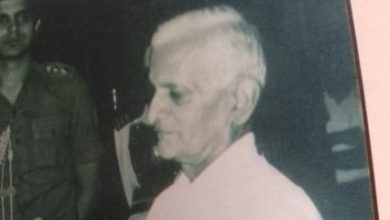
From First Law Minister to Exile – The Tragic Odyssey of Jogendra Nath Mandal, a founding figure of Pakistan
Mandal should not be remembered merely as “Pakistan’s first Hindu Law Minister.” He was a major participant in the political and constitutional developments surrounding the creation of Pakistan.
Dr. Jaipal Chhabria
Jogendra Nath Mandal occupies a remarkable but often overlooked place in the history of Pakistan. A Hindu Scheduled Caste leader from Bengal, he became an important political associate of Muhammad Ali Jinnah and the Muslim League during the decisive years before Partition. After the creation of Pakistan, he became the country’s first Law and Labor Minister. He was also a member of the first Constituent Assembly of Pakistan and served as its first temporary Chairman.
Mandal is sometimes described as a “co-founder of Pakistan.” This is not an official constitutional title, but it reflects the importance that some historians and commentators attach to his political contribution to the Pakistan movement and the early state.
Mandal’s support for the Muslim League was rooted in his own political circumstances. He believed that Scheduled Castes and Muslims, both of whom he regarded as disadvantaged under the existing social and political structure, could cooperate politically. He also believed that Muhammad Ali Jinnah’s assurances about minority rights could provide a framework in which historically oppressed communities would receive political protection and equality.
Mandal and Bengal Politics
Mandal played an important role in Bengal politics during the turbulent period before Partition. In 1946, he supported the ministry of Huseyn Shaheed Suhrawardy in Bengal.
In his resignation letter of 1950, Mandal described his efforts to obtain the support of Scheduled Caste and Anglo-Indian legislators for Suhrawardy’s ministry when it faced a political challenge. His own account claimed that his efforts helped the ministry survive.
This episode demonstrates that Mandal was not merely a symbolic supporter of the Muslim League. He was an active political leader whose support could influence legislative politics in Bengal.
Mandal in the Interim Government
In October 1946, when the Muslim League joined the Interim Government of British India, Jinnah nominated Jogendra Nath Mandal as one of the League’s representatives. Mandal was given the Law portfolio.
This was an extraordinary development. A Hindu Scheduled Caste leader had been selected by Jinnah and the Muslim League to hold the Law portfolio in the central government of British India.
Mandal therefore entered Pakistan’s political history even before Pakistan itself came into existence.
Mandal and Dr. B. R. Ambedkar
Mandal also played a significant role in the political career of Dr. B. R. Ambedkar.
When Ambedkar faced difficulty in securing election to the Indian Constituent Assembly from Bombay, Mandal worked to help him obtain a seat from Bengal. Historical accounts describe Mandal as playing an important role in securing Ambedkar’s election from Bengal.
This is another fascinating connection between the histories of Pakistan and India. Mandal, who later became Pakistan’s first Law Minister, also helped one of modern India’s most important constitutional figures, Dr Ambedkar, secure representation in the Constituent Assembly.
Mandal at the Birth of Pakistan
Pakistan’s first Constituent Assembly met in Karachi on 10 August 1947.
Liaquat Ali Khan proposed that Jogendra Nath Mandal should serve as the temporary Chairman, and Khwaja Nazimuddin seconded the proposal.
Mandal therefore became the first temporary Chairman of Pakistan’s Constituent Assembly.
It is important to make one historical distinction: Mandal was not the permanent Speaker or President of the Constituent Assembly. His position was that of temporary Chairman during the opening proceedings.
On 11 August 1947, Muhammad Ali Jinnah was elected President of the Constituent Assembly. Mandal presided over these proceedings in his capacity as temporary Chairman.
This was a remarkable moment in Pakistan’s history: a Hindu Scheduled Caste leader was presiding over the first constitutional proceedings of the new Muslim-majority country.
Mandal and Quaid-e-Azam
Mandal believed that Jinnah’s political vision offered minorities a place of equality and security in Pakistan.
Jinnah’s famous address to the Constituent Assembly on 11 August 1947 emphasized that citizens should have freedom of religion and that the state should protect the life, property and religious beliefs of its citizens.
Jinnah stated that people were free to go to their temples, mosques or other places of worship and emphasized the principle of equal citizenship.
Read: Political legacy of Jogendra Nath Mandal ‘overlooked’
Mandal understood these statements as evidence that minorities would be protected in the new Pakistan.
It is important, however, to recognize that historians have different interpretations of Jinnah’s broader constitutional and political ideas concerning religion and the state. Therefore, it is more historically careful to say that Mandal interpreted Jinnah’s assurances as a commitment to equal citizenship and minority protection rather than presenting one modern interpretation of Jinnah’s ideology as an uncontested historical fact.
Were All Religious Parties Against Pakistan?
The statement that all religious parties opposed Pakistan is historically incorrect.
The position of religious organizations was divided.
Some religious leaders strongly supported the Pakistan movement. Maulana Shabbir Ahmad Usmani was among the prominent ulema who supported Pakistan. A pro-Pakistan faction associated with the ulema also became associated with the formation of Jamiat Ulema-i-Islam.
At the same time, other important religious organizations opposed or criticized the demand for Pakistan before Partition. Jamiat Ulema-i-Hind opposed the Muslim League’s demand for Pakistan, while Jamaat-e-Islami under Maulana Abul Ala Maududi also opposed the creation of Pakistan before 1947.
Therefore, the historical picture was mixed: some religious groups opposed Pakistan, while other religious leaders supported it.
This distinction is important because history should be presented accurately rather than simplified.
Pakistan’s First Cabinet
After independence, Mandal became Pakistan’s first Law and Labor Minister.
His inclusion in the first government was symbolically and politically significant. A Hindu Scheduled Caste leader was not only accepted as a citizen of Pakistan but was given a senior cabinet position in the country’s first government.
This demonstrated that the new state initially included members of religious minorities in its highest political institutions.
The Objectives Resolution
The death of Jinnah in September 1948 changed the political environment.
In March 1949, Prime Minister Liaquat Ali Khan introduced the Objectives Resolution in the Constituent Assembly. It was adopted on 12 March 1949.
The Resolution declared that sovereignty belonged to Allah while also referring to democracy, freedom, equality, tolerance and social justice. It also included a commitment that minorities would be free to profess and practice their religions and develop their cultures.
Mandal and other minority representatives expressed objections to the constitutional direction represented by the Resolution.
For Mandal, the issue was deeply connected with the future political and legal status of minorities in Pakistan.
Why Did Mandal Resign?
The most important document for understanding Mandal’s later disappointment is his lengthy resignation letter of 1950 addressed to Prime Minister Liaquat Ali Khan.
By this time, Mandal had become deeply concerned about the treatment of Hindus and Scheduled Castes in East Bengal.
In his resignation letter, he described communal violence, forced conversions, abductions, dispossession, discrimination and administrative failures. He argued that the assurances given to minorities at the creation of Pakistan were not being adequately implemented.
His resignation represented a dramatic change from the hopes with which he had entered Pakistan’s government.
The man who had been Pakistan’s first Law Minister and had presided over the opening proceedings of its first Constituent Assembly eventually left the country because he believed that the treatment of minorities had moved away from the principles he had expected.
Mandal returned to India in 1950.
Did FIR Exist Against Mandal?
Claims are sometimes made in secondary accounts about legal action or an arrest warrant against Mandal after his departure. However, a reliable primary record establishing a specific FIR number, police station, date, offence and subsequent court proceedings has not been established in the sources examined.
Therefore, it would be historically unsafe to state categorically that a particular FIR was registered against him without documentary evidence.
Mandal’s Historical Legacy
Jogendra Nath Mandal’s life contains a remarkable contradiction.
He was a Hindu leader who supported the creation of Pakistan.
He worked with Muhammad Ali Jinnah.
He served in the Interim Government of British India.
He supported Suhrawardy’s ministry in Bengal.
He helped Dr. B. R. Ambedkar obtain representation from Bengal.
He became Pakistan’s first temporary Chairman of the Constituent Assembly.
He became Pakistan’s first Law Minister and Labor Minister.
And only three years after independence, he resigned and returned to India after expressing serious concerns about the treatment of minorities.
His story is therefore essential to understanding the complicated history of Pakistan.
Mandal should not be remembered merely as “Pakistan’s first Hindu Law Minister.” He was a major participant in the political and constitutional developments surrounding the creation of Pakistan.
His life raises fundamental historical questions about equal citizenship, minority protection, constitutionalism, religion and the rule of law.
For Pakistani students and young people, the story of Jogendra Nath Mandal is particularly important because it demonstrates that the history of Pakistan was shaped by people belonging to different religions, communities and political backgrounds.
Remembering Mandal does not require ignoring the disagreements and controversies surrounding his political choices. Instead, his complete story should be studied — his support for Pakistan, his cooperation with Jinnah, his achievements in the first government, his constitutional concerns and finally his resignation.
Only by studying the complete history can the next generation understand the hopes, promises, achievements and failures of Pakistan’s formative years.
Read: Respect Sindh, Strengthen Pakistan
____________
 Dr. Jaipal Chhabria is based in Karachi