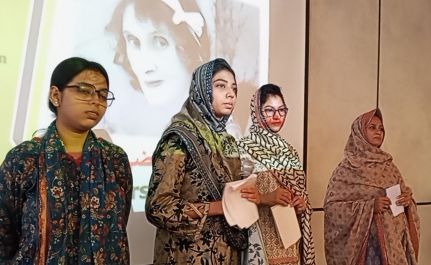
Learners of the Sindhi Language Training Course present insightful perspectives on the lives and literary contributions of Sindh’s eminent scholars and intellectual figures at a seminar hosted by SLA Karachi Office.
Event Summary by: Yasir Qazi
Learners of the Sindhi Language Training Course (Batch 6: September–November 2026), organized by the Karachi Sub-Office of the Sindhi Language Authority (SLA), Hyderabad, presented insightful perspectives on the lives and literary contributions of Sindh’s eminent scholars and intellectual figures.
To facilitate the presentations, the class was divided into six distinct groups, each named after a geographical region of Sindh.
Group 1: Saro
Comprising female students, the first group was named ‘Saro’—referring to the upper region of Sindh, including Jacobabad and Kandhkot-Kashmore. Assigned to cover the life and works of renowned intellectual Mother Elsa Kazi, team members Salma Begum, Zoya Shah, and Fabiha Imtiaz presented under the supervision of their group leader, Sidra Imtiaz (the batch’s top-performing student to date). They highlighted Elsa Kazi’s personal legacy, literary achievements, and landmark contributions in detail.
Group 2: Uttar
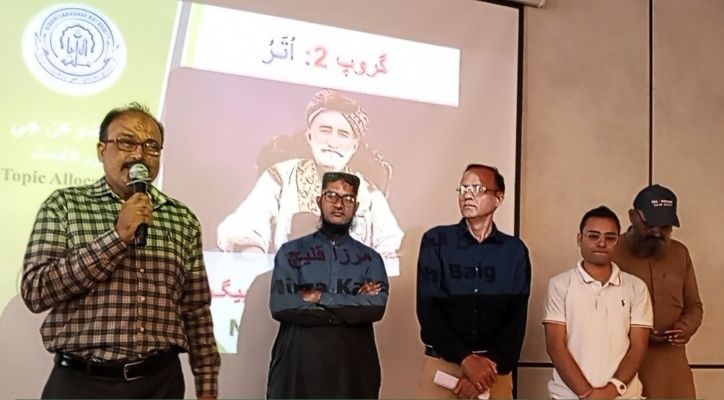 The second group, ‘Uttar’—named after the northern region of Sindh covering Larkana, Shikarpur, Sukkur, Khairpur, and Dadu districts—focused on the life and literary legacy of Shams-ul-Ulama Mirza Kaleech Baig. Group leader Mansoor Hussain led team members Prof. Ghulam Muhammad Raghib Khan, Muhammad Sajid Iqbal, Zubair Ansari, and Gulzar Shah Mashwani. They paid rich tributes to Mirza Kaleech Baig, describing his literary output of 461 books as an invaluable treasure chest for students and lovers of Sindhi literature.
Group 3: Vicholo
Named after ‘Vicholo’—the central geographical region encompassing Nawabshah (Shaheed Benazirabad), Sanghar, Hyderabad, and Tando Muhammad Khan districts — the third group focused on the eminent scholar, philosopher, and former Vice-Chancellor of the University of Sindh, Karachi/Hyderabad/Jamshoro, Allama I.I. Kazi (Allama Imdad Ali Imam Ali Kazi). Guided by team leader Muhammad Nadir, group members Akbar Ali, Azhar Hussain, and Muhammad Izhar Ahmad Khawaja detailed Allama Kazi’s scholarly achievements, teaching philosophy, and foundational role in developing the University of Sindh.
Group 4: Laar
Group four was named ‘Laar’, representing southern Sindh, particularly the districts of Thatta and Badin. Tasked with researching Shams-ul-Ulama Allama Dr Umar Bin Muhammad Daudpota, the group presented their findings under the leadership of Muhammad Jawad Abdul Rahim (the second-highest scoring student of the batch). Team members Muhammad Usman, Syed Murtaza Habib Hassany, and Khalid Pervez Siddiqui characterized Dr. Daudpota as a “Beacon of knowledge and Scholars.” They paid glowing tributes to his research on Shah Abdul Latif Bhittai and his seminal editorial work during the early years of the quarterly journal “Mehran” of Sindhi Adabi Board.
Group 5: Kohistan
The fifth group represented ‘Kohistan’, the western mountainous belt stretching from the Sindh-Balochistan border between Karachi and Hyderabad up to the Dharaiaro Mountains in Qambar-Shahdadkot District. Group member Muhammad Aqib Khan covered the life and multi-faceted work of renowned scholar, researcher, author, and educationist Dr Nabi Bakhsh Khan Baloch (Dr N. A. Baloch). Aaqib detailed Dr Baloch’s landmark work across Sindhi, English, Urdu, Arabic, and Persian literature, specifically highlighting his compilation of the comprehensive Sindhi dictionary (Jami’u Sindhi Lughat), the 40+ Books of Sindhi Folklore Series, and the authentic compilation of Shah Jo Risalo in 10 volumes.
Group 6: Thar
The final group, named after the ‘Thar’ region, presented on the life and legacy of eminent educationist, leftist activist, intellectual, and author Muhammad Ibrahim Joyo. Group leader Muhammad Younis, along with Prof Dr Muhammad Ashar Malik, Adnan Muhammad Ayoob, Arshad Shah, and Muhammad Chand, paid tribute to Joyo as a guiding light of Sindhi intellect. They highlighted his tenure at Sindh Madressatul Islam and underscored his contributions to Sufism, progressive thought, and anti-Partition intellectual resistance.
During the 90-minute session, class members gained an enriched, holistic perspective on Sindh’s literary and research heritage by sharing findings across all six regions and personalities.
Read: The Future of Sindhi Language
___________
 The reporter is an independent multimedia journalist, media expert, and the author of twelve books in Sindhi language. Correspondence regarding this event summary can be directed to djyasirqazi@yahoo.com.