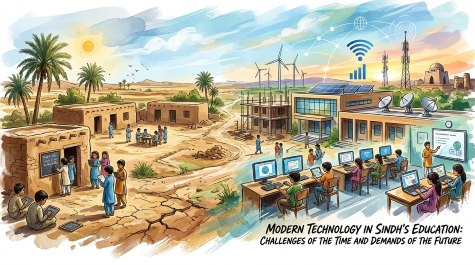
The future of Sindh’s education is incomplete without technology. We cannot prepare our children for the world of the twenty-first century with the methods of the twentieth century.
By Fida Hussain Malik
The world has changed. The ways of acquiring knowledge, the styles of teaching, the means of communication, and the fields of employment have all taken a new shape. A nation that stands apart from technology today will be left behind in the race for progress tomorrow. Education is the foundation of any nation’s progress, and when education remains trapped in old, traditional methods, society cannot move forward either.
Sindh, the land of knowledge, literature, civilization and tolerance, stands today at an important turning point regarding its education system. On one side we have intelligent students, hardworking teachers and a society that loves knowledge; on the other, many of our schools are still deprived of basic facilities, sound teaching methods and modern technology. In such circumstances, the use of modern technology in Sindh’s education is not a matter of decoration; it is an unavoidable demand of the time.
Technology does not mean only computers, mobile phones or the internet. Its real meaning is easy access to knowledge, making learning interesting and easy for students, making the teacher’s work more effective, and running the education system transparently and well. When a student learns a lesson not only from the letters of a book but also through pictures, videos, sound and practical examples, his understanding deepens, his memory stays fresh, and his love for learning grows. This is the identity of today’s education, and the child of Sindh must not be deprived of it.
The Current State of Education in Sindh
Education in Sindh faces many problems. In many government schools there is still a shortage of classrooms, a lack of furniture, and a lack of basic facilities such as clean drinking water and electricity. Children from far-off villages walk miles to reach school. In some places, due to a shortage of teachers, a single teacher has to teach combined classes in one classroom, which makes it difficult to give individual attention to every student. The late arrival of textbooks, the absence of science laboratories and the lack of new teaching material also weaken the quality of learning.
The second major problem is our old teaching method, which rests largely on rote memorization. A student may memories a lesson to pass an examination, but the real understanding of that lesson, the power of thought, the ability to solve problems and the creative thinking to produce something new do not develop in him. The result is that even with a degree in hand, the young person lags behind in practical life and in the field of employment. In today’s world a degree alone is not enough; along with it, skill, digital knowledge and the power of thinking are also required.
If we keep moving with the same old methods, we will get the same results. That is why it is necessary to align our education with the demands of this era, and for this task technology is the greatest and most effective tool.
Why Is Technology Needed?
The first and greatest point is that technology brings equality of access to knowledge. Earlier, good education reached only big cities, expensive schools and resourceful families. The village child was far from a good library, a capable teacher and new information. Today, through a mobile phone and the internet, a student from Ghotki, Thar, Jacobabad, Kashmore and Badin can listen to the same lecture, read the same book and reach the same information that a student in Karachi or any big city of the world has. This narrowing of the knowledge gap between city and village, rich and poor, is real equality in education.
Secondly, technology makes learning easy and enjoyable. A difficult science lesson, when shown with moving pictures and video, is understood within minutes. When the rules of mathematics are explained with examples from daily life, the student takes interest instead of fear. Subjects like history, geography, language and literature also come alive through maps, pictures, past events and audio material. The student no longer remains a mere listener; he himself becomes a participant in learning.
The third important benefit is that technology breaks down the walls of time and distance. When schools close due to rain, floods, illness or any other sudden calamity, education also comes to a halt. Sindh has repeatedly suffered this loss due to floods and changing weather, and education has been affected the most. If we have a system of online classes, recorded lectures and digital material, children’s education will not come to a complete standstill even in such conditions. Technology saves education from breaking down; it keeps it going.
What Are the Benefits for Students?
Modern technology inculcates the habit of self-learning in the student. Today’s student is not dependent only on the teacher’s lecture. He can find the answer to his question himself, take information from many sources, read at a pace of his own ease, and where he does not understand, he can watch and listen to the lesson again and again. This self-confidence makes the child a lifelong learner.
Technology is also a great blessing for lagging and special children. A student who hesitates to ask a question in class can learn without hesitation through digital means. For a child weak in hearing or sight, audio material, large-print texts and written explanations in videos make learning easy. In this way every child gets the opportunity to learn according to his need and ability.
Along with this, in today’s era digital skill itself has become an essential education. Operating a computer, the safe and correct use of the internet, typing, verifying the truth of information and communicating online — these are all skills without which no young person can advance in government service, private work, business or online employment from home. If our schools do not teach these skills, our students will lag behind even with degrees in hand.
Teachers and Technology
It is sometimes said that technology will take the teacher’s place, but this is not correct. Technology can never take the teacher’s place, because a teacher is not merely a giver of information; he is a builder of character, a guide and a well-wisher of the child. Technology does, however, strengthen the teacher’s hand. A teacher who uses a smart board, multimedia lectures, online tests and digital attendance saves time, teaches more effectively, and can assess every student’s performance properly.
Technology can also do great work in the training of teachers. Teachers from far-off areas could not participate in training programs due to travel and expense. Today, through online training and video lectures, every teacher can learn new teaching methods from his school or home. One good and trained teacher can shape the lives of hundreds of children, which is why connecting teachers with technology is the most beneficial investment.
We teachers must also regard technology not as a threat, but as an opportunity. Only a teacher who is ready to learn himself can prepare his students for the future. For this, the government, the education department and teachers’ organizations must jointly make firm arrangements for the continuous and practical training of teachers.
Improvement in Administration and Transparency
The benefit of technology is not limited to the classroom. It can also bring reform to the entire administration of education. If students’ admissions, attendance, examination results, teachers’ appointments and transfers, funds given to schools and repair work are run through a digital system, corruption will decrease, records will remain safe, and correct data will be available for policymaking. Today many decisions are made on guesswork, because correct and timely information is not available. Digital data can tell which district has a shortage of teachers, from which schools children drop out more, and where more attention needs to be given to girls’ education.
Technology can also bring reform to the examination system. Online admissions, timely and transparent publication of results, and assessment of students’ performance — all these steps will make examinations more trustworthy. When the system becomes transparent, the trust of parents, teachers and students will also return.
Difficulties and Obstacles
It must not be overlooked that bringing technology into education in Sindh is not an easy task. The biggest obstacle is the lack of basic facilities. Many schools have no electricity at all, and where there is electricity, load-shedding affects teaching. Outside the cities, the internet is weak. Computer laboratories either do not exist at all, or the machines in them are old and broken. In such a situation, announcements alone will bring no change.
The second obstacle is poverty. Not every parent can buy a smartphone, tablet or laptop for his child. If education comes to stand entirely on expensive devices, the knowledge gap between rich and poor will widen rather than narrow. That is why technology must be made equally available to all within schools, so that the poor man’s child can benefit from it equally.
The third obstacle is that of language. Most material on the internet is in English or Urdu, while millions of children in Sindh think in Sindhi and learn with ease only in Sindhi. If digital material is not prepared in the Sindhi language, technology will remain foreign to children. Preparing books, video lectures, mobile apps and learning material in Sindhi is a great need of today. This work is not the government’s alone; universities, writers, teachers and young experts must also play their part in it.
Along with this, the misuse of technology is also a danger. Mobile phones and social media can distract children’s attention. Therefore, teaching children digital ethics, safe internet use and the correct use of time is equally necessary. Technology becomes a blessing only when it is used with purpose and under the guidance of elders.
Recommendations: The Way Forward
To bring technology into Sindh’s education, first of all a clear, long-term and politics-free policy is needed. Instead of the policy changing with every new government, a common path must be formed that continues in the same direction for years. In this policy, firm targets should be set for providing every school, in turn, with electricity, solar systems, internet, smart classrooms and computer labs.
The second step is the training of teachers. Every teacher must be given basic computer education, and for newly recruited teachers, digital knowledge must be made part of eligibility. In every district, teams of such expert teachers should be formed who help and guide other teachers.
The third step is preparing a digital curriculum in the Sindhi language. The Sindh Textbook Board, universities and the education department should jointly prepare a free online repository of video lectures, audio books, exercises and tests for every class and every subject, which every student can access without any cost. This repository must be easy to run on a mobile phone, so that it works even on a weak internet connection.
Fourth, the private sector, mobile companies and social organizations should also be included in this noble work. They can provide computers, solar electricity and internet facilities in schools, but all this must happen under a transparent system so that facilities truly reach deserving schools.
Fifth, parents and society should also be made partners in this change. Parents should be made to understand that technology is not merely a thing of play; it is also a door to knowledge. When parents keep an eye on their child’s digital learning and remain in contact with teachers, the results will be even better.
Conclusion
In the end, it would only be right to say that the future of Sindh’s education is incomplete without technology. We cannot prepare our children for the world of the twenty-first century with the methods of the twentieth century. The world has entered the era of artificial intelligence, new inventions and digital employment. If we do not decide even today, our youth will lag far behind others tomorrow in the fields of knowledge, employment and honor.
But there is no cause for despair. As teachers, the responsibility of history rests on our shoulders, and we ourselves can play an important role in this entire process. There is no shortage of intelligence in the soil of Sindh. Whenever our children get an opportunity, they prove their ability at the national and international level. The only need is that they get opportunity, facility and correct guidance. Technology is that very opportunity. Let us all — government, teachers, parents, society and the youth themselves — together make every school in Sindh a center of knowledge and technology, so that every child of Sindh, whether from a big city or a small village, can move forward shoulder to shoulder with the modern world. This is the real path of Sindh’s progress, and this is our true loyalty to the coming generations.
Read: Better Access to Assistive Technology
_______________
 Fida Hussain Malik, MPhil Scholar, Primary School Teacher, Defence & IR Analyst, Ghotki, Sindh