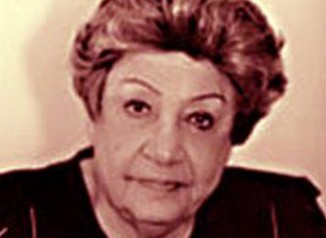
Amina Sa’id – The Egyptian Women Rights Champion Who Visited Hyderabad Sindh in 1945
Amina had addressed the 18th Session of All India Women Conference held from Dec 28 1945 to Jan 1, 1946

The All India Women Conference, hosted by Sindhi women, was participated by over 550 women from across India and delegates of Syria, Lebanon, Ceylon, UK and Australia.
Amina Sa’id, the Egyptian Women Rights Champion Who Visited Hyderabad Sindh in 1945 and had addressed the 18th Session of All India Women Conference held from Dec 28 1945 to Jan 1, 1946. The All India Women Conference, hosted by Sindhi women, was participated by over 550 women from across India and delegates of Syria, Lebanon, Ceylon, UK and Australia. Several women leaders from across the world including former Soviet Union had sent their messages of solidarity with Indian women. Madame Charaouie Pasha of Egypt had also sent her message, which read at the conference. Amina Sa’id’s speech at this conference is a historic document, which sheds light on the struggle of Egyptian women for their rights.
About Amina Sa’id
Amina al-Sa’id, the first woman magazine editor in the Middle East, who was born on January 20, 1914 and died of cancer on August 13, 1995 at the age of 81 in Cairo, Egypt, was the last of a generation of feminists who, as suffrage campaigners, political dissidents, trade unionists and human rights campaigners, picked up the torch from their 19th-century forebears.
Born to a middle-class family, Amina lived her childhood in the closed society of Assiut (Asyut) city when Hoda Shaarawy and her colleagues’ struggle for equality was on its climax, she joined the youth wing of the Egyptian Feminist Union at the age of 14. She was among the first women to attend Fuad University (Now Cairo University) in 1931. She earned a degree in English literature in 1935. Saʿīd was opposed to veiling and played tennis in public without a veil. She joined the news magazine Al-Musawar as a columnist.
Amina founded women’s magazine ‘Hawaa’ (Eve) in 1954, first ever in Egypt. She was among the earliest full-time female journalists in the country. From 1958 to 1969 she was secretary general of the Pan-Arab League Women’s Union, a federation of organizations of Egypt, Iraq, Syria, Lebanon, Palestine and Transjordan. She became editor of Al-Musawar in 1973. From 1976 to 1985 she chaired the magazine’s publishing group. She continued writing until shortly before her death.
She also was Egypt’s representative at a number of international conferences. Among the awards she received were the First Order of the Republic (1975), the Universal Star (1979), and the National Arts Award (1982).
In her writings, Amina tackled larger and more important topics than the beauty tips and cooking recipes that women’s writings used to deal with. Amina Al-Sa’id’s defense of equality between men and women was the fuel for her valuable writings for many years that changed the history of Egypt.
Amina’s courage and daring earned her respect and popularity among her fellow writers and journalists. She was known as “the woman who knows no fear”. She also became the president of Dar Al-Hilal, and boldly led a new campaign for Egyptian women, but this time against the Islamic fundamentalist tide that began in the seventies of the last century. Amina is known to be the first paid woman to work for a mainstream publishing house “Dar al-Hilal” and later headed the Board of the Press Syndicate in 1956.
Speech at All India Women Conference in Hyderabad Sindh
Madam Amina El Sa’id said: It is a great pleasure to me to come on behalf of my association, the Egyptian Union for Women, to attend your Conference, and speak to you on our efforts to help our Egyptian sisters. I will tell you, too, all about our aims and aspirations, our point of view ·in dealing with things, and how far time will possibly fulfil our demands.
But I prefer to begin with a short history of the Egyptian woman, and explain the ups and downs of her career in Egypt, the ups that raised her to glory and greatness sometimes, and the downs that brought her ignorance and social poverty. The attempt of the Egyptian women today to take their proper place in society is not new to the history of our country. They did, in the past, take their full responsibility in public life, they contributed to the building up of Egypt’s greatness in its glorious days, and helped to revive it in its less happy periods.
In Pharaonic times-and that was five thousand years ago–women ascended the throne, occupied the highest positions of priesthood, and took their full share in-the social, religious and political life of our country. When Islamic religion came, the Egyptian woman enjoyed the grea.t, generous rights that this religion gave to her such as economic independence, the right to education, work and commerce. History records in the Egypt ·of that time, women as eminent poets, authors and writers on law and astrology. This state of things continued to the middle of the ”Fatimite Rule” 600 years ago, when an eccentric king called “AI Hakem” ordered the total seclusion of women in their homes on penalty of death. To ensure· strict execution of his order he prevented shoe-makers from making or selling shoes for women.
It was said that for seven long years not a single woman was seen in the streets of Cairo. But knowing that this same ruler forbade the eating of J.!oney and ordered shops to close all day and open all night, we no longer doubt his madness. Whatever the cause might be, the fact remains that his reign marks the beginning of social deterioration and the status of women in Egypt went from bad to worse until they sank into complete obscurity.
The year 1919 would be a most suitable landmark in the history of our Egyptian women’s renaissance. A political revolution directed against the English broke out in Egypt that year. – The movement was not merely political. It was indeed national in the broad sense of the word. The desire that the Egyptians should govern their own country ·was accompanied by an equally keen desire that they should become worthy of their aspirations by trying to raise the standard of living, to educate women and give them a chance of becoming useful citizens. During the revolution the women of Egypt, under the leadership of our President Madame Charaouie, took their full share, fought side by side with men, made sacrifices and accepted the sad results bravely and courageously. The news of what our sisters did reached Europe through the press, and the whole world became aware of their existence.
The Egyptian woman was invited, for the first time, to attend the International Congress held in Rome in 1923. When Madame Charaouie returned from· Rome, the first thing she did was to discard the “Purdah”. Our Egyptian women followed her and did the same, so that ‘Purdah” disappeared from Egypt, and a serious obstacle was removed from our way of advance.
Then Madame Charaouie formed in our country ”The Egyptian Union of Women” which I represent today. The first thing my association did was to work hard in raising both the educational and -social standard of women, so that they would be fit for the equality we hoped for.
We, therefore, demanded from our Government the following things:-
- New laws restricting the minimum age of marriage to 16 for the girl and 18 for the boy.
- New laws raising the age at which a father could get custody of a child in case of divorce to 9 for the boy and 11 for the girl.
- Giving the right to woman to divorce her husband in special cases.
- Permitting married women teachers to carry on their teachin4t work.
- Opening all departments of education for girls.
- Abolishing extra-territorial rights in Egypt.
- Starting free compulsory education all over the country.
- Equal pay for men and women.
After a hard, short, struggle, all these demands were granted by our government. I am glad to say that we have now in Egypt women lawyers, barristers and doctors, practicing successfully. We have teachers and professors on the staff of the Universities, government officials in nearly all the ministries, pilots piloting planes on regular air service. Outside the government we have journalists, writers, thinkers, painters, artists etc.
Until the last year two faculties only out of all the different colleges we have in Egypt refused to admit any girl students, namely, the College of Agriculture and the College of Engineering. My association was very concerned about that matter and kept on asking and pressing until we succeeded this year, and girls were admitted to both. I am again glad to say that in a few years we will be having in Egypt women as engineers and agricultural specialists.
From the moral standpoint we demanded that the government should control the hours for public sale of liquors, and should abolish regulation of prostitution by withdrawing all the licenses and preparing special rescue homes for these unfortunate women. At last our demand was granted, but the project was again neglected because of the war.
On the economic side, our association did its best to encourage local industry. So we founded a big school of industry where the Egyptian young women learn to weave, make carpets, and all sorts of pottery work. We also run two other schools: one for primary education and the other for domestic studies. In these three schools hundreds of poor girls get free education and free meals too.
I have mentioned before that we were granted many of the rights we claimed. But it does not mean that we were granted everything. We still have much to fight for, and because of that we formed an Arab Union for Women representing Egypt, Palestine, Syria, Lebanon, Iraq and Transjordan.
That Arab Union was formed for two just causes: the cause of women, and the cause of Palestine. Both were cases of natural and just right which had been taken away and should be restored at once. For the case of women we are fighting hard for:-
- New laws restricting. Polygamy and divorce.
- New laws raising the age at which a father could get custody over his child in case of divorce to 16 for the boy and 18 for the girl.
- Allowing women to become judges.
- Giving women the right to vote and go into Parliament.
Our demands concerning polygamy and divorce will not meet with any strong objection for everyone in Egypt now suffers under the present laws, and the public mind is prepared for the change. The proof is that polygamy in my country is dying out. In statistics of 1940 we find that the number of men married to more than one wife is 20,000 only out of 16,000,000. Only 200 men in the whole of Egypt have four wives. ·
I am very glad to say that our Government is very sympathetic to us in that point of view. The Minister of Social ·Affairs has already introduced a bill restricting polygamy and divorce, and that bill will be passed in the Parliament in the next sessions. Our demand concerning the right to vote will not also meet with any obstacle, because we are asking for a right, not a favor. Islamic religion gave us the right to vote for the Caliphs who were both religious as well as political leaders.
Dear friends, a few minutes ago I said that the Arab Union for Women was formed for two just causes. The first I have already explained. The second is Palestine.
Palestine too, is a case of confiscated rights which should be restored at once. Palestine is an Arab country. The Arabs have lived in it for centuries. Therefore, it is their own country and the European Jews have no right to usurp it. If some of the Europeans are so cruel as to persecute their Jewish countrymen for no reason, it is not our fault, and we should not bear the blame for others. We should not give our beloved home to those who have no right to it. Great countries like America and England that pride themselves over all others as builders of democracy, should never ignore the first principle of democracy in small countries like ours. For, we too have the right to enjoy it. And though our countries are small, we are as much human beings as the people of the big countries. We expect to be treated thus, and we do not like them to be generous at our expense.
The Arabs in Palestine are losing their land, property and homes. They are being kicked out for European Jews to take their place. Therefore, I appeal to all the people of India to stand beside the Palestinians and to defend them against their usurpers.
Before I finish, I would like to deliver to you all the love and respect of your Egyptian sisters. I also deliver to you their great hope of you and us working together in an Oriental Federation that would work for the great cause all over the East.

Message by Madame Charaouie Pasha, Chairperson, Pan-Arab League Women’s Union, Egypt
”Madame the President of the Conference, my dear Sisters, Women of India I would have loved to be present at your Conference, and give this message personally to express love and friendship which exists between our two countries although there is a great distance between the two lands. Owing to a very strenuous journey which I had to undergo recently, it is impossible for me to come to India to speak to you on the hopes and aspirations of Egyptian women as well as the whole Arabic world. I am sorry that I cannot have the pleasure of meeting you now, but I hope that a great number of Indian women will represent your country at the International Conference which is going to be held in Cairo in January 1947. I am looking forward to seeing many of you during that Conference.
“Now let me present to you our delegate to your Conference, Madam Amina El Sa’id. She is the Secretary-general of the Arab Union for Women, and is representing Egypt and Palestine. I also present Madam Bastoris, Madam. S. Gazawi, W. Selam and Madam. E. Faris Ibrahim, who represent Lebanon and Syria.
“Owing to difficult circumstances it has been impossible for the representatives of the other countries of the Arab world to be present at the All India Women’s Conference. I hope our representatives who are visiting your country now will be successful in their mission, and in conveying our message of love and friendship, and in bringing close our two nations, so that we could form a strong bloc to work in unity for the good and betterment of the oriental world and realize peace, plenty and justice for all of us. I conclude my message by conveying to you the greeting of all the Arab women, their hopes and good wishes for the success of your conference.” ·
Charaouie Pasha
Cairo, Egypt.
_________________
Source: Wikipedia, Britannica, Alraida Journal, Wlahawogohokhra, sanipanhwar.com