
Washington faces major operational weaknesses across every domain of modern warfare.
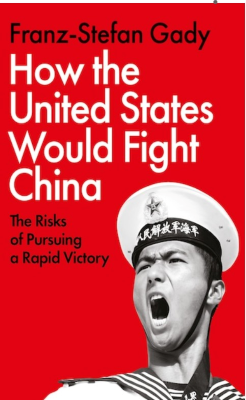
Overview of Defense analyst Franz-Stefan Gady’s book ‘How America Would Fight China’
By: Noor Muhammad Marri Advocate | Islamabad
In international policy and defense analysis, few questions carry as much weight as a potential military confrontation between the United States and China. Defense analyst Franz-Stefan Gady addresses this subject directly in his book ‘How America Would Fight China’, offering a sobering critique of modern American war planning. His central assessment is clear and troubling: the United States risks strategic defeat in a high-intensity war over Taiwan because its military planning, force structure, and industrial base are tethered to the illusion of a quick victory.
 American strategic culture has long suffered from an obsession with rapid, clean, and technologically dominant outcomes. Ever since the swift victory of the 1991 Gulf War, the American military has built its plans around the belief that advanced sensors, stealth aircraft, and precision missiles can quickly dismantle an enemy’s command structure before a conflict becomes a long struggle of physical endurance. Applied to a powerful neighbor like China, this “short-war” mindset is not just overly optimistic; it is dangerous. The assumption that American forces can easily achieve total information dominance and knock out the People’s Liberation Army ignores China’s vast defensive missile networks and its immense geographic depth.
This reliance on a quick victory creates a serious escalation trap. If American forces base their entire operational strategy on winning in the opening weeks, any failure to achieve that goal leaves commanders with very few conventional choices. When high-tech networks are jammed and precision missile stockpiles run low without a decisive result, the pressure to strike targets deep inside mainland China increases rapidly. As a result, searching for a quick technical victory significantly raises the danger of an accidental nuclear conflict between two atomic superpowers.
Beyond strategic assumptions, Washington faces major operational weaknesses across every domain of modern warfare. American military planning relies heavily on uninterrupted digital networks to connect sensors to weapons in real time. However, China’s cyber and space forces are explicitly designed to cut these digital links immediately. In a war over Taiwan, satellite communications and targeting feeds would face heavy jamming and missile attacks, forcing American commanders to fight in a completely degraded environment where units are cut off from one another.
In the air and at sea, geography creates severe problems for the United States. The U.S. Navy relies on a small number of expensive aircraft carriers and destroyers. Yet China has built a dense network of anti-ship ballistic missiles, quiet submarines, and air defense systems around its coast. This defensive shield forces American aircraft carriers to stay far away from the action, sharply reducing the number of air missions they can fly. At the same time, air defense ships expend their high-end interceptor missiles far faster than they can be replaced, requiring long transits back to distant ports just to rearm. On land, dispersed forces meant to guard forward bases face severe logistics bottlenecks. Without total control of the air and sea, forward-deployed troops risk becoming isolated enclaves that cannot receive fuel, food, or ammunition.
A major contribution of this analysis is the stark contrast between the industrial bases of the United States and China, which can be viewed as a contest between high-tech precision and raw industrial mass. The American defense industry has spent decades optimizing for peacetime budget efficiency and the production of small numbers of highly complex weapons. This model breaks down during a major war. War games show that critical U.S. stocks of long-range anti-ship and standoff missiles would be completely exhausted within a single week of high-intensity combat. Furthermore, American shipyards suffer from a shortage of dock space, skilled workers, and key suppliers, leaving the U.S. unable to repair multiple battle-damaged warships simultaneously.
In contrast, China’s strategy of integrating its commercial manufacturing with its military gives it a massive advantage in long-term endurance. China dominates global commercial shipbuilding, giving it a massive network of shipyards that can quickly switch to repairing warships and building military transport vessels. Beijing also prioritizes sheer volume over perfection. While individual Chinese weapons may not match the top-tier technology of American systems, China’s ability to mass-produce “good-enough” missiles, drones, and ships gives it a distinct edge in a long war of attrition.
Beyond weapons and factories, long wars are ultimately tests of political endurance and public willpower. A protracted conflict between major powers requires immense public sacrifice, economic hardship, and a high tolerance for casualties. American rhetoric frequently talks about great power competition, but American society and political institutions are not prepared for the realities of a total industrial war. Decades of expeditionary wars have accustomed the public to low casualties fought by a professional force while daily life continues as normal. A major war in the Pacific would bring severe economic disruptions, trade blockades, and direct cyber-attacks on domestic infrastructure. Without a prepared public, national resolve can collapse long before physical military forces are fully exhausted.
To prevent strategic defeat and build true deterrence, the United States must reform its defense policy and force structure. Deterrence works by convincing an adversary that a quick victory is impossible and that a long war will result in a struggle they cannot win. This requires moving away from buying only high-cost, fragile platforms and shifting toward low-cost, mass-produced systems like autonomous drones, loitering munitions, and affordable anti-ship missiles. Expand missile stockpiles and rebuild naval repair yards before a conflict begins, rather than relying on just-in-time manufacturing. Military units must practice fighting without continuous satellite guidance, empowering local commanders to act independently. Finally, fuel and supply stockpiles must be scattered across resilient nodes in the region so troops can survive under heavy fire.
From a legal and strategic perspective, the core purpose of military power is not to fight wars, but to maintain international stability by preventing them. When a nation relies on a strategy that does not match its industrial strength or societal readiness, its deterrent capacity loses credibility. Peace in the Indo-Pacific cannot be secured through technological arrogance or short-war promises. Avoiding catastrophe requires facing the reality of long-term industrial warfare, letting go of the illusion of rapid victory, and building a military posture capable of enduring a long struggle. Only by preparing for the realities of attrition can a nation maintain a credible deterrent and preserve global balance.
Read: Dilemma of Modern Intelligentsia
_______________
 Noor Muhammad, Advocate and Mediator, Islamabad