Nobel Prizes 2026: Global Recognition of Knowledge, Research and Creativity for Humanity
Discoveries Across Six Fields, Their Benefits for Humanity, and Important Questions About Pakistan’s Scientific Future
By Ramesh Raja
The eagerly awaited week of scientific and intellectual celebration in October has finally come to an end. Throughout the year, scientists, writers, economists and advocates of peace across the world look forward to the announcement of the Nobel Prizes. As the laureates are announced, newspapers, magazines, television channels and social media platforms are filled with accounts of extraordinary individuals whose knowledge, research, creativity and humanitarian contributions have brought something new to the world.
The true greatness of these awards lies neither in the gold medals, international fame nor the millions of rupees awarded to the winners. Rather, it lies in the discoveries and contributions that make human life safer, healthier, more enlightened and prosperous.
On 27 November 1895, the renowned Swedish inventor, industrialist and chemist Alfred Nobel dedicated a substantial portion of his fortune, through his will, to recognizing individuals whose contributions had brought the greatest benefit to humanity. He died on 10 December 1896, and the first Nobel Prizes were awarded in 1901 in five original categories: Physics, Chemistry, Physiology or Medicine, Literature and Peace. The Prize in Economic Sciences was established in 1968 by Sweden’s central bank and has been awarded in memory of Alfred Nobel since 1969. Today, these prestigious international honours are presented across six fields.
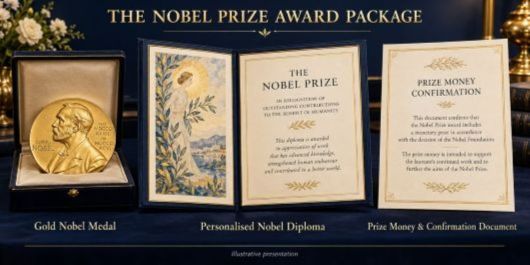
In 2025, the monetary value of a full Nobel Prize was 11 million Swedish kronor. A figure of 12 million kronor, equivalent to approximately PKR 333.7 million, has also been reported for 2026. This amount is not awarded separately to each laureate. It represents the total prize money for a particular category and is shared when there are multiple recipients. In addition to the cash award, each laureate receives a gold Nobel medal and an individually designed artistic diploma.
 Medicine: Controlling Brain Cells Through Light
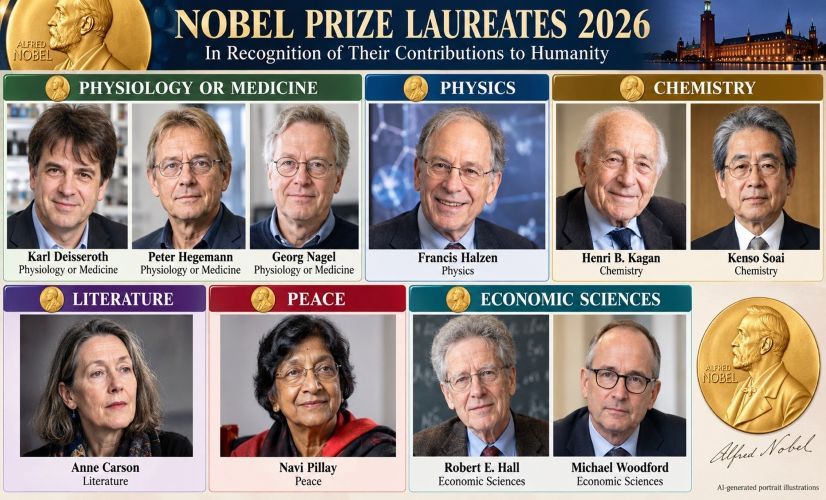
Among the names associated with the 2026 Nobel Prize in Physiology or Medicine are Karl Deisseroth, Peter Hegemann and Georg Nagel. Deisseroth is a psychiatrist and neuroscientist at Stanford University in the United States, while Hegemann is associated with Humboldt University in Germany and Nagel with the University of Würzburg. The three researchers have played important roles in developing the revolutionary technology known as optogenetics, which enables scientists to control the activity of specific nerve cells in the brain using light.
The human brain contains billions of nerve cells that communicate with one another to produce thoughts, memories, emotions, movements and behaviour. Understanding the functions of specific neurons has opened new avenues for investigating epilepsy, Parkinson’s disease, depression and other neurological disorders.
Although treatments based on this technology are not yet widely available to ordinary patients, its potential for developing more precise and effective therapies in the future is considerable.
Physics: Exploring the Universe Through Mysterious Particles
In Physics, Belgian-born American scientist Francis Halzen, approximately 82 years old, is internationally recognised for his extraordinary research into some of the universe’s most mysterious particles.
He is a professor of physics at the University of Wisconsin–Madison and has played a fundamental role in developing the IceCube Neutrino Observatory beneath the Antarctic ice. Thousands of highly sensitive instruments have been installed deep within the ice to detect neutrinos arriving from distant regions of the universe.
Neutrinos are extremely small particles capable of passing through ordinary matter almost without obstruction. By studying them, scientists are gaining valuable insights into black holes, exploding stars and some of the most energetic phenomena in the cosmos, information that conventional telescopes cannot easily obtain.
Halzen’s research is not primarily directed towards an immediate commercial invention. Its fundamental objective is to understand the laws governing the universe.
History demonstrates that many discoveries in fundamental science initially emerge from intellectual curiosity rather than practical necessity. Over time, however, such discoveries often become the foundations of new technologies and transformative inventions.
Chemistry: Understanding the Molecular Structures of Life
In Chemistry, the research of distinguished French chemist Henri B. Kagan, approximately 96 years old, and Japanese scientist Kenso Soai, approximately 76, concerns the precise three-dimensional structures of molecules.
Kagan is a retired professor at Paris-Sud University, while Soai has been associated with the Tokyo University of Science.
Their research helps explain how chemical reactions produce molecules in two different forms that resemble mirror images of each other, and how chemists can selectively produce one form in greater quantities.
This phenomenon, known as chirality, is extremely important to human life.
Just as our right and left hands are mirror images but cannot be perfectly superimposed, many molecules exist in two distinct mirror-image forms. In medicines, these forms may produce different biological effects. One may be beneficial, while the other may be less effective or even harmful.
The ability to manufacture molecules in a desired form is therefore essential for developing safer and more effective medicines, improving industrial chemical processes and understanding the fundamental chemistry of living organisms.
Literature: Illuminating the Human Mind and Spirit
In discussions surrounding the Literature Prize, the name of renowned Canadian poet, essayist, translator and scholar of ancient Greek literature Anne Carson has also emerged.
Born in Toronto in 1950, Carson has taught at several universities in Canada and the United States. Her literary distinction lies in her remarkable ability to combine ancient Greek mythology, philosophy and history with contemporary human emotions and experiences.
Her celebrated works include Autobiography of Red, Nox and Eros the Bittersweet.
Carson’s writing explores love, separation, memory, loneliness and the complexities of human existence through a distinctive intellectual and creative perspective.
Her work reminds us that human progress cannot be measured solely through scientific instruments, technological advancement or economic resources.
Literature teaches people to examine their inner lives, understand the suffering of others and appreciate the experiences of different civilizations.
If science reveals the mysteries of the physical universe, literature illuminates the unseen worlds of human consciousness and the spirit.
Peace: Human Rights, Justice and Human Dignity
In the field of Peace, distinguished South African jurist Navanethem “Navi” Pillay is closely associated with the international struggle for human rights and justice.
Born in Durban in 1941 into a family of Indian Tamil ancestry, Pillay defended oppressed communities during South Africa’s apartheid era. She subsequently held important positions in international criminal justice institutions and served as the United Nations High Commissioner for Human Rights from 2008 to 2014.
At the heart of her work lies the principle that human rights are not the exclusive privilege of any race, religion, nationality or political power. They are the fundamental rights of every human being.
Her legal and institutional contributions to accountability for genocide, war crimes, violence against women and crimes against humanity have strengthened the international pursuit of justice.
Such contributions remind the world that lasting peace does not simply mean the absence of war. It must be founded upon justice, human dignity and the rule of law.
Economic Sciences: Understanding Inflation, Employment and Economic Stability
In Economic Sciences, the research of American economists Robert E. Hall, aged 83, and Michael Woodford, approximately 71, has made important contributions to understanding economic stability, interest rates, household spending, savings and business decisions.
Hall is associated with Stanford University, while Woodford is affiliated with Columbia University.
Their economic models help explain how decisions taken by governments and central banks influence inflation, employment, production and overall economic activity.
The practical importance of such research is particularly significant for developing countries like Pakistan, where inflation, unemployment, rising energy costs and economic uncertainty affect millions of households.
These models can help policymakers make better-informed decisions concerning interest rates, public expenditure and fiscal and monetary measures.
When properly applied, such knowledge can help reduce the severity of economic crises, protect employment and preserve the purchasing power of ordinary citizens.
Nevertheless, economic research alone cannot guarantee prosperity. Its effectiveness depends upon institutional capacity, sound policymaking and successful implementation.
Six Disciplines, One Common Purpose: Human Progress
Examining these six disciplines reveals a remarkable common thread.
Medicine seeks ways to protect human life from disease. Physics uncovers the mysteries of the universe. Chemistry explains the structure of matter and helps develop safer medicines and materials. Literature expands human imagination, understanding and emotional awareness. Peace initiatives emphasise human dignity, justice and coexistence. Economics seeks better ways to manage society’s resources and promote prosperity.
Despite their different approaches, all six disciplines ultimately contribute, in one way or another, to improving the human condition.
A Century and a Quarter of Nobel Achievements
The history of the Nobel Prizes is equally fascinating.
According to figures verified by the Nobel Foundation, 633 Nobel Prizes were awarded across the six categories between 1901 and 2025, representing 1,026 awards to individuals and organizations.
Because some individuals and organizations have received the Prize more than once, these awards correspond to 990 distinct individuals and 28 organizations.
With the addition of six prizes in 2026, the total number of Nobel Prizes reaches 639, while the updated number of distinct laureates requires confirmation against the complete official list.
Over approximately 125 years of recognizing knowledge, literature, peace and service to humanity, the Nobel Prize has established itself as one of the world’s most respected international honours.
Different authoritative institutions are responsible for selecting the laureates.
The Royal Swedish Academy of Sciences selects the recipients in Physics, Chemistry and Economic Sciences. The Nobel Assembly at Karolinska Institutet selects the laureates in Physiology or Medicine. The Swedish Academy chooses the Literature laureate, while the Norwegian Nobel Committee decides the Peace Prize.
The formal award ceremonies take place annually on 10 December, the anniversary of Alfred Nobel’s death.
The King of Sweden presents the awards in five categories at the Stockholm Concert Hall, while the Nobel Peace Prize is presented by the Chair of the Norwegian Nobel Committee at Oslo City Hall in Norway.
The Nobel Peace Prize: Recognition and Controversy
The history of the Nobel Peace Prize also contains controversial examples in which political leaders and rulers received the award but subsequently failed to establish lasting peace, while bloodshed continued during their leadership.
Former US Secretary of State Henry Kissinger received the Nobel Peace Prize in 1973 for efforts to negotiate a ceasefire in Vietnam. However, his role in the American bombing of Cambodia attracted severe criticism. Two members of the Nobel Committee resigned in protest against the decision.
US President Barack Obama received the Peace Prize in 2009 for his contributions to international diplomacy. Nevertheless, the war in Afghanistan and counterterrorism drone strikes continued during his presidency.
Myanmar’s political leader Aung San Suu Kyi received the Nobel Peace Prize in 1991 for her struggle for democracy and human rights. However, her silence and her government’s position during the military atrocities against Rohingya Muslims in 2017 attracted widespread international condemnation.
Similarly, Ethiopian Prime Minister Abiy Ahmed received the Peace Prize in 2019 for establishing peace with Eritrea. Yet, the following year, a civil war erupted between his government and forces in the Tigray region, causing enormous loss of human life.
These examples do not diminish the importance of genuine efforts for peace. They do, however, raise an important question:
Should the Nobel Peace Prize be awarded on the basis of a political leader’s particular achievement, or should the selection also consider that leader’s overall record, respect for human rights and contribution to lasting peace?
 Women and the Nobel Prize: A Growing Recognition
The increasing recognition of women in the Nobel Prizes represents another encouraging development.
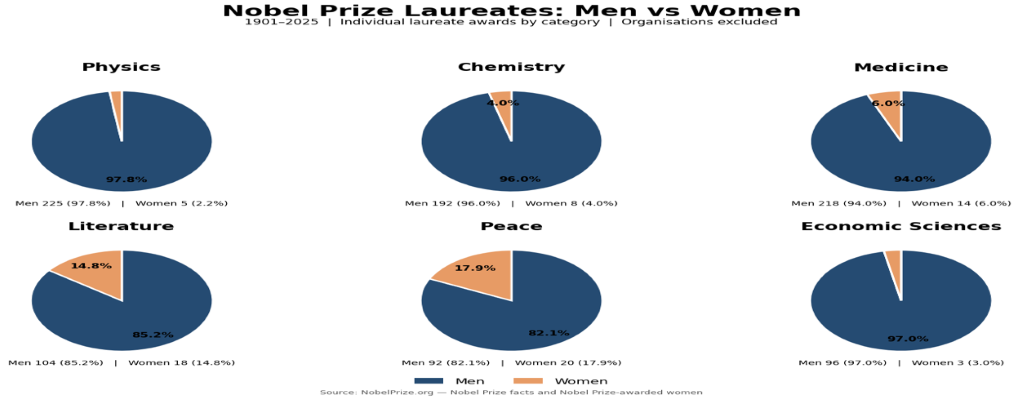
According to official figures through 2025, 67 individual women had received the Nobel Prize on 68 occasions, because Marie Curie won the award twice.
If two additional women are confirmed among the 2026 laureates, the total would rise to 69 women and 70 awards.
Under this count, women would have received the Nobel Prize 21 times in Peace, 19 in Literature, 14 in Physiology or Medicine, eight in Chemistry, five in Physics and three in Economic Sciences.
Although women still represent a relatively small proportion of all Nobel laureates, their increasing recognition, particularly in Peace, Literature and human health, is an important sign of intellectual and social progress.
Marie Curie made history by winning the Nobel Prize in Physics in 1903 and Chemistry in 1911, opening new possibilities and inspiring generations of women scientists.
Five Individuals Who Won the Nobel Prize Twice
Five remarkable individuals have received the Nobel Prize twice: Marie Curie, Linus Pauling, John Bardeen, Frederick Sanger and K. Barry Sharpless.
Marie Curie won in Physics and Chemistry; Linus Pauling in Chemistry and Peace; John Bardeen twice in Physics; Frederick Sanger twice in Chemistry; and Barry Sharpless also twice in Chemistry.
These achievements demonstrate that scientific curiosity does not necessarily end with one extraordinary discovery. Sometimes the same researcher continues exploring and makes another contribution capable of transforming humanity’s understanding of the world.
South Asia’s Contribution to Nobel History
South Asia also occupies an important place in Nobel history.
Twelve prominent laureates associated with the region include Rabindranath Tagore (Literature, 1913, India); C. V. Raman (Physics, 1930, India); Har Gobind Khorana (Medicine, 1968, an Indian-born American scientist); Dr Abdus Salam (Physics, 1979, Pakistan); Mother Teresa (Peace, 1979, associated with India); Subrahmanyan Chandrasekhar (Physics, 1983, an Indian-born American scientist); Amartya Sen (Economic Sciences, 1998, India); Muhammad Yunus and Grameen Bank (Peace, 2006, Bangladesh); Venkatraman Ramakrishnan (Chemistry, 2009, an Indian-born scientist); Malala Yousafzai (Peace, 2014, Pakistan); Kailash Satyarthi (Peace, 2014, India); and Abhijit Banerjee (Economic Sciences, 2019, an Indian-born American economist).
These represent twelve prominent individual figures, while any comprehensive count of laureates associated with South Asia must clearly define the criteria concerning birthplace, nationality and the country in which their contributions were made.
Despite the region’s considerable intellectual and human potential, why does South Asia, particularly Pakistan, remain underrepresented in major international scientific honours?
Among the principal reasons are inadequate investment in research, a shortage of modern laboratories, an education system heavily dependent upon memorization, weak merit-based institutions, restrictions on academic freedom and the migration of talented individuals to other countries.
The region does not suffer from a shortage of intelligence.
What it needs are institutions and academic environments in which talent receives opportunity, research receives resources and independent thinking enjoys freedom.
 Nobel Laureates and Religious Backgrounds
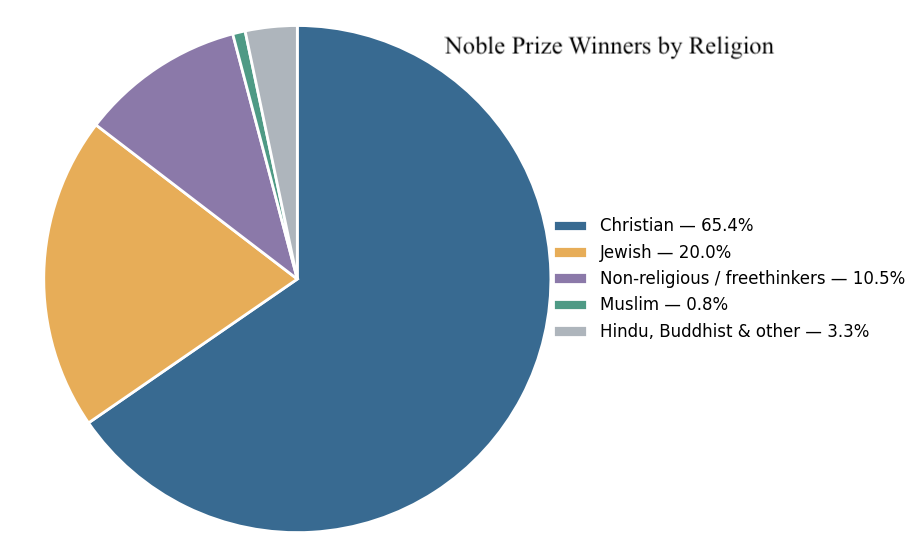
An unofficial historical study of the religious and intellectual backgrounds of Nobel laureates covering 1901 to 2026 suggests that approximately 65.4% were Christian, more than 20% Jewish, 10.5% nonreligious or freethinking, and approximately 0.8% Muslim. Hindu, Buddhist and other religious backgrounds accounted for the remaining proportion.
These figures do not represent an official classification by the Nobel Foundation, since estimates may vary depending on whether individuals are categorized by personal religious beliefs, family backgrounds or intellectual identities.
Common historical estimates identify approximately 16 Nobel laureates who were Muslim or came from Muslim backgrounds, although the precise figure varies according to the criteria applied.
Among them are Pakistan’s Dr Abdus Salam (Physics, 1979); Egypt’s Naguib Mahfouz (Literature, 1988), Ahmed Zewail (Chemistry, 1999) and Mohamed ElBaradei (Peace, 2005); Iran’s Shirin Ebadi (Peace, 2003) and Narges Mohammadi (Peace, 2023); Bangladesh’s Muhammad Yunus (Peace, 2006); Türkiye’s Orhan Pamuk (Literature, 2006) and Aziz Sancar (Chemistry, 2015); Yemen’s Tawakkol Karman (Peace, 2011); and Pakistan’s Malala Yousafzai (Peace, 2014).
An important question arises: Why have relatively few Nobel Prize-winning scientists emerged from the Muslim world, which has a population of approximately two billion?
The explanation should not be sought in religious identity itself, but in the structural weaknesses affecting research and education in many countries.
These include inadequate investment in scientific research, shortages of high-quality universities and advanced laboratories, restrictions on academic freedom, memorization-based education, political instability and the migration of talented researchers.
The intellectual history of the Muslim world includes extraordinary scholars such as Ibn al-Haytham, Al-Biruni, Al-Khwarizmi and Ibn Sina (Avicenna).
The challenge today is to transform pride in that historical legacy into a living tradition of modern research, scientific reasoning, merit and intellectual freedom.
What Pakistan Must Learn from the Nobel Prizes
The global celebration of the Nobel Prizes offers an important lesson for Pakistan.
Every day, we benefit from scientific discoveries. We use modern medicines, mobile phones, computers, artificial intelligence and advanced technologies as essential parts of our lives.
Yet, in many of our educational institutions, memorizing textbooks, passing examinations and obtaining degrees are still treated as the primary measures of academic success.
In numerous schools and colleges, laboratories are either unavailable or remain underutilised because of outdated equipment, inadequate facilities and insufficient practical training.
Where students are not encouraged to experiment, ask questions, make observations and draw independent conclusions, how can we expect new discoveries to emerge?
Pakistan must develop an academic environment in which scientists enjoy the freedom to question, stable financial support for research, access to modern equipment, trained colleagues and fair recognition of their contributions.
The value of research should not be measured merely by the number of published papers, but by their quality, originality and benefits to humanity.
Instead of encouraging students to memories textbook definitions, educational institutions should introduce them to experimentation, observation, critical thinking and creative questioning.
Scientific institutions must recognize individuals on the basis of ability and research achievements rather than religious, gender or social identities.
The decades-long scientific work of researchers such as Francis Halzen teaches us that major discoveries require patience, sustained effort, financial resources and institutional confidence.
Sometimes the results of research become visible almost immediately. At other times, its true benefits emerge only after several decades.
Investment in scientific research should therefore never be regarded as an unnecessary financial burden. It should be understood as an investment in the future of coming generations.
Conclusion: The True Measure of Human Greatness
Through his fortune, Alfred Nobel established a tradition that placed service to humanity above wealth and power.
The fundamental message of the awards he created is that human greatness should not be measured by personal possessions, official positions or public fame, but by what an individual contributes to the world and how that contribution improves the lives of others.
Behind the world’s greatest discoveries stand not only extraordinary minds, but also societies and institutions that allow those minds to question, experiment and learn from failure.
If Pakistan wishes to produce Nobel Prize-winning scientists, writers and intellectuals in the future, it must first create an environment that encourages knowledge, research and creativity, where every talented individual has a genuine opportunity to develop and demonstrate their abilities.
Nobel Prizes are not won merely through a nation’s aspirations. They are earned through intellectual freedom, decades of dedicated effort and extraordinary contributions to humanity.
(All images provided by the author)
Read: Afghan Railways: A Wake-Up Call for Pakistan
_________________
 Hailing from Gambat town of Sindh, Engr. Ramesh Raja, is a Civil Engineer, visionary planner, PMP certified and literary enthusiast with a passion for art and recreation. He can be reached at engineer.raja@gmail.com